Monday, February 1, 2021

Mysterious magnetic fossils offer past climate clues - Phys.org
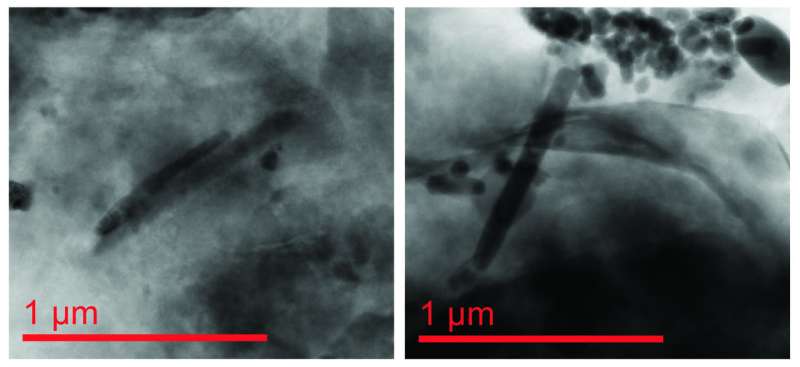
There are fossils, found in ancient marine sediments and made up of no more than a few magnetic nanoparticles, that can tell us a whole lot about the climate of the past, especially episodes of abrupt global warming. Now, researchers including doctoral student Courtney Wagner and associate professor Peter Lippert from the University of Utah, have found a way to glean the valuable information in those fossils without having to crush the scarce samples into a fine powder. Their results are published in Proceedings of the National Academy of Sciences.
"It's so fun to be a part of a discovery like this, something that can be used by other researchers studying magnetofossils and intervals of planetary change," Wagner says. "This work can be used by many other scientists, within and outside our specialized community. This is very exciting and fulfilling."
The name "magnetofossil" may bring to mind images of the X-Men, but the reality is that magnetofossils are microscopic bacterial iron fossils. Some bacteria make magnetic particles 1/1000 the width of a hair that, when assembled into a chain within the cell, act like a nano-scale compass. The bacteria, called "magnetotactic bacteria," can then use this compass to align themselves to the Earth's magnetic field and travel efficiently to their favorite chemical conditions within the water.
During a few periods in the Earth's past, at the beginning and middle of the Eocene epoch from 56 to 34 million years ago, some of these biologically-produced magnets grew to "giant" sizes, about 20 times larger than typical magnetofossils, and into exotic shapes such as needles, spindles, spearheads and giant bullets. Because the bacteria used their magnetic supersense to find their preferred levels of nutrients and oxygen in the ocean water, and because the giant magnetofossils are associated with periods of rapid climate change and elevated global temperature, they can tell us a lot about the conditions of the ocean during that rapid warming, and especially how those conditions changed over time.
Previously, extraction and analysis of these fossils required crushing the samples into a fine powder for electron microscopy imaging. "The extraction process can be time-consuming and unsuccessful, electron microscopy can be costly, and the destruction of samples means that they are no longer useful for most other experiments," Wagner says. "Collection and storage of these samples require specialized personnel, equipment and planning, so we want to preserve as much material for additional studies as we can."
So Wagner, Lippert and colleagues including Ramon Egli from the Central Institute for Meteorology and Geodynamics and Ioan Lascu at the National Museum of Natural History, found another way. Using sediment samples collected in New Jersey, they designed a new way of conducting an analysis called FORC (first order reversal curve) measurements. With these high-resolution magnetic measurements, they found that the magnetic signature of giant magnetofossils was distinctive—enough that the technique could be used in other samples to identify the presence of the fossils. "FORC measurements probe the reaction of magnetic particles to externally applied magnetic fields, enabling to discriminate among different types of iron oxide particles without actually seeing them," says Egli.
"The ability to rapidly find giant magnetofossil assemblages in the geologic record will help to identify the origin of these unusual magnetofossils," the researchers write, as well as the ecology of the organisms that formed them. This is important, Wagner says, because no known living organisms form giant magnetofossils today, and we still don't know what organisms formed them in the past. "The organisms that produced these giant magnetofossils are utterly mysterious, but this leaves exciting research avenues open for the future" adds Lascu.
Beyond that, though, the information contained in magnetofossils helps scientists understand how oceans responded to past climate changes—and how our current ocean might respond to ongoing warming.
Explore further
Citation: Mysterious magnetic fossils offer past climate clues (2021, February 1) retrieved 2 February 2021 from https://ift.tt/2YBdTJG
This document is subject to copyright. Apart from any fair dealing for the purpose of private study or research, no part may be reproduced without the written permission. The content is provided for information purposes only.
https://ift.tt/3rehY2G
Science
SpaceX announces first space mission with all-civilian crew - CNBC Television
[unable to retrieve full-text content]
- SpaceX announces first space mission with all-civilian crew CNBC Television
- SpaceX to fly first civilian crew to space later this year, with public competitions for two seats CNBC
- SpaceX announces first-ever all-civilian space flight crew CNN
- SpaceX announces first mission to space with all-civilian crew NBC News
- To Get on This SpaceX Flight, You Don’t Have to Be Rich, Just Lucky The New York Times
- View Full Coverage on Google News
https://ift.tt/36tyrs3
Science
The Skin-Deep Physics of Sidewinder Snakes - The New York Times

A close-up on snake skin helped scientists work out what might help certain snakes navigate sandy surfaces.
When it comes to slithering, most snakes do it the same way: straight ahead. But for snakes that live in deserts, getting around can be a challenge.
“As we know from trying to move on sand in a beach or other places, it can be difficult to move on these materials that yield underneath you as you move forward,” said Jennifer Rieser, a professor of physics at Emory University in Atlanta.
That’s why sidewinders slither sideways. Although some snakes can move laterally under certain conditions, Dr. Rieser said, sidewinders — the common name for a group of three distantly-related vipers found in the deserts of Africa, the Middle East and North America — have raised this unique form of movement to an art. The sidewinding rattlesnake, for example, can travel at speeds of 18 miles per hour, making it the fastest snake in the world.
Now a new study by Dr. Rieser and her colleagues may have found their secret: scales packed with tiny pits, instead of the minuscule spikes found on the bottom of other snakes. Their research was published on Monday in Proceedings of the National Academy of Sciences.
The microstructure of snake bellies is important to how they move, Dr. Rieser said, because that’s how limbless animals interact with the ground. To examine the microstructure of sidewinder scales, her team used an atomic force microscope to scan naturally shed snake skins, provided by institutions such as the Atlanta Zoo. They then built mathematical models to test how the structures they saw would perform under different kinds of friction.
Although they appear smooth to the naked eye, the belly scales of most snakes have microscopic spikes that are oriented from head to tail. These create a friction between the snake’s body and the ground, Dr. Rieser said, which helps them move forward in a familiar headfirst slither.
Snakes from a wide variety of habitats and ecological roles — including close relatives of the sidewinder rattlesnake, such as cottonmouths or diamondback rattlesnakes — have these prominent spikes on their bellies.
But sidewinding species have either reduced or phased out those spikes, trading them in for belly scales that are pocked with microscopic pits that can move in any particular direction. Dr. Rieser suggests that’s because directional friction makes movement in a frictionless environment harder: “Picture a snake trying to move on linoleum or silk.”
Sidewinding instead depends on lifting large chunks of the body into the air as the animal moves. Scales that create strong directional friction, Dr. Rieser said, do very badly with this kind of movement. But if scale friction is uniform in all directions, it makes sidewinding significantly easier.
The Saharan horned viper and the sidewinding adder of the Namib desert — which are closely related — have belly scales with uniform pits and no spikes. But the sidewinding rattlesnake, which comes from a different branch of the viper family tree, still has a few vestigial belly spikes as well as pits.
One possible explanation for the difference is that the deserts of the North American southwest are only 15,000 to 20,000 years old, compared with the North African deserts, which are seven million to 10 million years old.
“So maybe there’s been less time for American sidewinders to evolve structures that might help this type of movement,” Dr. Rieser said.
While the team’s hypothesis about the precise function of the microscopic pits will require additional study, the loss or reduction of these belly spikes in distantly-related sidewinders suggests that these changes are a direct adaptation to sideways movement, they suggest.
“Given that movement is so crucial to survival, it’s reasonable to think that’s part of the reason this change has occurred,” Dr. Rieser said.
https://ift.tt/3pEJwOl
Science
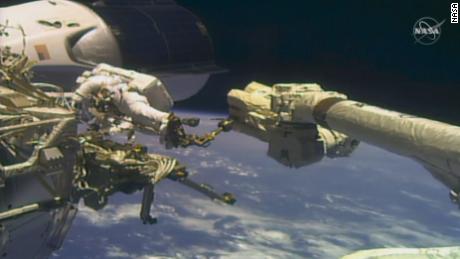
Watch NASA astronauts conduct the second spacewalk of the year - CNN
https://ift.tt/3r76gaf
Science
This Insane Picture of The Moon Was Actually Taken From Earth - ScienceAlert
A test of a powerful new space imaging instrument has given us a gloriously detailed new perspective of the Apollo 15 Moon landing site.
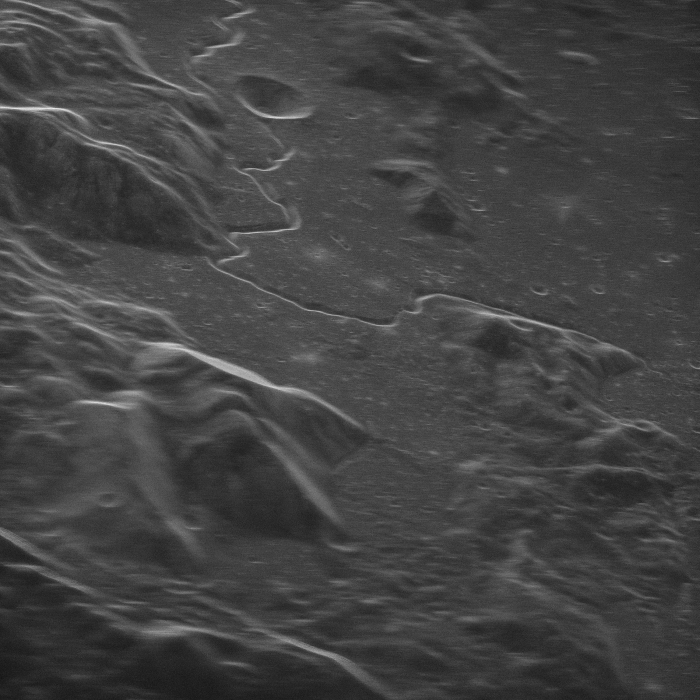
By bouncing a powerful radar signal off the lunar surface, the new instrument has been able to achieve spectacular resolution, showing objects as small as 5 metres (16.4 feet).
Designed for the Green Bank Telescope in West Virginia by Raytheon Intelligence & Space, this proof-of-concept technology paves the way for even more powerful radar imaging in the future, potentially allowing scientists to study objects even as far away as Neptune.
Radar imaging of the Moon is not a new idea, however. It's an extraordinarily useful tool for revealing fine structures on the surface and, at longer wavelengths, even probing over 10 metres below the surface to observe variations in the density of the regolith (here on Earth, this technology can help us find buried ruins).
But the Green Bank Observatory, the National Radio Astronomy Observatory, and Raytheon Intelligence & Space are trying to push the technology even further.
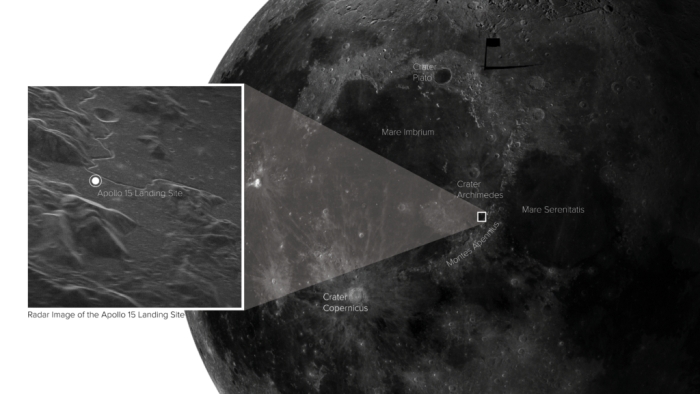 (Sophia Dagnello, NRAO/GBO/Raytheon/AUI/NSF/USGS)
In a test in November of last year, the new transmitter sent out a radar signal to the Moon, specifically targeting the Apollo 15 landing site - a small patch of Moon, on a disc 3,474.2 kilometres (2,158.8 miles) in diameter, hundreds of thousands of kilometres away.
This signal, when it bounced back, was collected by the Very Long Baseline Array. This is a collection of radio telescopes across the US, basically combining to create a continent-sized collecting dish.
The image below is the result. That divot in the top middle is a crater called Hadley C, about 6 kilometres across. Snaking past it is the Hadley Rille, thought to be a collapsed lava tube.
 (NRAO/GBO/Raytheon/NSF/AUI)
Believe it or not, though, this ain't even the half of it. Now that they have successfully proven the concept, the team will be working on an even more powerful transmitter: a 500-kilowatt, high-power radar system that will enable them to see in even more incredible detail.
This tool would be useful for all sorts of science. We could see our Moon more closely, sure. We could see other planets' moons. It could even be used to image passing asteroids and space debris, which are too faint to see using optical telescopes, but that we can probe using radar technology.
This could help us better understand the population of objects - both natural and anthropogenic - in near-Earth space, which in turn could aid in planetary defence against potentially hazardous objects.
"The planned system will be a leap forward in radar science, allowing access to never before seen features of the Solar System from right here on Earth," said site director Karen O'Neil of the Green Bank Observatory.
And if it gets us even more incredible pictures of the Moon, we're so here for it.
Article From & Read More ( This Insane Picture of The Moon Was Actually Taken From Earth - ScienceAlert )https://ift.tt/2NJSVWP
Science
Ancient Jersey teeth find hints at Neanderthal mixing - Yahoo News

Prehistoric teeth unearthed at a site in Jersey reveal signs of interbreeding between Neanderthals and our own species, scientists say.
UK experts re-studied 13 teeth found between 1910 and 1911 at La Cotte de St Brelade in the island's south-west.
They were long regarded as being typical Neanderthal specimens, but the reassessment also uncovered features characteristic of modern human teeth.
The teeth may represent some of the last known Neanderthal remains.
As such, they might even yield clues to what caused the disappearance of our close evolutionary cousins.
The Neanderthals evolved around 400,000 years ago and inhabited a large area from western Europe to Siberia.
They were typically shorter and stockier than modern humans, with a thick ridge of bone overhanging the eyes.
They finally disappeared around 40,000 years ago, just as anatomically modern humans (Homo sapiens), a newly arrived species from Africa, was settling in Europe.
However, the two types of human may have overlapped for at least 5,000 years.
The teeth were discovered on a small granite ledge at the cave site.
They were previously thought to belong to a single Neanderthal individual. However, the new research found they were from at least two adults.
The researchers used computed tomography (CT) scans of the teeth to study them at a level of detail that wasn't available to researchers in the past.
'Dual ancestry'
While all the specimens have some Neanderthal characteristics, some aspects of their shape are more typical of teeth from modern humans.
This suggests these were traits that were prevalent in their population.
Research leader Prof Chris Stringer, from London's Natural History Museum, said: "Given that modern humans overlapped with Neanderthals in some parts of Europe after 45,000 years ago, the unusual features of these La Cotte individuals suggest that they could have had a dual Neanderthal-modern human ancestry."
At the time these individuals were alive, the climate in this part of the world was colder than it is today and the sea level was tens of metres lower.
Co-author Dr Matt Pope, from the Institute of Archaeology at University College London (UCL), said the area would have been "fantastic for hunting", because of its "dead-end valleys and blind gulleys".
"Caves of that scale and size are extremely rare in that landscape," he said, adding: "It seems to be embedded in their routines, coming back to that place for tens of thousands of years."

In fact, there is a record of occupation at the La Cotte site going back to 250,000 years ago.
The human teeth are thought to be around 48,000 years old, close to the presumed Neanderthal extinction date of 40,000 years ago.
So, rather than going extinct in the traditional sense, were Neanderthal groups simply absorbed into incoming modern human populations?
"This now needs to be a scenario that's seriously considered, alongside others, and it's going to emerge as we get more understanding of the process of genetic admixture," Dr Pope told BBC News.
"But certainly, that word 'extinct' now starts to lose its meaning where you can see multiple episodes of admixture and the retention of a significant proportion of Neanderthal DNA in humans beyond sub-Saharan Africa."
Neanderthals contributed 2-3% of the genomes - the genetic instruction booklet for making a person - of people with ancestry from outside Africa.
"This idea of a hybrid population could be tested by the recovery of ancient DNA from the teeth, something that is now under investigation," said Prof Stringer.
The study has been published in the Journal of Human Evolution.
Article From & Read More ( Ancient Jersey teeth find hints at Neanderthal mixing - Yahoo News )https://ift.tt/3ozC85z
Science
Postingan Populer
-
The Event Horizon Telescope (EHT) collaboration, who produced the first ever image of a black hole released in 2019, has today a new view o...
-
[unable to retrieve full-text content] 10 night sky events to see in September, from a blood moon eclipse to a prime view of the Milky Way...
-
[unable to retrieve full-text content] SpaceX launches 24 Starlink satellites to orbit from California (video) Space Live coverage: Sp...
