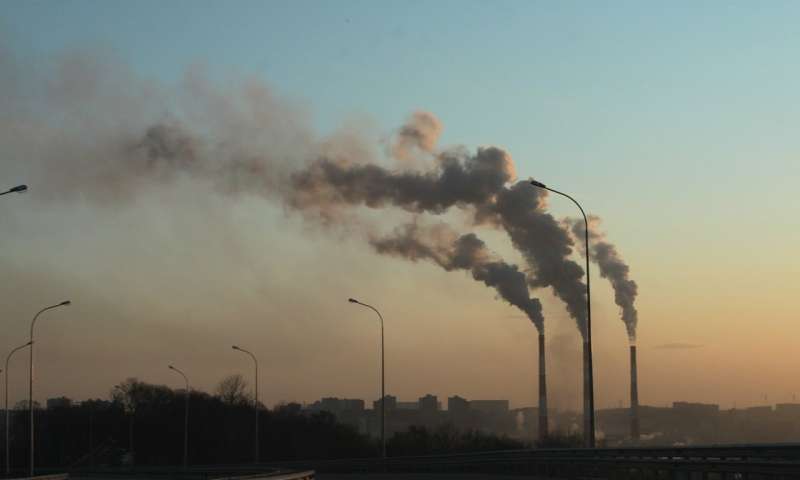
Earth spiked a bit of a fever in 2020, partly because of cleaner air from the pandemic lockdown, a new study found.
For a short time, temperatures in some places in the eastern United States, Russia and China were as much as half to two-thirds of a degree (.3 to .37 degrees Celsius) warmer. That’s due to less soot and sulfate particles from car exhaust and burning coal, which normally cool the atmosphere temporarily by reflecting the sun’s heat, Tuesday’s study in the journal Geophysical Research Letters reported.
ADVERTISEMENT
Overall, the planet was about .05 degrees (.03 degrees Celsius) warmer for the year because the air had fewer cooling aerosols, which unlike carbon dioxide is pollution you can see, the study found.
“Cleaning up the air can actually warm the planet because that (soot and sulfate) pollution results in cooling” which climate scientists have long known, said study lead author Andrew Gettelman, an atmospheric scientist at the National Center for Atmospheric Research. His calculations come from comparing 2020 weather to computer models that simulated a 2020 without the pollution reductions from pandemic lockdowns.
This temporary warming effect from fewer particles was stronger in 2020 than the effect of reduced heat-trapping carbon dioxide emissions, Gettelman said. That’s because carbon stays in the atmosphere for more than a century with long-term effects, while aerosols remain in the air about a week.
Even without the reduction in cooling aerosols, global temperatures in 2020 already were flirting with breaking yearly heat record because of the burning of coal, oil and natural gas — and the aerosol effect may have been enough to help make this the hottest year in NASA’s measuring system, said top NASA climate scientist Gavin Schmidt, who wasn’t part of this study but said it confirms other research.
“Clean air warms the planet a tiny bit, but it kills a lot fewer people with air pollution,” Gettelman said.
The Associated Press Health and Science Department receives support from the Howard Hughes Medical Institute’s Department of Science Education. The AP is solely responsible for all content.
Astronomers have detected what they believe to be one of the earliest instances of "galactic cannibalism" — when one galaxy consumes one of its smaller neighbors — in an ultrafaint dwarf galaxy called Tucana II. The findings stem from the discovery of an ancient dark matter halo, located in a galaxy 163,000 light years from Earth.
Tucana II is just one of dozens of dwarf galaxies surrounding the Milky Way. They are thought to be artifacts left over from the first galaxies in the universe — and Tucana II is among the most primitive of them.
In a new study, published Monday in the journal Nature Astronomy, astrophysicists report detecting nine previously unknown stars at the edge of Tucana II, using the SkyMapper Telescope in Australia and the Magellan Telescopes in Chile. The stars are shockingly far away from its center but remain in the small galaxy's gravitational pull.
The configuration of stars provides the first evidence that the galaxy contains an extended dark matter halo — a region of matter three to five times larger than scientists originally believed — in order to keep a gravitational hold on its distant stars. The findings suggest that the earliest galaxies in the universe were much more massive than previously believed.
"Tucana II has a lot more mass than we thought, in order to bound these stars that are so far away," one of the authors of the study, MIT graduate student Anirudh Chiti, said in a statement. "This means that other relic first galaxies probably have these kinds of extended halos too."
Every galaxy is believed to be held together by a halo of dark matter, a type of hypothetical matter thought to make up over 85% of the universe, MIT News explains. But the new findings represent the first time one has been detected in an ultrafaint dwarf galaxy.
"Without dark matter, galaxies would just fly apart," Chiti said. "[Dark matter] is a crucial ingredient in making a galaxy and holding it together."
The vicinity of the Tucana II ultra-faint dwarf galaxy, as imaged with the SkyMapper Telescope.Anirudh Chiti, MIT
Scientists also found that these far-flung stars are older than the stars at Tucana II's core — the first evidence of such an imbalance in this type of galaxy. Their discovery points to the possibility that the galaxy could be the product of one of the first mergers between two galaxies in the universe, which scientists refer to as "galactic cannibalism."
"We may be seeing the first signature of galactic cannibalism," said MIT Professor Anna Frebel. "One galaxy may have eaten one of its slightly smaller, more primitive neighbors, that then spilled all its stars into the outskirts."
Using a telescope's imaging filter, astronomers are able to study the metal content of a galaxy's stars to determine just how primitive it is. They had previously found stars at Tucana II's core with such low metal content that the galaxy was identified as the most chemically primitive of the known ultrafaint dwarf galaxies.
New research found the outer stars were three times more metal-poor than the ones at the center, making them even more primitive.
"This probably also means that the earliest galaxies formed in much larger dark matter halos than previously thought," Frebel said. "We have thought that the first galaxies were the tiniest, wimpiest galaxies. But they actually may have been several times larger than we thought, and not so tiny after all."
An early galactic merger is one likely explanation for the imbalance. Galactic cannibalism occurs "constantly" across today's universe, according to MIT News, but mergers in the early universe are not so certain.
"Tucana II will eventually be eaten by the Milky Way, no mercy," Frebel said. "And it turns out this ancient galaxy may have its own cannibalistic history."
The team hopes to use their approach to discover even older, more distant stars in other ultrafaint dwarf galaxies.
Article From & Read More ( Astronomers find origins of "galactic cannibalism" with discovery of ancient dark matter halo - CBS News )
https://ift.tt/3cHWRSF
Science
Earth spiked a bit of a fever in 2020, partly because of cleaner air from the pandemic lockdown, a new study found.
For a short time, temperatures in some places in the eastern United States, Russia and China were as much as half to two-thirds of a degree (.3 to .37 degrees Celsius) warmer. That’s due to less soot and sulfate particles from car exhaust and burning coal, which normally cool the atmosphere temporarily by reflecting the sun’s heat, Tuesday’s study in the journal Geophysical Research Letters reported.
Overall, the planet was about .05 degrees (.03 degrees Celsius) warmer for the year because the air had fewer cooling aerosols, which unlike carbon dioxide is pollution you can see, the study found.
“Cleaning up the air can actually warm the planet because that (soot and sulfate) pollution results in cooling” which climate scientists have long known, said study lead author Andrew Gettelman, an atmospheric scientist at the National Center for Atmospheric Research. His calculations come from comparing 2020 weather to computer models that simulated a 2020 without the pollution reductions from pandemic lockdowns.
This temporary warming effect from fewer particles was stronger in 2020 than the effect of reduced heat-trapping carbon dioxide emissions, Gettelman said. That’s because carbon stays in the atmosphere for more than a century with long-term effects, while aerosols remain in the air about a week.
Even without the reduction in cooling aerosols, global temperatures in 2020 already were flirting with breaking yearly heat record because of the burning of coal, oil and natural gas — and the aerosol effect may have been enough to help make this the hottest year in NASA’s measuring system, said top NASA climate scientist Gavin Schmidt, who wasn’t part of this study but said it confirms other research.
“Clean air warms the planet a tiny bit, but it kills a lot fewer people with air pollution,” Gettelman said.
The Associated Press Health and Science Department receives support from the Howard Hughes Medical Institute’s Department of Science Education. The AP is solely responsible for all content.
When NASA astronauts Mike Hopkins and Victor Glover went on a spacewalk on February 1st, they wrapped up a multi-year effort to replace the aging nickel hydrogen batteries on the ISS with new lithium-ion models. The International Space Station Program approved the development of lithium-ion batteries to replace the station’s aging power storage system back in 2011. Battery production started in 2014, and the first lithium—ion replacements flew to the station aboard JAXA’s Kounotori 6 resupply flight in December 2016. Now, four years after that flight and 14 spacewalks with 13 different astronauts later, the upgrade is finally complete.
Ground controllers used the Canadarm2 robotic arm to position some of the batteries for installation. However, some required additional spacewalks for the locations the arm couldn’t reach. The batteries aren’t quite like the lithium-ion we’re used to, with their space-grade lithium-ion cells and radiant barrier shield. Since lithium-ion technology has greater energy density than nickel-hydrogen, only 24 new batteries were needed to replace the 48 old ones.
The ISS uses batteries to store energy harnessed from the sun with its solar panels, and it taps into those reserves every time it doesn’t have access to sunlight. And that happens often, since the station passes between sunlight and darkness every 45 minutes. That stored power is necessary to keep everything working on the ISS, including the station’s life support systems. Aside from providing the station with much—needed power, the batteries could also give us the insight needed to improve lithium-ion safety.
Now that this particular upgrade is complete, the ISS program will shift its focus to replacing the station’s solar arrays. Six new arrays will be flying aboard SpaceX flights over the next few years to replace the current ones near the end of their 15-year lifespan.
The battery upgrades at the space station are complete today after eight years of development and 14 spacewalks. https://t.co/OMjNN4lUUG
All products recommended by Engadget are selected by our editorial team, independent of our parent company. Some of our stories include affiliate links. If you buy something through one of these links, we may earn an affiliate commission.
The lockdowns and reduced societal activity related to the COVID-19 pandemic affected emissions of pollutants in ways that slightly warmed the planet for several months last year, according to new research led by the National Center for Atmospheric Research (NCAR).
The counterintuitive finding highlights the influence of airborne particles, or aerosols, that block incoming sunlight. When emissions of aerosols dropped last spring, more of the Sun's warmth reached the planet, especially in heavily industrialized nations, such as the United States and Russia, that normally pump high amounts of aerosols into the atmosphere.
"There was a big decline in emissions from the most polluting industries, and that had immediate, short-term effects on temperatures," said NCAR scientist Andrew Gettelman, the study's lead author. "Pollution cools the planet, so it makes sense that pollution reductions would warm the planet."
Temperatures over parts of Earth's land surface last spring were about 0.2-0.5 degrees Fahrenheit (0.1-0.3 degrees Celsius) warmer than would have been expected with prevailing weather conditions, the study found. The effect was most pronounced in regions that normally are associated with substantial emissions of aerosols, with the warming reaching about 0.7 degrees F (0.37 C) over much of the United States and Russia.
The new study highlights the complex and often conflicting influences of different types of emissions from power plants, motor vehicles, industrial facilities, and other sources. While aerosols tend to brighten clouds and reflect heat from the Sun back into space, carbon dioxide and other greenhouse gases have the opposite effect, trapping heat near the planet's surface and elevating temperatures.
Despite the short-term warming effects, Gettelman emphasized that the long-term impact of the pandemic may be to slightly slow climate change because of reduced emissions of carbon dioxide, which lingers in the atmosphere for decades and has a more gradual influence on climate. In contrast, aerosols—the focus of the new study—have a more immediate impact that fades away within a few years.
The study was published in Geophysical Research Letters. It was funded in part by the National Science Foundation, NCAR's sponsor. In addition to NCAR scientists, the study was co-authored by scientists at Oxford University, Imperial College, and the University of Leeds.
Teasing out the impacts
Although scientists have long been able to quantify the warming impacts of carbon dioxide, the climatic influence of various types of aerosols—including sulfates, nitrates, black carbon, and dust—has been more difficult to pin down. One of the major challenges for projecting the extent of future climate change is estimating the extent to which society will continue to emit aerosols in the future and the influence of the different types of aerosols on clouds and temperature.
To conduct the research, Gettelman and his co-authors used two of the world's leading climate models: the NCAR-based Community Earth System Model and a model known as ECHAM-HAMMOZ, which was developed by a consortium of European nations. They ran simulations on both models, adjusting emissions of aerosols and incorporating actual meteorological conditions in 2020, such as winds.
This approach enabled them to identify the impact of reduced emissions on temperature changes that were too small to tease out in actual observations, where they could be obscured by the variability in atmospheric conditions.
The results showed that the warming effect was strongest in the mid and upper latitudes of the Northern Hemisphere. The effect was mixed in the tropics and comparatively minor in much of the Southern Hemisphere, where aerosol emissions are not as pervasive.
Gettelman said the study will help scientists better understand the influence of various types of aerosols in different atmospheric conditions, helping to inform efforts to minimize climate change. Although the research illustrates how aerosols counter the warming influence of greenhouse gases, he emphasized that emitting more of them into the lower atmosphere is not a viable strategy for slowing climate change.
"Aerosol emissions have major health ramifications," he said. "Saying we should pollute is not practical."
More information: A. Gettelman et al, Climate Impacts of COVID‐19 Induced Emission Changes, Geophysical Research Letters (2020). DOI: 10.1029/2020GL091805
Citation: COVID-19 lockdowns temporarily raised global temperatures (2021, February 2) retrieved 3 February 2021 from https://ift.tt/3rlik7X
This document is subject to copyright. Apart from any fair dealing for the purpose of private study or research, no part may be reproduced without the written permission. The content is provided for information purposes only.
Although all three spacecraft will make it to orbit around Mars this month, NASA's Perseverance (or "Percy") gets to take center stage. It will be the only mission to land on the surface this month, with an expected arrival date of Feb. 18. Perseverance builds on an impressive history of interplanetary exploration, with its sibling rover Curiosity coming up on nine years on Mars, delivering breathtaking photographs and some puzzling data.
CNET Science
From the lab to your inbox. Get the latest science stories from CNET every week.
That's not to take anything away from the UAE's Hope, or Al Amal, and China's Tianwen-1. Both spacecraft are expected to perform Mars orbital insertion, or MOI, maneuvers within a day of each other on Feb. 9 and Feb. 10, respectively. Hope will remain in orbit and analyze the Martian atmosphere, but Tianwen-1 will attempt something only achieved by two other nations: landing on Mars' unfriendly surface. China is expected to release Tianwen-1's lander and rover duo sometime in May.
Here's a recap of the journey to Mars and what we can expect this month.
First place
Every 26 months, the orbits of Earth and Mars line up in such a way that space agencies can take advantage of something known as a Hohmann transfer orbit.
"We do this kind of transfer orbit in order to use the least fuel," James O'Donoghue, a planetary scientist with Japanese space agency JAXA, told CNET last year. "It's like passing a football to a striker, you've got to aim where they're going to be."
In July 2020, everything lined up perfectly, and the three missions were out of here. Some fast facts:
The cadence of launches means Hope will reach Mars first in February. It's expected to perform its MOI on Feb. 9, slowing down from 75,000 miles per hour to just 11,200. At approximately 7:42 a.m. PT, the bus-length probe will arrive "at" Mars and will begin to transition to the science phase of the mission. The maneuver is totally autonomous, because communication doesn't quite work as quickly as it does here on Earth -- the interplanetary phone call has a more than 13-minute delay, so Hope will be flying on its own from a set of preset instructions.
Tianwen-1's arrival is slightly more mysterious. China's space agency doesn't typically reveal a lot of information about its activities, even for a potentially history-making mission such as this. According to Chinese news service CCTV, it will be the second craft to enter orbit, on Feb. 10.
Three spacecraft, seven months
Although the majority of the science will be performed when the spacecraft reach Mars, scientists and engineers have been testing the capability of their spacecraft on the cruise phase of the mission. The journey itself is a long one -- covering about 300 million miles (~480 million kilometers) -- and each agency has a chance to improve the trajectory of the craft for a perfect arrival. What else has been happening?
Last but not least
NASA's Perseverance rover will touch down on Feb. 18. Though NASA's got a good track record of landing on the red planet in the last few decades, there are no guarantees -- Mars is hard.
"Success is never assured," said Allan Chen, engineering lead on the entry, descent and landing phase of the mission, during a NASA press conference on Jan. 27. "That's especially true when we're trying to land the biggest, heaviest and most complicated rover we've ever built to the most dangerous site we've ever attempted to land on."
The space agency expects to have the best footage of landing ever, with a suite of cameras and a microphone ready to capture the entry, descent and landing. It's the first time we'll be able to listen to the sounds of a Martian landing, providing a completely new sensory experience for avid Mars fans. Sadly, there's no way we'll be able to watch live, as such, but NASA will provide coverage of the moment. We've got a comprehensive guide to Mars landing day and what you can expect.
NASA Perseverance rover ready to explore the wilds of Mars