Rechercher dans ce blog

Thursday, February 4, 2021

Everything to know about NASA's Mars Ingenuity helicopter — the first to fly on another planet - CBS News

When NASA's Mars Perseverance rover touches down on the red planet later this month, it will arrive with a lot of precious cargo. Among the brand new technology is a drone that is set to be the first ever to fly on another planet: the Ingenuity helicopter

Ingenuity is essentially a test flight — it's experimenting with flight on another planet for the first time, and has limited capabilities. It weighs only about 4 pounds, but its success will no doubt pave the way for more ambitious exploration of the red planet.

"The Wright Brothers showed that powered flight in Earth's atmosphere was possible, using an experimental aircraft," Håvard Grip, Ingenuity's chief pilot at NASA's Jet Propulsion Laboratory (JPL) said in a statement. "With Ingenuity, we're trying to do the same for Mars."

The rover doesn't carry any science instruments to support Perseverance, and is considered an entirely separate mission from the rover. It currently sits in Perseverance's belly, only to emerge after the duo touches down on Mars on February 18.
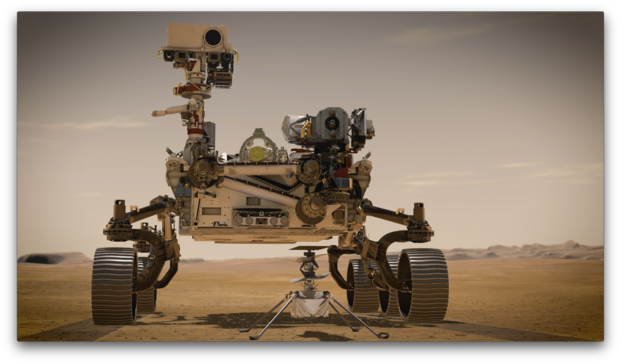
pia23962.png
On February 18, 2021, NASA's Mars Perseverance rover and Ingenuity helicopter (shown in an artist's concept) will be the two newest explorers on the red planet. NASA/JPL-Caltech

Flying on Mars vs. Earth

Mars' thin atmosphere, which is 99% less dense than Earth's, will make it difficult for Ingenuity to achieve enough lift to properly fly. Because of this, it has been designed to be extremely lightweight. It stands just 19 inches tall.

The helicopter has four large carbon-fiber blades, fashioned into two rotors that span about 4 feet and spin in opposite directions at about 2,400 rpm — significantly faster than typical helicopters on Earth. 

Additionally, the Jezero Crater, Perseverance's landing spot, is extremely cold — temperatures at night drop to minus-130 degrees Fahrenheit. A lot of Ingenuity's power will go directly towards keeping warm rather than flight itself.

Flight controllers at JPL won't be able to control Ingenuity while it's actually flying. Due to significant communication delays, commands will be sent in advance of flights, and the team won't know how the flight went until its over. Ingenuity will be able to make its own decisions about how to fly and keep itself warm. 

"This is a technology that's really going to open up a new exploration modality for us, very much like the rovers did 20 years ago when we flew Sojourner on the first mission to Mars," Matt Wallace, Mars 2020 deputy project manager at JPL, said during a news conference last week. 

Perseverance is carrying more than two dozen cameras and Ingenuity has two of its own. Here on Earth, we will have a front-row view of Ingenuity's test flights from the rover's perspective, as well as aerial shots from the helicopter itself. 
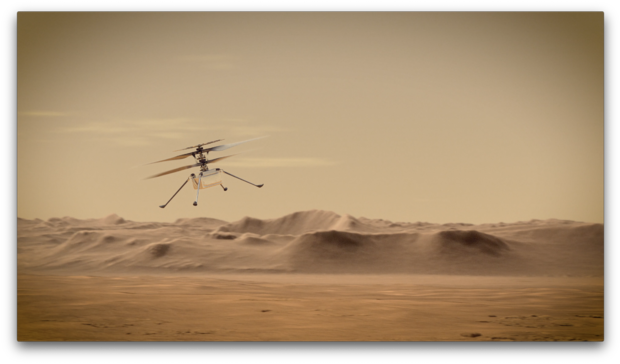
pia23961.png
An artist's concept of NASA's Ingenuity Mars Helicopter flying through the red planet's skies. NASA/JPL-Caltech

What's in a name? 

The name Ingenuity was originally submitted by Alabama high school student Vaneeza Rupani for the Mars 2020 rover, which was ultimately named Perseverance. But the NASA team figured it would be the perfect name for a helicopter that took so much creative thinking to get off the ground. 

"The ingenuity and brilliance of people working hard to overcome the challenges of interplanetary travel are what allow us all to experience the wonders of space exploration," Rupani wrote. "Ingenuity is what allows people to accomplish amazing things."

Twenty-eight thousand students across the U.S. submitted essays and proposed names for NASA's newest Mars rover. Virginia seventh-grader Alexander Mather's suggestion, Perseverance, was ultimately chosen.

Ingenuity must still pass tests before flight

The team at NASA has a list of milestones for the helicopter to survive before it ever takes off on Mars: 

  • Surviving the launch from Cape Canaveral, which took place July 30; the journey to Mars; and landing on February 18
  • Safely deploying to the surface from inside the belly of Perseverance
  • Autonomously keeping itself warm through the harsh Martian nights using internal heaters 
  • Autonomously charging itself with a solar-powered panel

After all of this, Ingenuity will take off for the first time, hovering just a few feet from the ground for about 20 to 30 seconds before landing. If it makes a successful first flight, the team will attempt up to four other tests within a month's time frame, each gradually pushing the limits of distance and altitude, like a baby bird learning to fly.  

"The helicopter Ingenuity is a high risk, high reward endeavor," Wallace said. "It's something we have not tried and there's always going to be some probability of an issue. But that's why we're doing it — we'll learn from the issue if it occurs."
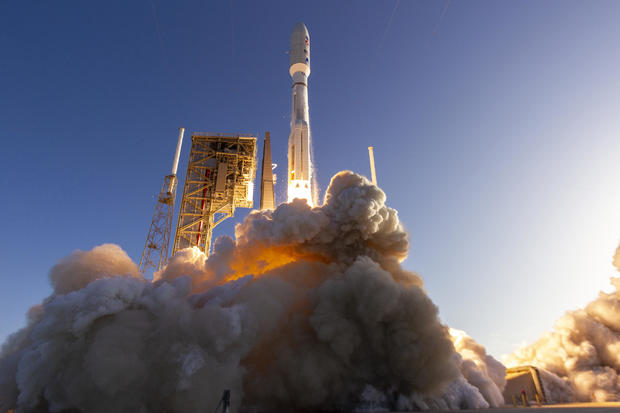
liftoff-panoramic-original.jpg
A United Launch Alliance (ULA) Atlas V rocket carrying the Mars 2020 mission with the Perseverance rover and Ingenuity helicopter lifts off from Space Launch Complex-41 on July 30, 2020. United Launch Alliance

Adding a component of aerial exploration could prove crucial to future planetary exploration

"The Ingenuity team has done everything to test the helicopter on Earth, and we are looking forward to flying our experiment in the real environment at Mars," said MiMi Aung, Ingenuity's project manager at JPL. "We'll be learning all along the way, and it will be the ultimate reward for our team to be able to add another dimension to the way we explore other worlds in the future."

Helicopters on future Mars missions could act as robotic scouts, viewing terrain from above that rovers cannot access, or as spacecrafts carrying scientific instruments. They may even be able to help future astronauts someday explore the red planet. 

But before any of this can happen, Perseverance needs to survive the "seven minutes of terror" that comprise its entry, descent and landing on Mars. NASA will be live streaming the historic event on its website on February 18, beginning at 2:15 p.m. ET.

Let's block ads! (Why?)

Article From & Read More ( Everything to know about NASA's Mars Ingenuity helicopter — the first to fly on another planet - CBS News )
https://ift.tt/3pQ02LL
Science

An optical coating like no other - Phys.org

An optical coating like no other
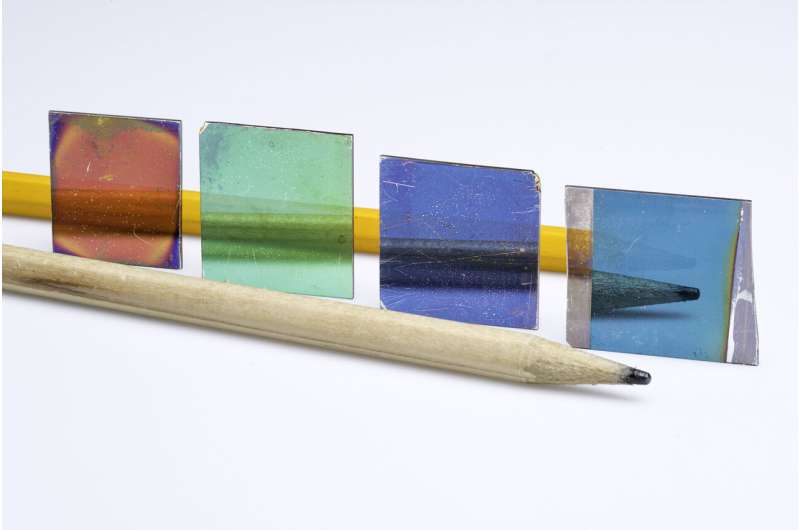
Researchers in the lab of Chunlei Guo, a professor of optics at the University of Rochester, have developed an optical coating that exhibits the same color in reflection (pictured) and transmission. Credit: University of Rochester /J. Adam Fenster

For more than a century, optical coatings have been used to better reflect certain wavelengths of light from lenses and other devices or, conversely, to better transmit certain wavelengths through them. For example, the coatings on tinted eyeglasses reflect, or "block out," harmful blue light and ultraviolet rays.

But until now, no optical coating had ever been developed that could simultaneously reflect and transmit the same , or color.

In a paper in Nature Nanotechnology, researchers at the University of Rochester and Case Western Reserve University describe a new class of optical coatings, so-called Fano Resonance Optical Coatings (FROCs), that can be used on filters to reflect and transmit colors of remarkable purity.

In addition, the coating can be made to fully reflect only a very narrow wavelength range.

"The narrowness of the reflected light is important because we want to have a very precise control of the wavelength," says corresponding author Chunlei Guo, professor at Rochester's Institute of Optics. "Before our technology, the only coating that could do this was a multilayered dielectric mirror, that is much thicker, suffers from a strong angular dependence, and is far more expensive to make. Thus, our can be a low-cost and high-performance alternative."

The researchers envision a few applications for the new technology. For example, they show how FROCs could be used to separate thermal and photovoltaic bands of the solar spectrum. Such capability could improve the effectiveness of devices that use hybrid thermal-electric power generation as a solar energy option. "Directing only the useful band of the solar spectrum to a photovoltaic cell prevents its overheating," says Guo.

The technology could also lead to a six-fold increase in the life of a photovoltaic cell. And the rest of the spectrum "is absorbed as thermal energy, which could be used in other ways, including energy storage for night-time, electricity generation, solar-driven , or heating up a supply of water," Guo says.

"These optical coatings can clearly do a lot of things that other coatings cannot do," Guo adds. But as with other new discoveries, "it will take a little bit of time for us or other labs to further study this and come up with more applications.

"Even when the laser was invented, people were initially confused about what to do with it. It was a novelty looking for an application."

Guo's lab, the High-Intensity Femtosecond Laser Laboratory, is noted for its pioneering work in using femtosecond lasers to etch into .

The FROC project resulted from a desire to explore "parallel" ways to create unique surfaces that do not involve laser etching. "Some applications are easier with laser, but others are easier without them," Guo says.

Fano resonance, named after the physicist Ugo Fano, is a widespread wave scattering phenomenon first observed as a fundamental principle of atomic physics involving electrons. Later, researchers discovered that the same phenomenon can also be observed in optical systems. "But this involved very complex designs," Guo says.

Guo and his colleagues found a simpler way to take advantage of Fano resonance in their optical coatings.

They applied a thin, 15 nanometer-thick film of germanium to a metal surface, creating a surface capable absorbing a broad band of wavelengths. They combined that with a cavity that supports a narrowband resonance. The coupled cavities exhibit Fano resonance that is capable of reflecting a very narrow band of light.


Explore further

Researchers achieve extreme-ultraviolet spectral compression by four-wave mixing

More information: Mohamed ElKabbash et al, Fano-resonant ultrathin film optical coatings, Nature Nanotechnology (2021). DOI: 10.1038/s41565-020-00841-9

Citation: An optical coating like no other (2021, February 4) retrieved 4 February 2021 from https://ift.tt/39KO5kJ

This document is subject to copyright. Apart from any fair dealing for the purpose of private study or research, no part may be reproduced without the written permission. The content is provided for information purposes only.

Let's block ads! (Why?)

Article From & Read More ( An optical coating like no other - Phys.org )
https://ift.tt/2OakKYH
Science

Remastered images reveal how far Alan Shepard hit a golf ball on the Moon - Ars Technica

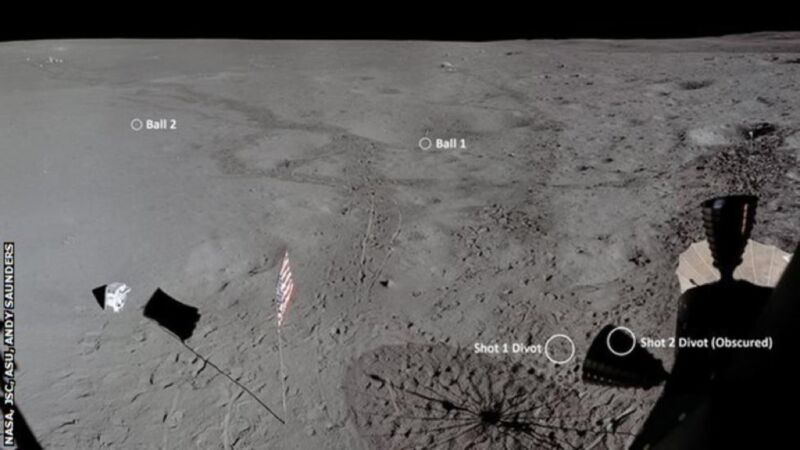
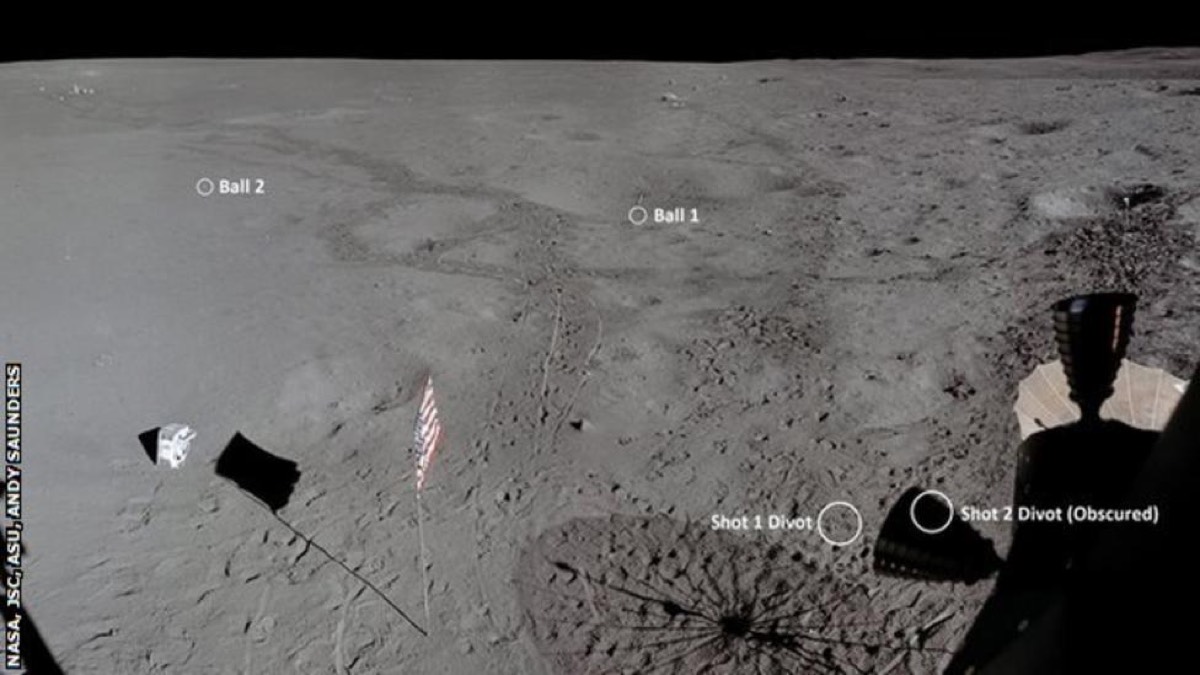
This image consists of six photographs taken from the Apollo 14 Lunar Module, enhanced and stitched into a single panorama to show the landing scene, along with the location from where Alan Shepard hit two golf balls. Both astronaut's PLSS' (life-support backpacks) can also be seen at left.
Enlarge / This image consists of six photographs taken from the Apollo 14 Lunar Module, enhanced and stitched into a single panorama to show the landing scene, along with the location from where Alan Shepard hit two golf balls. Both astronaut's PLSS' (life-support backpacks) can also be seen at left.

Fifty years ago this week, NASA astronaut Alan B. Shepard Jr. made space history when he took a few golf swings on the Moon during the Apollo 14 mission, successfully hitting two golf balls across the lunar surface. Space enthusiasts have debated for decades just how far that second ball traveled. It seems we now have an answer, thanks to the efforts of imaging specialist Andy Saunders, who digitally enhanced archival images from that mission and used them to estimate the final resting spots of the golf balls.

Saunders, who has been working with the United States Golf Association (USGA) to commemorate Shepard's historical feat, announced his findings in a Twitter thread. Saunders concluded that the first golf ball Shepard hit traveled roughly 24 yards, while the second golf ball traveled 40 yards.

Shepard's fondness for cheeky irreverence had popped up occasionally during his successful pre-NASA naval career, most notably when he was a test pilot at the Naval Air Station Patuxent River in Maryland. He was nearly court-martialed for looping the Chesapeake Bay Bridge during a test flight, but fortunately, his superiors intervened. When President Dwight D. Eisenhower established NASA in 1959, Shepard was selected as one of the seven Mercury astronauts. (The others were Scott Carpenter, Gordon Cooper, John Glenn, Gus Grissom, Wally Schirra, and Deke Slayton.)

Shepard beat out some fierce competition be chosen for the first American crewed mission into space. Russian cosmonaut Yuri Gagarin famously became the first man in space on April 25, 1961, thanks to repeated postponements of NASA's Mercury mission, but Shepard wasn't far behind. He made his own flight into space one month later, on May 5. Alas, he was a grounded after being diagnosed with Ménière's disease, resulting in an unusually high volume of fluid in the inner ear.

Surgery four years later corrected the problem, and Shepard was cleared for flight. He narrowly missed being assigned to the famous Apollo 13 mission—NASA's "most successful failure" and the subject of the 1995 Oscar-winning film, Apollo 13 (one of my all-time faves). Instead, Shepard commanded the Apollo 14 mission, which launched on January 31, 1971, and landed on the Moon on February 5.

To the Moon!

The idea for Shepard's golfing stunt came out of a 1970 visit by comedian Bob Hope to NASA headquarters in Houston. An avid golfer, Hope cracked a joke about hitting a golf ball on the Moon, and Shepard thought it would be an excellent means of conveying to people watching back on Earth the difference in the strength of gravity. So he paid a pro named Jack Harden at the River Oaks Country Club in Houston to adapt a Wilson Staff 6-iron head so that it could be attached to a collapsible aluminum and Teflon sample collector. Once NASA's Technical Services division added some finishing touches, Shepard practiced his golf swing at a course in Houston while wearing his 200-plus-pound spacesuit to prepare.

Most popular accounts describe Shepard as "smuggling" two balls and a golf club onto the spacecraft, but according to a later interview with Shepard, that wasn't the case. The astronaut ran the idea past then-NASA director Bob Gilruth, who was initially opposed but relented once Shepard laid out the precise details. Shepard also assured Gilruth that the stunt would only be done once all the official exploration tasks had been completed and then only if the mission had gone off without a hitch.

On February 6, Shepard brought out the club and two balls. His spacesuit was too bulky to use both hands, so he swung the makeshift club with just his right hand. After two swings that were "more dirt than ball," he made contact with the ball on his third swing, "shanking" it into a nearby crater. ("Looked like a slice to me, Al," Apollo 13 pilot Fred Haise joked while watching from Mission Control.)

But Shepard nailed his fourth attempt. He sent the ball soaring out of camera range and declared that it traveled for "miles and miles and miles." And as he had anticipated, the impressive 30-second time of flight perfectly showcased the difference in gravity between the Earth and the Moon. Not to be left out, crewmate Edgar Mitchell used a pole from a solar wind experiment as a javelin, which landed near the first golf ball. Once back on Earth, Shepard donated his makeshift club to the USGA museum and had a reproduction made that is now on display at the Smithsonian.

The location of the first ball Shepard hit has been known for quite some time—it's sitting in a crater next to Mitchell's javelin, about 24 yards from where Shepard stood when he took his swing. Saunders' remastering of archival photos enabled him to locate the second ball that traveled farther, as well as one of the divots in the lunar soil.

"You can access Apollo imagery to very high quality online," Apollo historian and video editor W. David Woods told Ars. "These shots were taken at 55 millimeters, the negatives and transparencies, for 55 millimeters a side. The scans they've done on them that are available online are 11,000 pixels across. So they're enormous, huge pictures that you can really dive into, if you've got expertise in image processing."

Image tricks

Saunders has that expertise. He relied on recent high-resolution scans of the original flight film, and he also used a technique known as substacking, among others.

"Some stuff was shot using 16 millimeter movie film," said Woods. "Each individual image is quite small and grainy. But if you stack them one on top of the other, you cancel out the grain, you cancel out the noise, and you're left with the imagery that's inherent in all those frames. It's a trick that astronomers use, where they take lots and lots of pictures of one area of the night sky. They cancel out the noise by stacking the images in just the same way."

The Apollo 14 crew had taken a sequence of photographs from the window of the lunar module to capture the scene for posterity, which Saunders stitched together into a single panorama. According to Saunders, given the known location of the TV camera, it was possible to identify Shepard's bootprints, showing his stance for his first two (failed) attempts. Using a known scale from images taken by the Lunar Reconnaissance Orbiter, he was then able to measure the point between the divot and the second golf ball to come up with his estimate for 40 yards.

Saunders, whose forthcoming book is entitled Apollo Remastered, estimates that a professional US Open golfer like Bryson DeChambeau could, in theory, hit a ball as far as 3.41 miles on the Moon, with a hang time of 1 minute 22 seconds—much farther (and longer) than Shepard's feat. As he told the BBC:

Unfortunately, even the impressive second shot could hardly be described as "miles and miles and miles," but of course this has only ever been regarded as a light-hearted exaggeration. The Moon is effectively one giant, unraked, rock-strewn bunker. The pressurized suits severely restricted movement, and due to their helmet's visors they struggled to even see their feet. I would challenge any club golfer to go to their local course and try to hit a six-iron, one-handed, with a one-quarter swing out of an unraked bunker. Then imagine being fully suited, helmeted, and wearing thick gloves. Remember also that there was little gravity to pull the clubhead down toward the ball. The fact that Shepard even made contact and got the ball airborne is extremely impressive.

And of course, the astronaut's legacy as the first human to play golf on the Moon remains secure.

Let's block ads! (Why?)

Article From & Read More ( Remastered images reveal how far Alan Shepard hit a golf ball on the Moon - Ars Technica )
https://ift.tt/3pS22Tx
Science

Martian landslides caused by underground salts and melting ice? - Phys.org

Martian landslides caused by underground salts and melting ice?
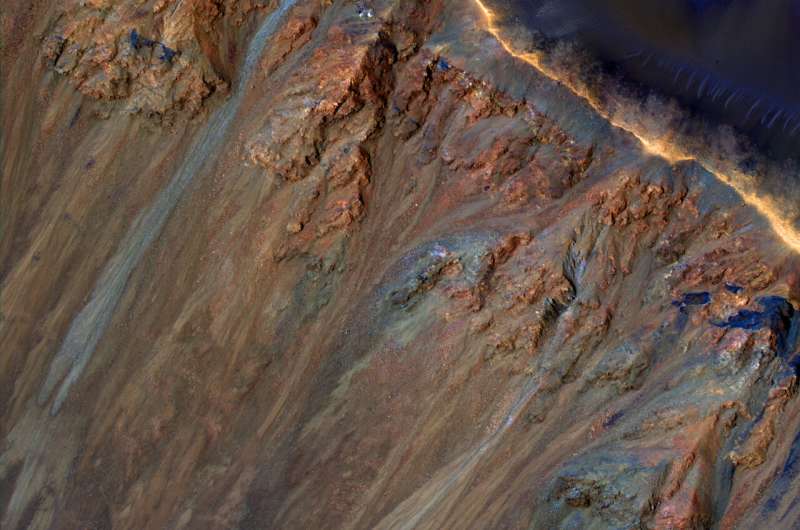
Development of RSL features at Palikir crater on Mars as viewed by the HiRISE camera on 6 occasions during Mars years 29-30. Credit: NASA/JPL/University of Arizona

A team of researchers led by SETI Institute Senior Research Scientist Janice Bishop, a member of the SETI Institute NASA Astrobiology Institute (NAI) team, has come up with a theory about what is causing landslides on the surface of Mars.

Previous ideas suggested that liquid debris flows or dry granular flows caused this movement. Neither model can completely account for the seasonal martian flow features known as Recurring Slope Lineae (RSL). The team alternatively hypothesizes that ice melting in the near-surface regolith is causing changes at the surface that make it vulnerable to dust storms and wind. As a result, the RSL features appear and/or expand on the surface of Mars today. Further, the team believes that the thin layers of melting ice result from interactions between underground water ice, chlorine salts and sulfates, which create an unstable, liquid-like flowing slush instigating sinkholes, ground collapse, surface flows and upheave.

"I am excited about the prospect of microscale liquid water on Mars in near-surface environments where ice and salts are present," said Bishop. "This could revolutionize our perspective on habitability just below the surface on Mars today."

High Resolution Imaging Science Experiment (HiRISE) data from the Mars Reconnaissance Orbiter (MRO) shows RSL located on sun-facing slopes where they continue to appear and/or expand over time. Previous studies have suggested RSL are related to chlorine salts and noted their occurrence in regions of high sulfate outcrops. The current study extends these observations with a near-surface cryosalt activity model based on field observations and lab experiments. Mars analog field investigations on Earth, such as in the Dry Valleys of Antarctica, the Dead Sea in Israel, and Salar de Pajonales in the Atacama Desert, show that when salts interact with gypsum or water underground, it causes disruptions on the surface, including collapse and landslides.

"During my fieldwork at Salar de Pajonales, a dry salt bed in Northern Chile, I have observed numerous examples of the action of salts on the local geology. It's gratifying to find that it could play a role in shaping Mars as well," said Nancy Hinman, Professor of Geosciences at the University of Montana and member of the SETI Institute NAI team.

Short video illustrating wetting of Mars soil analog material covering calcium sulfate and calcium chloride from below, absorption of water by salts and soil particles, migration of the salts towards the surface, and formation of crust with cavities. Credit: Janice Bishop and Markus Gruendler, SETI Institute

To test their theory, the team conducted lab experiments to observe what would occur if they froze and thawed Mars analog samples comprised of chlorine salts and sulfates at such as would be found on Mars. The result was slushy ice formation near -50 °C, followed by gradual melting of the ice from -40 to -20 °C.

"Probing the low-temperature behavior of Mars analog permafrost in the lab with infrared spectroscopy revealed that thin layers of liquid-like water were forming along grain surfaces as the thawed under subzero, Mars-like temperatures," said Merve Ye?ilba?, NASA Postdoctoral (NPP) Fellow at the SETI Institute and collaborator on the NAI team.

Modeling the behavior of chlorine salts and sulfates, including gypsum, under low temperatures demonstrates how interrelated these salts are. It may be that this microscale liquid water migrates underground on Mars, transferring water molecules between the sulfates and chlorides, almost like passing a soccer ball down the field. Additional lab experiments tested these sulfate-chloride reactions in a Mars analog soil with color indicators that revealed subsurface hydration of these salts and the migration of salts through the soil grains.

"I was thrilled to observe such rapid reactions of water with sulfate and chlorine salts in our lab experiments and the resulting collapse and upheave of Mars analog soil on a small scale, replicating geologic collapse and upheave features in karst systems, reservoirs, and edifice collapse on a large scale," said Bishop.

This project arose out of work on sediments from the McMurdo Dry Valleys in Antarctica, one of our planet's coldest and driest regions. As on Mars, the Dry Valleys' surface regolith is scoured by dry winds most of the year. However, subsurface permafrost contains water ice, and chemical alteration appears to be occurring below the surface.

Martian landslides caused by underground salts and melting ice?
HiRISE camera view of Krupac crater on Mars featuring gullies along the rim and RSL lower down the crater wall. Credit: NASA/JPL/University of Arizona

"Sediments in the Dry Valleys provide an excellent testbed for processes that may be occurring on Mars," said Zachary Burton, recent graduate of Stanford University and collaborator on the SETI Institute NAI team. "The presence of elevated concentrations of sulfates and chlorides a few centimeters below the harsh surface landscape in Wright Valley presents the intriguing possibility that these water-related mineralogical associations and attendant processes could exist on Mars as well."

Water ice has been detected below the surface on Mars within soil scooped up at the Phoenix landing site, as well as from orbit using radar measurements and using neutron and gamma ray spectroscopy. More recently, HiRISE has captured views of this near-surface ice at mid-latitudes. Warmer temperatures (e.g., -50 to -20 °C) at equatorial sites on Mars could support subsurface liquid water/brines during spring and summer months. RSL observed at some of these equatorial sites are often interpreted to be related to larger features called gullies, which are similar to ravines on Earth.

"Tributary gully systems present along the Northern (poleward-facing) and Northeastern slopes of Krupac crater and RSL lower down the crater wall in this region could be associated with surface features produced through near-surface brine activity, according to our model," said Virginia Gulick, SETI Institute Senior Research Scientist and member of the SETI Institute NAI team.

In addition to helping explain Mars' geological and chemical processes, this theory also suggests that the martian environment continues to be dynamic—that the planet is still evolving and active—which has implications for both astrobiology and future human exploration of the Red Planet. The potential for thin films of water below the on Mars in salty permafrost regions opens new doors for exploring habitability.

The paper is published in Science Advances.


Explore further

Scientists model Mars climate to understand habitability

More information: J.L. Bishop el al., "Martian subsurface cryosalt expansion and collapse as trigger for landslides," Science Advances (2021). advances.sciencemag.org/lookup … .1126/sciadv.abe4459
Provided by SETI Institute

Citation: Martian landslides caused by underground salts and melting ice? (2021, February 3) retrieved 4 February 2021 from https://ift.tt/2O2Vjbw

This document is subject to copyright. Apart from any fair dealing for the purpose of private study or research, no part may be reproduced without the written permission. The content is provided for information purposes only.

Let's block ads! (Why?)

Article From & Read More ( Martian landslides caused by underground salts and melting ice? - Phys.org )
https://ift.tt/39MjHGI
Science

SpaceX launches 60 Starlink satellites on record-setting used rocket, nails landing - Space.com

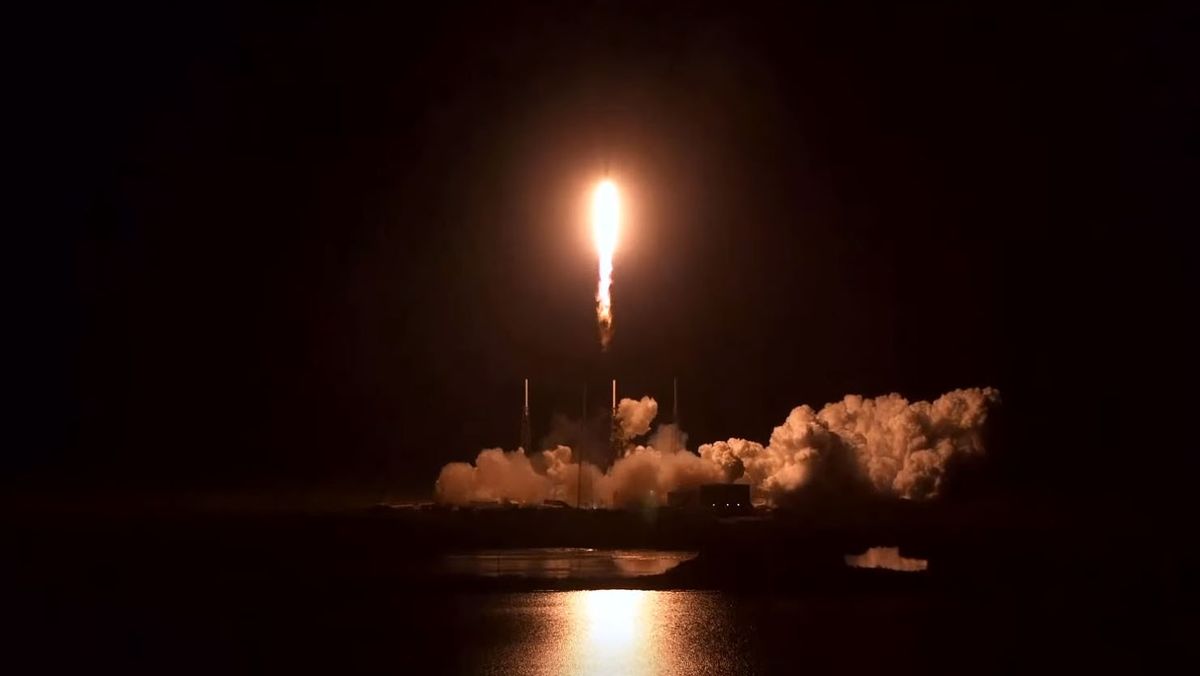
CAPE CANAVERAL, Fla. — SpaceX launched 60 more Starlink internet satellites to orbit this morning (Feb. 4) on a mission that notched a booster-reusability milestone for the company.

A two-stage Falcon 9 rocket topped with the 60 broadband spacecraft lifted off from Space Launch Complex 40 here at Cape Canaveral Space Force Station today at 1:19 a.m. EST (0619 GMT). 

Approximately nine minutes later, the rocket's first stage returned to Earth, landing smoothly on one of SpaceX's drone ships in the Atlantic Ocean. The massive ship, "Of Course I Still Love You," is one of two SpaceX vessels that catch falling boosters and return them to port. 

Related: SpaceX's Starlink satellite megaconstellation launches in photos

It was the fifth launch for this Falcon 9 first stage, which last flew just 27 days ago — the quickest turnaround between missions for any SpaceX booster. Today's launch was also the first of two nearly back-to-back Starlink liftoffs; another 60 satellites are scheduled to take flight early Friday morning (Feb. 5) on a different Falcon 9.

Today's launch, dubbed Starlink 18, leapfrogged that coming flight, known as Starlink 17. Starlink 17 was supposed to get off the ground on Monday (Feb. 1) but was delayed due to poor weather in the recovery zone and the need for extra pre-flight checks. 

For a while, it looked like Starlink 17 would fly this morning as well. The Eastern Range, which oversees all launches from the U.S. East Coast, granted SpaceX approval to launch Starlink 17 today from NASA's Kennedy Space Center, next door to Cape Canaveral Space Force Station, less than five hours after Starlink 18 took flight.  

If that had happened, it would have been the first time since 1966 that two orbital missions had launched from the Eastern Range on the same day, officials with the 45th Space Wing said via Twitter yesterday (Feb. 3). On Nov. 11, 1966, a Gemini rocket and an Atlas Agena launched just 99 minutes apart. 

This short turnaround time between Falcon 9 launches can happen because SpaceX operates from two different launch pads here in Florida and also because the Space Force has streamlined launch procedures. Such streamlining is possible partly because all Falcon 9 rockets are equipped with an automatic flight termination system (FTS), which reduces the amount of staff needed on console for any launch.

The FTS is a safety feature that will destroy a rocket in a controlled manner if something goes wrong during flight. Falcon 9 is currently the only American rocket that packs an automated FTS — meaning the rocket's onboard computer can detect if there's something wrong and, if so, either shut down the rocket's engines before liftoff or destroy the vehicle in flight. 

Other rockets rely on humans to make that call, but as a requirement set by the Space Wing, all future launchers (Blue Origin's New Glenn and United Launch Alliance's Vulcan Centaur, for example) will also have this key feature.  

Related: See the evolution of SpaceX's rockets in pictures

Double the launches

With today's successful launch, SpaceX has now deposited more than 1,000 Starlink satellites into orbit. And there are more launches coming; SpaceX’s initial Starlink constellation will consist of 1,440 satellites, and there could eventually be tens of thousands of spacecraft in the network.

Starlink 17, the other part of the doubleheader, was originally set to blast off Monday (Feb. 1). It was initially pushed 24 hours to allow for improved weather conditions at the recovery zone, then delayed several more times, causing it to switch places with Starlink 18. SpaceX relies heavily on its fleet of reused rockets, so the company wants to make sure that its recovery efforts are successful. 

Starlink 17 will mark just the second time that one of the company’s Falcon 9 first stages has flown eight times. The booster, known by the designation B1049, launched a Telstar communications satellite in September 2018, lofted an Iridium NEXT satellite in January 2019, and then flew five different Starlink missions.

A record launch

The Falcon 9 first stage for Starlink 18, booster B1060, set a new record today for the fastest turnaround time between flights: B1060 just ferried the Turksat 5A satellite into space for Turkey on Jan. 7. Before that, it had launched a GPS III satellite for the U.S. Space Force and lofted two other Starlink batches as well.

Today’s launch was the fourth of 2021 for SpaceX and the 17th overall Starlink mission. It was also the 107th flight overall for the workhorse Falcon 9, as well as the 73rd successful rocket landing for the company. 

SpaceX flew a record 26 missions in 2020, with 22 of them on refurbished rockets.

The current Falcon 9 iteration, which entered service in 2018, features the ability to fly multiple times with few refurbishments in between. That’s thanks to a series of upgrades — including a more robust thermal protection system, titanium grid fins and a more durable interstage — that facilitate reuse.

As such, SpaceX has relied heavily on its fleet of veteran rockets, having now reflown a total of 53 first-stage boosters since the first one landed on terra firma at Cape Canaveral in December 2015. 

SpaceX has its two drone-ship landing platforms — "Of Course I Still Love You" and "Just Read the Instructions" — in Florida, allowing it to launch (and land) more rockets. Both massive ships are stationed out at their respective recovery zones, awaiting action.

"Of Course I Still Love You" was recently refurbished following a busy 2020. It did its rocket-catching job today, and "Just Read the Instructions" will be called into action on Friday.

SpaceX's very big year: A 2020 of astronaut launches, Starship tests & more

Falling fairings

SpaceX also has two fast net-equipped boats designed to recover falling payload fairings, the protective nose cones that surround satellites during launch. Both of these boats — GO Ms. Tree and GO Ms. Chief — have been deployed for action. They had been hanging out in the Port at Morehead City, North Carolina, until weather conditions improved and SpaceX could launch the Starlink 18 mission.

For most of the week, the seas in the recovery zone were too rough for the boats, but that cleared up today and the company could recover all of its hardware safely.

GO Ms. Tree and GO Ms. Chief will likely scoop both fairing pieces — SpaceX fairings come back to Earth in two halves — out of the ocean for future reuse. Both fairing halves on this mission have been used before. 

Follow Amy Thompson on Twitter @astrogingersnap. Follow us on Twitter @Spacedotcom or Facebook.

Let's block ads! (Why?)

Article From & Read More ( SpaceX launches 60 Starlink satellites on record-setting used rocket, nails landing - Space.com )
https://ift.tt/3q08UhC
Science

SpaceX launches first of twin Starlink missions, 45th Space Wing's busy year continues - NASASpaceFlight.com - NASASpaceflight.com

SpaceX launches first of twin Starlink missions, 45th Space Wing’s busy year continues - NASASpaceFlight.com

Let's block ads! (Why?)

Article From & Read More ( SpaceX launches first of twin Starlink missions, 45th Space Wing's busy year continues - NASASpaceFlight.com - NASASpaceflight.com )
https://ift.tt/3oMofkO
Science

NASA, AIAA Host Discussion on Mars Perseverance Rover Technology - NASA

[unable to retrieve full-text content]

  1. NASA, AIAA Host Discussion on Mars Perseverance Rover Technology  NASA
  2. NASA Mars Perseverance rover: What to expect on landing day  CNET
  3. View Full Coverage on Google News
Article From & Read More ( NASA, AIAA Host Discussion on Mars Perseverance Rover Technology - NASA )
https://ift.tt/3oNvUiK
Science

Search

Featured Post

Two meteor showers will peak tonight. How to watch the Southern Delta Aquariids and the Alpha Capricornids. - Yahoo

[unable to retrieve full-text content] Two meteor showers will peak tonight. How to watch the Southern Delta Aquariids and the Alpha Caprico...

Postingan Populer