Rechercher dans ce blog

Thursday, January 6, 2022

Ruins of Ancient Star Cluster Discovered at the Fringes of Our Galaxy - SciTechDaily

Primordial Stellar Stream Near Milky Way

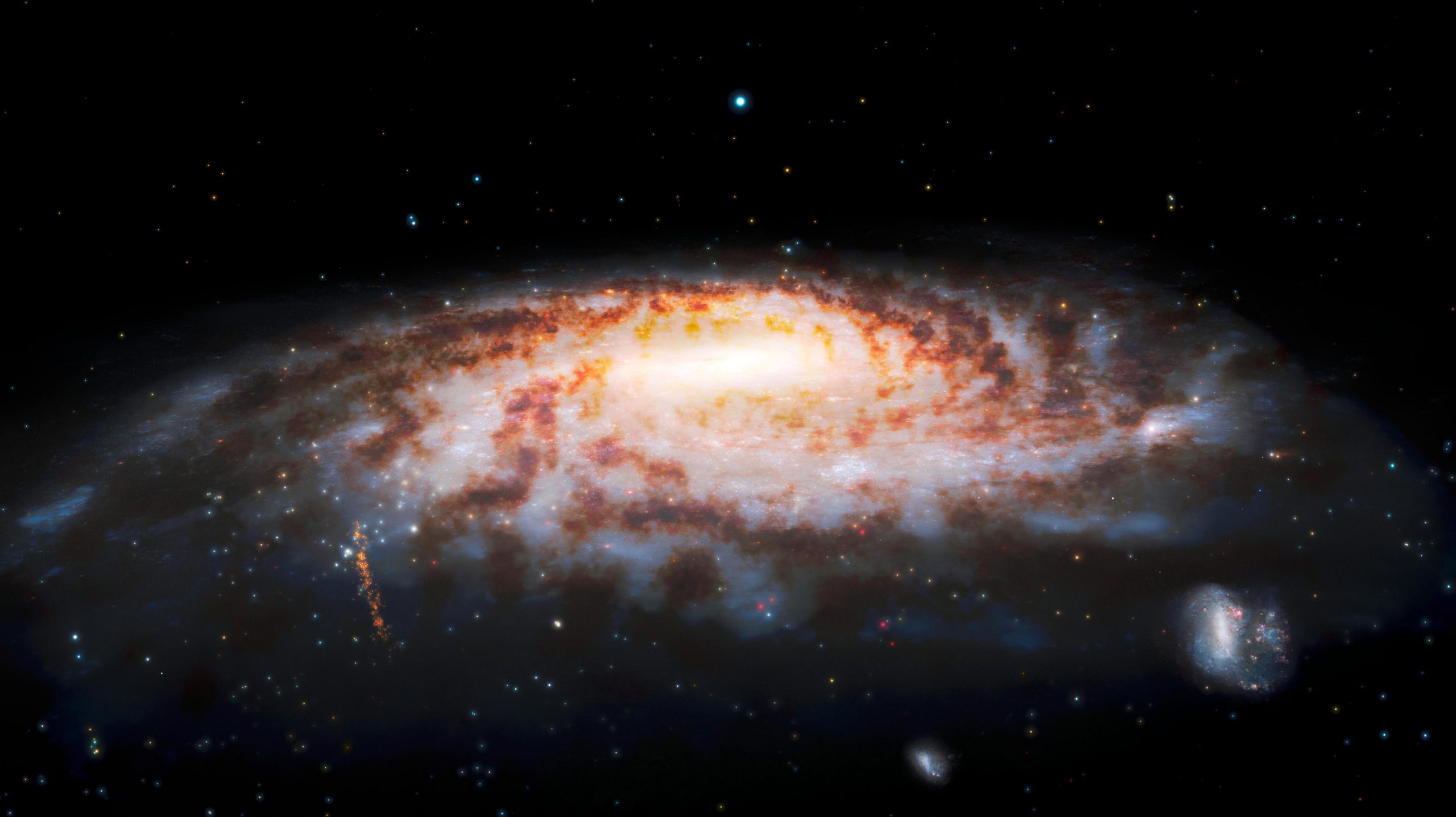
This illustration shows the location of the C-19 stellar stream (orange, vertical stream of stars in lower left), which was recently discovered at the edge of our Milky Way Galaxy. Observations using the Gemini North telescope — part of the international Gemini Observatory, a Program of NSF’s NOIRLab — reveal that the stars in this stream were once part of an ancient globular star cluster that was torn apart by gravitational interactions with our galaxy. The Large Magellanic Cloud and Small Magellanic Cloud (satellite galaxies of the Milky Way) appear in the lower right. Credit: International Gemini Observatory/NOIRLab/NSF/AURA/J. da Silva/Spaceengine, Acknowledgment: M. Zamani (NSF’s NOIRLab)

Gemini Observatory helps reveal that a stream of old stars at Milky Way’s edge is a shredded star cluster.

A primordial stellar stream discovered in the outer reaches of the Milky Way has a lower proportion of heavy elements than any known stellar system in our galaxy. Observations with the Gemini Observatory, a Program of NSF’s NOIRLab, showed that the stars in this stream were torn from an ancient star cluster and are relics from the early days of the Milky Way, which could provide insights into the formation of the first stars.

An international team of researchers including members from Europe, Canada, and Russia has discovered a unique stream of stars orbiting the Milky Way.[1] Called C-19, the stellar stream is south of the spiral of the Milky Way, and its orbit extends about 20,000 light-years from the Galactic Center at its closest approach and roughly 90,000 light-years at its farthest. The stellar stream stretches across an impressive expanse of the night sky — roughly 30 times the width of the full Moon — although it isn’t visible to the naked eye.

Using the Gemini North telescope — located in Hawai‘i as part of the international Gemini Observatory, a Program of NSF’s NOIRLab — and the GRACES instrument[2] the team realized that C-19 is a remnant of a globular cluster. In addition, the stars in the stream possess a uniquely low proportion of heavy elements, or as astronomers phrase it, low “metallicity.”[3] Globular clusters were previously thought to have metallicities no lower than 0.2%, but C-19 has an unprecedentedly low metallicity of less than 0.05% — lower than has ever been observed for a stellar system in the Milky Way or its surroundings.

The discovery that a low-metallicity stream originated from a globular cluster has implications for the formation of stars, star clusters, and galaxies in the early Universe. The very existence of the stream proves that globular clusters and the first building blocks of the Milky Way must have been able to form in low-metal environments, before successive generations of stars supplied the Universe with heavier elements.[4]

Primordial Stellar Stream Near Milky Way Annotated

This illustration shows the location of the C-19 stellar stream, which was recently discovered at the edge of our Milky Way Galaxy. The location of the Sun is provided for reference. (The size of the Sun is exaggerated and is not to scale.) The Large Magellanic Cloud and Small Magellanic Cloud (satellite galaxies of the Milky Way) appear in the lower right. Credit: International Gemini Observatory/NOIRLab/NSF/AURA/J. da Silva/Spaceengine, Acknowledgment: M. Zamani (NSF’s NOIRLab)

“It was not known if globular clusters with so few heavy elements exist — some theories even hypothesized they couldn’t form at all,” commented Nicolas Martin of the Strasbourg Astronomical Observatory, who is the lead author of the Nature paper reporting this discovery. “Other theories suggest that they would all have long-since disappeared, which makes this a key discovery for our understanding of how stars form in the early Universe.”

Members of the team originally spotted C-19 in data from the Gaia mission[5] using an algorithm they designed specifically to detect stellar streams. The stars in C-19 were also identified by the Pristine survey — a search for the lowest-metallicity stars in and around the Milky Way using the Canada-France-Hawaii Telescope in Hawai‘i — as being interesting enough to merit follow-up observations. To identify the origin of C-19’s constituent stars, astronomers needed the detailed spectra from GRACES.[6] The team also gathered data using a spectrograph mounted on the Gran Telescopio Canarias on La Palma in the Canary Islands.
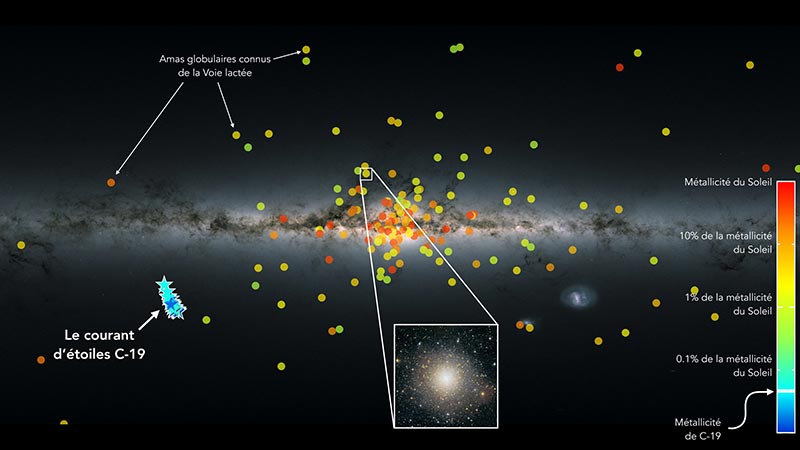
Distribution of Globular Clusters in Milky Way

Credit: Distribution of very dense groups of stars in the Milky Way, called globular clusters, superimposed on a map of the Milky Way compiled from data obtained with the Gaia Space Observatory. Each dot represents a cluster of a few thousand to several million stars, as in the insert image of the Messier 10 cluster. The colour of the dots shows their metallicity, in other words, their abundance of heavy elements relative to the Sun. The C-19 stars are indicated by the light blue symbols. Credit: © N. Martin / Strasbourg Astronomical Observatory / CNRS; Canada-France-Hawaii Telescope / Coelum; ESA / Gaia / DPAC

“GRACES provided the critical clues that C-19 is a disrupted globular cluster and not the more common disrupted dwarf galaxy,” explained Kim Venn of the University of Victoria, the lead investigator for the GRACES observations.[7] “We already knew that this was a very metal-poor stream, but identifying it as a globular cluster required the precision metallicities and detailed chemical abundances only available with high-resolution spectra.”

The Gemini observations suggest that the cluster must have formed from very early generations of stars, making C-19 a remarkable relic from the time when the very first groups of stars were being formed. Consequently, this discovery improves our understanding of the formation of stars and star clusters that arose shortly after the Big Bang and provides a close-to-home natural laboratory in which to study the oldest structures in galaxies.


This animation shows how a globular star cluster, orbiting a still-forming Milky Way Galaxy, can get torn apart by the gravity of the developing galaxy to become the C-19 stellar stream that now orbits the present-day Milky Way. Credit: Gabriel Pérez Díaz, SMM (IAC)

“This artifact from ancient times opens a direct and unique window onto the early epochs of star formation in the Universe,” concluded co-investigator Julio Navarro of the University of Victoria. “While astronomers can look at the most distant galaxies to study the early Universe, we now know that it is possible to study the oldest structures in our own galaxy as fossils from those ancient times.”

“This international collaboration reveals startling new insight into the structure, evolution, and formation of our galaxy,” added Martin Still, Gemini Program Director at the National Science Foundation. “The Gemini observatories continue to demonstrate key advances in the understanding of our night sky, concerning the cosmic ecosystem and our own place in the Universe.”

Notes

  1. Stellar streams are collections of stars that once peacefully resided in globular clusters or dwarf galaxies but have since been torn apart by gravitational interactions and distorted into long rivulets of stars stretching along the original orbit of the cluster.
  2. Gemini Remote Access to CFHT ESPaDOnS Spectrograph (GRACES) is the result of a cooperation between the Canada-France-Hawaii Telescope (CFHT), Gemini, and NRC-Herzberg (Canada). It combines the large collecting area of the Gemini North telescope with the high resolving power and high efficiency of the ESPaDOnS spectrograph at the CFHT to deliver high-resolution spectroscopy across optical wavelengths. This is achieved through a 270-meter-long fiber optics feed from the Gemini North telescope to ESPaDOnS.
  3. Astronomers use the term “metals” to refer to elements heavier than helium. As most of the conventional matter in the Universe consists of the two lightest elements, hydrogen and helium, “metals” is a convenient shorthand used to describe all other elements. For example, our Sun has a metallicity of 0.012, meaning that only 1.2% of the Sun consists of elements heavier than helium (mainly oxygen, carbon, and iron).
  4. Elements heavier than helium are formed principally through stellar nucleosynthesis — the creation of chemical elements through fusion in the cores of stars. At the end of stars’ lives, the heavy elements they created are thrown out into the Universe and incorporated into new stars. As a result, older stars from the early Universe tend to have lower metallicities than younger stars, which formed recently in relatively metal-rich environments.
  5. The European Space Agency’s Gaia spacecraft was launched in 2013 with the mission of creating a precise three-dimensional map of more than a billion stars, including mapping these stars’ locations, motions, compositions, and temperatures.
  6. The Gemini observations were part of a Large and Long observing program led by Kim Venn of the University of Victoria (Canada). These programs are awarded to a handful of astronomers each year in anticipation of significant scientific impact and improved collaboration in the astronomical community.
  7. The Gemini observations revealed that sodium-magnesium ratios in C-19 stars varied by a factor of three, which is typical of stars in ancient globular clusters (mostly likely due to high-temperature hydrogen burning) and not seen in regular dwarf galaxies.

Reference: “A stellar stream remnant of a globular cluster below the metallicity floor” by Nicolas F. Martin, Kim A. Venn, David S. Aguado, Else Starkenburg, Jonay I. González Hernández, Rodrigo A. Ibata, Piercarlo Bonifacio, Elisabetta Caffau, Federico Sestito, Anke Arentsen, Carlos Allende Prieto, Raymond G. Carlberg, Sébastien Fabbro, Morgan Fouesneau, Vanessa Hill, Pascale Jablonka, Georges Kordopatis, Carmela Lardo, Khyati Malhan, Lyudmila I. Mashonkina, Alan W. McConnachie, Julio F. Navarro, Rubén Sánchez-Janssen, Guillaume F. Thomas, Zhen Yuan and Alessio Mucciarelli, 5 January 2022, Nature.
DOI: 10.1038/s41586-021-04162-2

The team is composed of Nicolas F. Martin (Strasbourg Astronomical Observatory), Kim A. Venn (University of Victoria), David S. Aguado (University of Cambridge, Instituto de Astrofíisica de Canarias, and Universitá degli Studi di Firenze), Else Starkenburg (University of Groningen), Jonay I. González Hernández (Instituto de Astrofísica de Canarias and Universidad de La Laguna), Rodrigo A. Ibata (Université de Strasbourg), Piercarlo Bonifacio (Observatoire de Paris), Elisabetta Caffau (Observatoire de Paris), Federico Sestito (University of Victoria), Anke Arentsen (Université de Strasbourg), Carlos Allende Prieto (Instituto de Astrofísica de Canarias and Universidad de La Laguna), Raymond G. Carlberg (University of Toronto), Sebastien Fabbro (University of Victoria and NRC Herzberg Astronomy & Astrophysics), Morgan Fouesneau (Max-Planck-Institut für Astronomie), Vanessa Hill (Université Côte d’Azur), Pascale Jablonka (École Polytechnique Fédérale de Lausanne and Observatoire de Paris), Georges Kordopatis (Université Côte d’Azur), Carmela Lardo (Università degli Studi di Bologna), Khyati Malhan (Stockholm University), Lyudmila I. Mashonkina (Russian Academy of Sciences), Alan W. McConnachie (NRC Herzberg Astronomy & Astrophysics), Julio F. Navarro (University of Victoria), Rubén Sánchez Janssen (UK Astronomy Technology Centre), Guillaume F. Thomas (Instituto de Astrofíisica de Canarias and Universidad de La Laguna), Zhen Yuan (Université de Strasbourg), and Alessio Mucciarelli (Università degli Studi di Bologna and INAF–Osservatorio di Astrofisica e Scienza dello Spazio di Bologna).

Adblock test (Why?)

Article From & Read More ( Ruins of Ancient Star Cluster Discovered at the Fringes of Our Galaxy - SciTechDaily )
https://ift.tt/3G8h6EY
Science

Wednesday, January 5, 2022

Exploding meteor 'booms' over Pennsylvania on New Year's Day - Space.com

Observations from GOES-16 shows a flash that was later determined came from an exploding meteor on Jan. 1, 2022. (Image credit: Twitter/NWSPittsburgh)

A meteor hurtling through Earth's atmosphere exploded over Pittsburgh, Pennsylvania on New Year's Day (Jan. 1).

Just before 11:30 a.m. EST (1630 GMT) on Jan. 1, people in Pittsburgh heard what sounded like a loud "boom" outside. Reports described windows rattling and objects shaking in their homes, according to CBS Pittsburgh. The sudden blast surprised those living in the Pittsburgh area as the meteor broke up in the cloudy morning sky. 

The loud bang was actually a bolide, a term for a large meteor that explodes in our atmosphere, burst apart with the energy of 30 tons of TNT detonating, according to NASA's Meteor Watch. 

Related: Stunning pictures of the Geminid meteor shower

The doomed meteor, which was estimated to measure about 3 feet (0.9 meters) across with a mass close to 1,000 pounds (453 kilograms), was likely traveling around 45,000 mph (72,420 kph) as it broke apart in Earth's atmosphere, the NASA social media site said. 

NASA's Meteor Watch added that if it were not cloudy when the meteor burned up in our atmosphere, the event would have been about 100 times as bright as the full moon and visible in the daylight. 

Through the clouds, however, some say it appeared as a "little purple flash," the National Oceanic and Atmospheric Administration (NOAA) tweeted. 

See more

NOAA added that the event was detected by the Geostationary Lightning Mapper (GLM) on the GOES-East Earth-monitoring satellite. 

This meteoric event follows just a few months after a fireball was spotted in the skies over West Virginia, on Sept. 17, 2021. The event, which was later determined to be a meteor burning up in the atmosphere, also caused a loud "boom" and shook the ground, causing some to suspect a possible earthquake. 

"Fireballs" have also been reported by skywatchers witnessing what was actually rocket launches. Skywatchers all along the Eastern coast in the U.S. reported hundreds of sightings following a November SpaceX launch that lofted its Crew-3 mission to the International Space Station.

Email Chelsea Gohd at cgohd@space.com or follow her on Twitter @chelsea_gohd. Follow us on Twitter @Spacedotcom and on Facebook.

Adblock test (Why?)

Article From & Read More ( Exploding meteor 'booms' over Pennsylvania on New Year's Day - Space.com )
https://ift.tt/338anvN
Science

Monday, January 3, 2022

NASA presses ahead with Webb space telescope sunshield deployment - CBS News

Engineers activating the James Webb Space Telescope fine-tuned its electrical power system to better cope with the actual space environment and cooled down slightly warmer-than-expected motors before pressing ahead Monday with final deployment of the observatory's critical sunshade.

Bill Ochs, the NASA project manager, said tightening up the sunshade's five hair-thin layers, carefully pulling them taut with motor-driven cables running through multiple pulleys, likely would take three days to complete. But by Monday night, three of the five layers had been pulled into shape, with the final two awaiting tightening Tuesday.

The sunshade deployment has long been considered one of Webb's most challenging hurdles, but "I don't expect any drama," Ochs said.

sunshade2.jpg
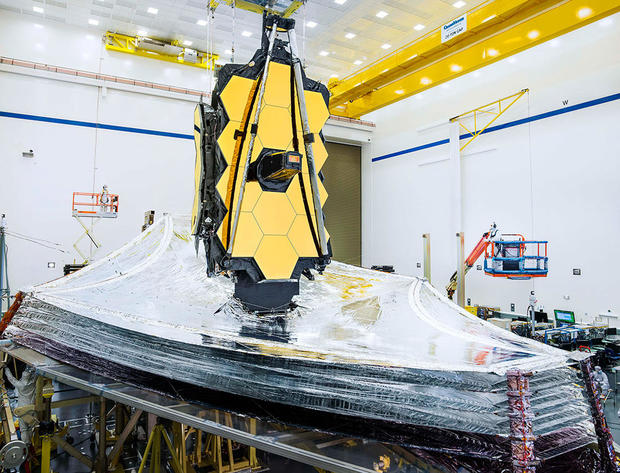
The James Webb Space Telescope's five-layer sunshade, seen during testing at Northrop Grumman's Redondo Beach, California, processing facility. NASA

"I always tell folks, the best thing for operations is boring," he said. "And that's what we anticipate over the next three days. I think we'll all breathe a sigh of relief once we get to the final layer five tensioning. But I don't expect drama."

Webb, the most expensive science probe ever built, was launched with great fanfare atop a European Space Agency-provided Ariane 5 rocket on Christmas Day, bound for an orbit around the sun a million miles from Earth.

Designed to capture infrared light from the first stars and galaxies to form in the wake of the Big Bang, Webb is extraordinarily complex. But other than minor growing pains common to all new spacecraft, Ochs said the $10 billion observatory is moving through its initial activation almost exactly as planned.

"We are still in the getting-to-know-you phase with the telescope," he told reporters in a morning teleconference. "All satellites will always be a little bit different on orbit than they are on the ground, and it takes time to get to know that, understand their characteristics.

"That's a lot of what we've been doing over the last week, as well as still making excellent progress on the commissioning timeline."

The telescope's solar array was deployed as planned moments after reaching space, two trajectory correction thruster firings were carried out, a high-gain antenna was unlimbered and pointed at Earth and two pallets holding the sunshade membranes were rotated into position.

An extendable tower lifted Webb's primary mirror and instruments about four feet above the still-folded sunshade, providing clearance and additional isolation from the heat generated by the spacecraft's electronics. A "momentum flap" then was deployed to counteract slight forces imparted by the solar wind.

After protective covers were rolled back out of the way, two telescoping booms extended from the sunshade pallets on New Year's Eve, pulling out the Kapton membranes into their now-iconic kite-like shape.

"The tensioning of the layers is obviously the next big step that we go through," Ochs said. "When we complete tensioning of all five layers, we will have retired somewhere between 70 and 75 percent of those 344 single-point failures that were discussed prior to the mission."

He was referring to the number of non-redundant devices and mechanisms required for Webb's myriad deployments that have no backups if something goes wrong. All of them simply have to work.

artist-impression.jpg
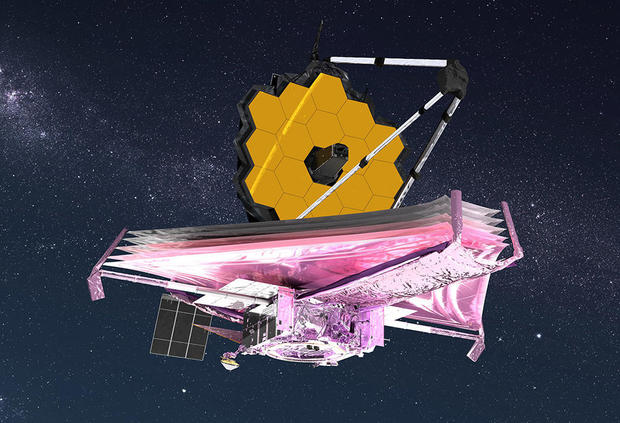
An artist's impression of the Webb telescope with its sunshade and optical system fully deployed. NASA

The sunshade is required to block out the heat of the sun, cooling Webb's 21.3-foot-wide primary mirror and instruments to nearly 400 degrees below zero, cold enough to register faint infrared light from the first stars and galaxies to light up after the Big Bang.

To achieve the required ultra-low temperatures, each layer must be pulled taut by motor-driven cables running through multiple pulleys, a process that also lifts and separates the membranes to allow gaps for heat to dissipate.

That final tensioning was held up over the weekend to give engineers time off after a busy first week of deployment activity and then to assess the performance of Webb's five-panel solar array and its battery system.

As it turned out, factory presets governing the solar array's output needed adjustment to take into account the actual temperatures Webb is experiencing in space. At the same time, the telescope was re-oriented slightly to cool six motors needed to pull the sunshade layers taut.

"Everything is hunky-dory and doing well now," said Amy Lo, Webb systems engineer with prime contractor Northrop Grumman. "The observatory was never in danger, we were never power starved. ... The rebalancing of the array gives us quite a lot of margin (for) the expected increase in power that we will be needing as we proceed on."

As for the motors, Lo said they were never out of limits, just a bit warmer than optimum. Playing it safe, Webb was reoriented Sunday to improve cooling and "we've got a lot of margin now on our temperature."

Adblock test (Why?)

Article From & Read More ( NASA presses ahead with Webb space telescope sunshield deployment - CBS News )
https://ift.tt/3zlN9OS
Science

NASA raises warning of 5 asteroids heading towards Earth in January, 2022 - HT Tech

An asteroid as large as Big Ben will be approaching Earth in January, 2022. However, it is not the only asteroid heading towards Earth.

The year 2022 has just started and here we are with dire NASA warnings of potentially hazardous asteroids heading for Earth. The National Aeronautics and Space Administration (NASA) has reported that as many as five asteroids are coming towards the Earth in the first month of the year. An asteroid around the size if a bus will approach the Earth in the first week of January itself.

Asteroids, comets, and meteoroids are large rocks in space that orbit the Sun and occasionally vary their orbits due to the gravitational attraction of planets. When these space rocks do collide with any planet, it's usually a disaster. That's why, even when an asteroid with a diameter of more than 150 metres approaches Earth, NASA classifies it as a potentially hazardous asteroid and monitors it closely.

Asteroids in January 2022

  • Asteroid 2021 YK

Asteroid 2021 YK which is 38 feet (12m) wide is expected to pass within 118,000 miles of Earth by today.

On January 6, a 24 feet around 7m in diameter comet named 2014 YE15 will pass within 4.6 million miles (7.4 million km) of Earth.

A small which is only 13 feet (4m) in diameter known as 2020 AP1 will pass Earth on January 7, at 1.08 million miles.

  • Asteroid 2013 YD48

One of the biggest asteroid coming near to Earth this month includes the Asteroid 2013 YD48 which is set to pass within 3.48 million miles of Earth on January 11. According to NASA, it is approximately 340 feet (104m) wide which makes it bigger than Big Ben. It has been reported that NASA identifies anything that passes within 120 million miles of Earth as a Near-Earth Object (NEO). Asteroid 2013 YD48 is being monitored by NASA on its Asteroid Watch Dashboard. According to NASA, anything passing within 120 million miles of Earth is classified as a Near-Earth Object (NEO). NASA's Asteroid Watch Dashboard is keeping an eye on asteroid 2013 YD48. Though it is not a dangerous object, but can be a matter of concern if it inches towards the Earth.

  • 7482 (1994 PC1)

Another huge asteroid is set to pass near our planet on January 18. The gigantic rock, 7482 (1994 PC1), is around two-and-a-half times the height of the Empire State Building. According to Nasa's Center for Near-Earth Object Studies, it will pass at a distance of 0.013 astronomical units.

Adblock test (Why?)

Article From & Read More ( NASA raises warning of 5 asteroids heading towards Earth in January, 2022 - HT Tech )
https://ift.tt/32MfEt9
Science

Sunday, January 2, 2022

Scientists create never-before-seen isotope of magnesium - Livescience.com

Scientists have just created the world's lightest form of magnesium — a never-before-seen isotope with just six neutrons in its atomic nuclei — inside a giant atom smasher.

And while the substance disintegrates too quickly to be measured directly, the researchers expect their discovery will help scientists better understand how atoms are constructed. That's because such exotic isotopes — versions of chemical elements with either more or fewer neutrons in their nuclei than usual — can help define the limits of the models that scientists use to figure out how atoms work. 

"By testing these models in making them better and better we can extrapolate out to how things work where we can't measure them," said Kyle Brown, a chemist at the Facility for Rare Isotope Beams at Michigan State University in East Lansing. "We're measuring the things we can measure to predict the things we can't."

The new magnesium isotope — called magnesium-18 — won't fill all the gaps in scientific knowledge about atoms, but the discovery will help refine the theories that scientists have developed to explain them, he said. In particular, the team's measurements of the products of the isotope's radioactive decay give new insights into the binding energies of electrons that orbit a nucleus, according to a summary of the research. 

Atomic nuclei

Under normal conditions, pure magnesium is a soft gray metal with the atomic number 12, which indicates it has 12 protons — particles with a positive charge — in its nucleus. It's highly flammable, and the intense white light from a burning magnesium strip often dazzles students in chemistry classes.

Like many chemical elements, magnesium originates in the fusion reactions of aging stars, and it's found on Earth because those long-dead stars have exploded as supernovas and "seeded" the interstellar clouds that formed our solar system. Magnesium is relatively abundant in the Earth's crust and it has an important chemical role in many biological and industrial compounds.

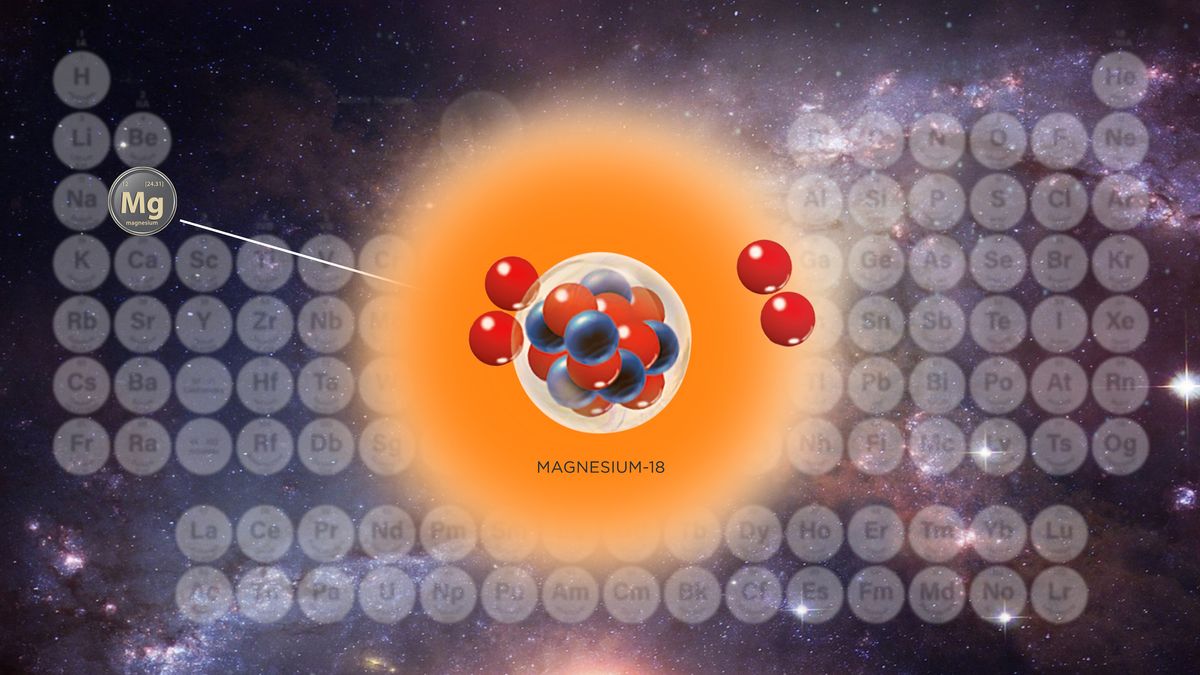
The most common stable isotope of magnesium has 12 neutrons — particles with a neutral charge — in each nucleus, giving this version of the element an atomic mass of 24. As a result, it's called magnesium-24. 

For their experiments, the researchers accelerated a beam of magnesium-24 nuclei to about half the speed of light inside the National Superconducting Cyclotron Laboratory at MSU — a circular, ultra-high-energy particle accelerator. They then fired the high-speed beam of magnesium nuclei at a target of metal foil made of beryllium. 

The collision in that step of the process yielded a "soup" of lighter magnesium isotopes the researchers could select from — among them the unstable isotope magnesium-20, which holds just eight neutrons per nucleus and radioactively decays in a few tenths of a second.

Working against the clock, the researchers then fired the magnesium-20 nuclei — again at about half the speed of light — at yet another beryllium target, about 100 feet (30 meters) away.

One of the products of the resulting collision was the newly-discovered isotope, magnesium-18 — the "lightest" isotope of magnesium ever seen, with 12 protons and just six neutrons in its nucleus.

Rare isotope

Most atomic nuclei quickly "cloak" themselves with electrons — particles with a negative charge — from their environment and become elemental atoms, which then can combine with atoms of other types to make chemical compounds.

But the newly-discovered magnesium-18 isotope is radically unstable and very short-lived: With so few neutrons, the nucleus quickly falls apart, with a half-life — the time it takes for half of its nuclei to disintegrate from radioactive decay — of less than one-sextillionth of a second, or 10^-21 seconds.

That means, it disappears much too quickly for a nucleus of magnesium-18 to even have the chance to cloak itself with electrons' and so it exists — and only very briefly — as "naked" nuclei. 

The isotope is so short-lived, in fact, that the magnesium-18 never leaves the beryllium target but decays inside it — and so the researchers deduced its presence from the telltale products of its decay: stray protons and the isotopes neon-16 and oxygen-14, the statement said.

"This was a team effort," Brown said. "It's pretty exciting — it's not every day people discover a new isotope."

Scientists have now identified several thousand isotopes of the 118 common elements in the periodic table, and more are discovered every year.

"We're adding drops to a bucket, but they are important drops," Brown said. "We can put our names on this one, the whole team can. And I tell my parents that I helped discover this nucleus that nobody else has seen before."

Brown is a lead author of an article describing the discovery published last week in the journal Physical Review Letters. Scientists from Peking University in China and Washington University in St. Louis were also involved.

Originally published on Live Science.

Adblock test (Why?)

Article From & Read More ( Scientists create never-before-seen isotope of magnesium - Livescience.com )
https://ift.tt/3eG0f07
Science

Saturday, January 1, 2022

We may finally be able to test one of Stephen Hawking's most far-out ideas - Livescience.com

We may soon be able to test one of Stephen Hawking's most controversial theories, new research suggests.

In the 1970s, Hawking proposed that dark matter, the invisible substance that makes up most matter in the cosmos, may be made of black holes formed in the earliest moments of the Big Bang. 

Now, three astronomers have developed a theory that explains not only the existence of dark matter, but also the appearance of the largest black holes in the universe. 

"What I find personally super exciting about this idea is how it elegantly unifies the two really challenging problems that I work on — that of probing the nature of dark matter and the formation and growth of black holes — and resolves them in one fell swoop," study co-author Priyamvada Natarajan, an astrophysicist at Yale University, said in a statement. What's more, several new instruments — including the James Webb Space Telescope that just launched — could produce data needed to finally assess Hawking's famous notion. 

Related: Stephen Hawking's most far-out ideas about black holes

Black holes from the beginning 

Dark matter makes up over 80% of all the matter in the universe, but it doesn't directly interact with light in any way.  It just floats around being massive, affecting the gravity within galaxies.

It's tempting to think that black holes might be responsible for this elusive stuff. After all, black holes are famously dark, so filling  a galaxy with black holes could theoretically explain all the observations of dark matter.

Unfortunately, in the modern universe, black holes form only after massive stars die, then collapse under the weight of their own gravity. So making black holes requires many stars — which requires a bunch of normal matter.Scientists know how much normal matter is in the universe from calculations of the early universe, where the first hydrogen and helium formed. And there simply isn't enough normal matter to make all the dark matter astronomers have observed.

Sleeping giants 

That's where Hawking came in. In 1971, he suggested that black holes formed in the chaotic environment of the earliest moments of the Big Bang. There, pockets of matter could spontaneously reach the densities needed to make black holes, flooding the cosmos with them well before the first stars twinkled. Hawking suggested that these "primordial" black holes might be responsible for dark matter. While the idea was interesting, most  astrophysicists focused instead on finding a new subatomic particle to explain dark matter.

What's more, models of primordial black hole formation ran into observational issues. If too many formed in the early universe, they changed the picture of the leftover radiation from the early universe, known as the  cosmic microwave background (CMB). That meant the theory only worked when the number and size of ancient black holes were fairly limited, or it would conflict with measurements of the CMB. .

The idea was revived in 2015 when the Laser Interferometer Gravitational-Wave Observatory found its first pair of colliding black holes. The two black holes were much larger than expected, and one way to explain their large mass was to say they formed in the early universe, not in the hearts of dying stars.  

A simple solution 

In the latest research, Natarajan, Nico Cappelluti at the University of Miami and Günther Hasinger at the European Space Agency  took a deep dive into the theory of primordial black holes, exploring how they might explain the dark matter and possibly resolve other cosmological challenges.

To pass current observational tests, primordial black holes have to be within a certain mass range. In the new work, the researchers assumed that the primordial black holes had a mass of around 1.4 times the mass of the sun. They constructed a model of the universe that replaced all the dark matter with these fairly light black holes, and then they looked for observational clues that could validate (or rule out) the model.

The team found that primordial black holes could play a major role in the universe by seeding the first stars, the first galaxies and the first supermassive black holes (SMBHs). Observations indicate that stars, galaxies and SMBHs appear very quickly in cosmological history, perhaps too quickly to be accounted for by the processes of formation and growth that we observe in the present-day universe.

"Primordial black holes, if they do exist, could well be the seeds from which all supermassive black holes form, including the one at the center of the Milky Way," Natarajan said.

And the theory is simple and doesn't require a zoo of new particles to explain dark matter.

"Our study shows that without introducing new particles or new physics, we can solve mysteries of modern cosmology from the nature of dark matter itself to the origin of supermassive black holes," Cappelluti said in the statement.

So far this idea is only a model, but it's one that could be tested relatively soon. The James Webb Space Telescope, which launched Christmas Day after years of delays, is specifically designed to answer questions about the origins of stars and galaxies. And the next generation of gravitational wave detectors, especially the Laser Interferometer Space Antenna (LISA), is poised to reveal much more about black holes, including primordial ones if they exist. 

Together, the two observatories should give astronomers enough information to piece together the story of the first stars and potentially the origins of dark matter.

"It was irresistible to explore this idea deeply, knowing it had the potential to be validated fairly soon," Natarajan said.

Originally published on Live Science.

Adblock test (Why?)

Article From & Read More ( We may finally be able to test one of Stephen Hawking's most far-out ideas - Livescience.com )
https://ift.tt/3sPKonW
Science

Friday, December 31, 2021

10 weird things scientists calculated in 2021 - Livescience.com

The world is full of beautiful equations, numbers and calculations. From counting beads as toddlers to managing finances as adults, we use math every day. But scientists often go beyond these quotidian forms of counting, to measure, weigh and tally far stranger things in the universe. From the number of bubbles in a typical glass of beer to the weight of all the coronavirus particles circulating in the world, here are 10 weird things scientists calculated in 2021.

Related: Photos: Large numbers that define the universe

Beer bubbles

(Image credit: Brian Hagiwara/Getty Images)

Pouring ice-cold beer into a glass forms lots of tiny bubbles — and thanks to some thirsty scientists, now we know how many. 

These scientists calculated that a half-pint glass of beer produces up to 2 million bubbles, about twice as many bubbles as Champagne makes. But the researchers found that the number of bubbles in a half-pint glass ranged from 200,000 to 2 million, according to their study, published in March in the journal ACS Omega. It turns out that the number of bubbles depends on three factors: the concentration of dissolved carbon dioxide (CO2) in the glass, the volume of bubbles and the point at which the CO2 depletes such that no more bubbles form. Also, tiny flaws in the glass would help bubbles emerge from the liquid.

Read more: How many bubbles are in a glass of beer?

Weight of SARS-CoV-2

(Image credit: Shutterstock)

If you were to gather all the particles of SARS-CoV-2, the virus that causes COVID-19, circulating around the globe into one place, the weight of the tiny, invisible particles would be somewhere between that of an apple and a young toddler, according to a study published in June in the journal Proceedings of the National Academy of Sciences. That calculation is based on the estimation that each infected individual carries about 10 billion to 100 billion SARS-CoV-2 particles at the peak of their infection. If there are between 1 million and 10 million infections at any given time, which has been the case during the course of the pandemic, the particles together would weigh somewhere between 0.22 and 22 pounds (0.1 and 10 kilograms).

"Here we are talking about a super-tiny mass of viruses, and they are completely wreaking havoc on the world," the researchers told Live Science. 

Read more: How much does all the SARS-CoV-2 in the world weigh? 

Elephants from space

(Image credit: Shutterstock)

Using satellites and artificial intelligence, researchers counted African elephants from space for the first time, according to a study published online in Dec. 2020 in the journal Remote Sensing in Ecology and Conservation. The team combined high-resolution images of Addo Elephant National Park in South Africa captured by satellites that orbit 372 miles (600 kilometers) above Earth's surface. This novel technique can survey thousands of miles in minutes, which is much faster than the typical way conservationists count elephants in low-flying planes, a process that can take hours. The researchers say this method could be vital for ensuring the survival of the African elephant (Loxodonta africana), a species the International Union for Conservation of Nature classifies as endangered. 

Read more: Elephants counted from space using satellites and AI

Acceleration of a finger snap

(Image credit: Nisara Tangtrakul / EyeEm / Getty Images)

Using high-speed cameras and force sensors, researchers figured out the fastest acceleration of the human body: a snap of the fingers. Finger snaps generate maximal rotational velocities of 7,800 degrees per second and a maximal rotational acceleration of 1.6 million degrees per second squared, according to a study published in November in the Journal of the Royal Society Interface. The acceleration of a finger snap is three times the acceleration produced by a professional baseball player's arm. 

"When I first saw the data, I jumped out of my chair," study senior author Saad Bhamla, an assistant professor of chemical and biomolecular engineering at the Georgia Institute of Technology, said in a statement. "The finger snap occurs in only seven milliseconds — more than 20 times faster than the blink of an eye, which takes more than 150 milliseconds." 

Read more: Scientists find the fastest acceleration in the human body

Most precise pi ever

(Image credit: Shutterstock)

Pi is one of the most famous irrational numbers, which means it can't be expressed as a common fraction and has an infinite number of digits after the decimal point. Researchers in Switzerland have now calculated the most precise value of pi ever, up to 62.8 trillion decimal places. Of course, the calculations, which took 108 days, weren't done by hand but rather with a supercomputer. But don't get too comfortable with this achievement. Because pi is irrational, this record can be broken over and over … forever. 

Read more: Pi calculated to a record-breaking 62.8 trillion digits

Popularity of your friends

(Image credit: Shutterstock)

According to the "friendship paradox," an idea that was first formulated in 1991, your friends are typically more popular than you are. But a group of mathematicians came up with a new theory that they say better describes real-world friendships, according to a study published in May in the Journal of Complex Networks. "Averages are often highly misleading or at least can fail to describe people's experiences," lead author George Cantwell, a postdoctoral fellow at the Santa Fe Institute in New Mexico, previously told Live Science. "Some people are less popular than their friends; others are more so." 

Their new equations show that the friendship paradox tends to be stronger in social networks made up of people with different levels of popularity, such as a high school. If a person has two friends in the same social network as a person with 100 friends, in general, the friendship paradox will be stronger than in a network where the most social person has 10 friends and the least social person has three. 

Read more: The 'friendship paradox' doesn't always explain real friendships, mathematicians say

Black holes

(Image credit: NASA/JPL-Caltech)

How many black holes exist in the universe? These mysterious objects are so dense that not even light escapes themt. Astronomers can't detect all the black holes out there, so they turned to theoretical calculations. In a study published in October the preprint database arXiv, a group of researchers calculated that there might be millions of small black holes in our cosmic neighborhood, or the most immediate environment around the sun, according to NASA. The largest black holes, supermassive black holes, are much rarer than the smaller ones; each galaxy usually has only one. All in all, they calculated that black holes hold about 1% of all ordinary matter (not dark matter) in the universe. 

Read more: How many black holes are there in the universe?

Walking around the moon

(Image credit: Shutterstock)

How long would it take to walk around the moon? The answer isn't black-and-white; rather, it depends on a number of factors, including how fast you walk and how much time you spend walking each day. It also depends on whether you take detours to avoid rough topography. At a hypothetical walking speed of up to 3.1 mph (5 km/h), which researchers previously calculated in a 2014 study, it would take about 91 days to walk the 6,786 miles (10,921 kilometers) around the moon, Live Science reported this year. But because it's not possible to walk nonstop for 91 days, the journey would likely take much longer. It's more likely that a person would walk a few hours a day. If a person walked at this speed for 4 hours a day, it would take about 547 Earth days, or about 1.5 years, to walk around the moon.

Read more: How long would it take to walk around the moon?

Satellites orbiting Earth

(Image credit: Shutterstock)

In another article, Live Science explored the question of how many satellites currently orbit the planet. Since Russia launched Sputnik, the world's first human-made satellite, in 1957, thousands of satellites have been lofted. About 10 to 60 were launched annually until the 2010s. Since then, the numbers have increased tremendously: 1,300 new satellites were sent to low Earth orbit in 2020 and more than 1,400 in 2021. As of September 2021, there were around 7,500 active satellites in low Earth orbit, Live Science reported.

Read more: How many satellites orbit Earth?

"Absolute limit" on the human life span

(Image credit: www.victoriawlaka.com via Getty Images)

The "absolute limit" on the human life span may be 120 to 150 years, according to a study published in May in the journal Nature Communications. A group of researchers calculated that limit using a mathematical model, which predicted that after 120 to 150 years, the body would lose its resilience, or the ability to recover from illness and injury. But if future therapies targeted and extended the body's resilience, humans might be able to live longer, the researchers said. The data for the study came from large data sets that contained medical data for more than 500,000 people across the U.S., the U.K. and Russia. The data included blood tests in which the researchers specifically looked for the ratio of two types of disease-fighting white blood cells.

Read more: Human life span may have an 'absolute limit' of 150 years

Originally published on Live Science.

Adblock test (Why?)

Article From & Read More ( 10 weird things scientists calculated in 2021 - Livescience.com )
https://ift.tt/3sOQXae
Science

Search

Featured Post

Two meteor showers will peak tonight. How to watch the Southern Delta Aquariids and the Alpha Capricornids. - Yahoo

[unable to retrieve full-text content] Two meteor showers will peak tonight. How to watch the Southern Delta Aquariids and the Alpha Caprico...

Postingan Populer