Rechercher dans ce blog

Friday, May 5, 2023

Get Ready to See More of the Northern Lights - The New York Times

Over the past few months, viewings of the lights have increased in areas farther south than usual. That’s going to continue into 2025.

Central Pennsylvania. Southern England. Arizona.

The northern lights are most often seen in the earth’s northernmost regions, but in recent months, they’ve been visible to residents farther south. It’s not a fluke, scientists say, but part of a trend that will allow a wider swath of the world to get a rare glimpse of the phenomenon for the next few years.

The lights will be visible farther south because of a shift in the sun’s magnetic fields, which flip on an 11-year cycle. This phenomenon will peak in 2025, during the phase known as solar maximum.

The expanded visibility of the lights, created by activity in the sun’s magnetic field, has already begun, said Shannon Schmoll, the director of the Abrams Planetarium at Michigan State University.

Green and purple lights in the sky with snowcapped trees
The Northern lights above Fairbanks, Alaska, in December.Khalid Elfiqi/EPA, via Shutterstock

The northern lights, or aurora borealis, are created when solar wind or charged particles from the sun, interact with the earth’s magnetic field, exciting atoms in the atmosphere.

Electrons jump to a higher energy level and release light — seen as the auroras — as they settle back down, she said.

Oxygen in the atmosphere creates green or red light during an aurora, while nitrogen causes blues.

Usually, the auroras are most easily viewable in places like Scandinavian countries and Northern Canada. Every winter, tourists from around the world flock to Arctic locations, venturing into the snowy night to spot the phenomenon.

But over the past few months in the northern hemisphere, viewings of the lights have increased in areas farther south.

One cold Sunday night in February, the skies of southern England and Ireland were alight with the auroras. In March, powerful geomagnetic storms helped to make them visible as far south in the United States as North Carolina and New York. In April, they were spotted in Arizona, central California, southern Ontario and England.

In the southern hemisphere, aurora australis, or the southern lights, are typically visible from Antarctica, Australia and south of Argentina. Their visibility has also expanded.

Besides creating a beautiful show, scientists are interested in the auroras because extreme geomagnetic storms, which can create the lights, can also damage power grids, said Taylor Cameron, a research scientist with the Canadian Hazards Information Service. The last large outage of this sort was in 1989, leaving six million people in Quebec without power.

As the sun’s magnetic fields flip over 11 years, this cycle, phases between solar minimum and solar maximum, Dr. Cameron said. Experts predict that solar maximum will be reached in 2025, meaning the auroral oval, or the area on earth where the lights are visible, will widen until then.

“When we’re in the minimum part of the solar cycle, the sun is very quiet, basically nothing going on,” Dr. Cameron said. “And then at maximum, we’ve got lots of solar flares, lots of coronal mass ejections. The sun is just much more active.”

The current cycle started in 2019, he said.

The solar cycle is tied to the sun’s magnetic field, Dr. Cameron said, but doesn’t affect its temperature. In contrast to the sun’s 11-year cycle, the earth’s magnetic field reverses every tens of thousands of years.

Earth’s northern and southern hemispheres may reach solar maximum at different times, given that they can be out of sync, said C. Alex Young, an associate director for science at NASA’s heliophysics science division.

Space weather modeling, which incorporates both real data and computer models recreating space physics, allows scientists to better understand the auroras, Dr. Young said.

The aurora from the International Space Station while it was passing over southeastern Manitoba.NASA/JSC/Cover Images via Reuters Connect

The best seasons to see the aurora are spring and fall, especially close to the equinoxes.

“That’s the same time in which sort of the Equator is totally flat with the rotational plane of the sun,” said William Archer, a mission scientist at the Canadian Space Agency.

Solar terrestrial events are measured by a Kp-index, which is a scale from zero to nine, Dr. Archer said. The higher the number, the more active the aurora.

A northern lights episode last month reached a Kp of eight. For central United States viewing, the Kp has to reach about seven or higher, he said. Darker areas away from city lights have the best visibility.

Trips to see the aurora often involve hunting for the perfect view, said Amy Hope, a managing director for the Aurora Zone, a northern lights tourism company based in Britain.

In the past, solar maximum has helped to grab travelers’ attention, she said. Since the aural window has expanded, Ms. Hope has received messages from friends in Scandinavia who have seen the lights from kitchen windows. Even during solar maximum, tour groups will hunt for the best view.

“What’s so addictive about it — for want of a better word — is that it’s different every single time,” Ms. Hope said.

The National Oceanic and Atmospheric Administration operates a short-term forecast with the location and intensity of auroras.

Experts also recommend using SpaceWeather.com and SpaceWeatherLive.com as resources to hunt for the light shows; AuroraMAX shows a livestream of the lights during winter months.

The Geophysical Institute run out of the University of Alaska Fairbanks provides forecasts for locations in North America, Europe, and the southern hemisphere.

Facebook communities have also formed for people in common aurora-spotting areas to discuss forecasts and to suggest viewing points. Many destinations have similar websites, including Fairbanks, Alaska, Canada and Iceland.

“For many people, the aurora is a beautiful nighttime phenomenon that is worth traveling to Arctic regions just to observe,” NOAA’s Space Weather Prediction Center said on its website. “It is the only way for most people to actually experience space weather.”

Adblock test (Why?)

Article From & Read More ( Get Ready to See More of the Northern Lights - The New York Times )
https://ift.tt/2zCRTxo
Science

Wednesday, May 3, 2023

Gargantuan 'superflare' from distant star may have launched one of the strongest solar storms ever seen - Livescience.com

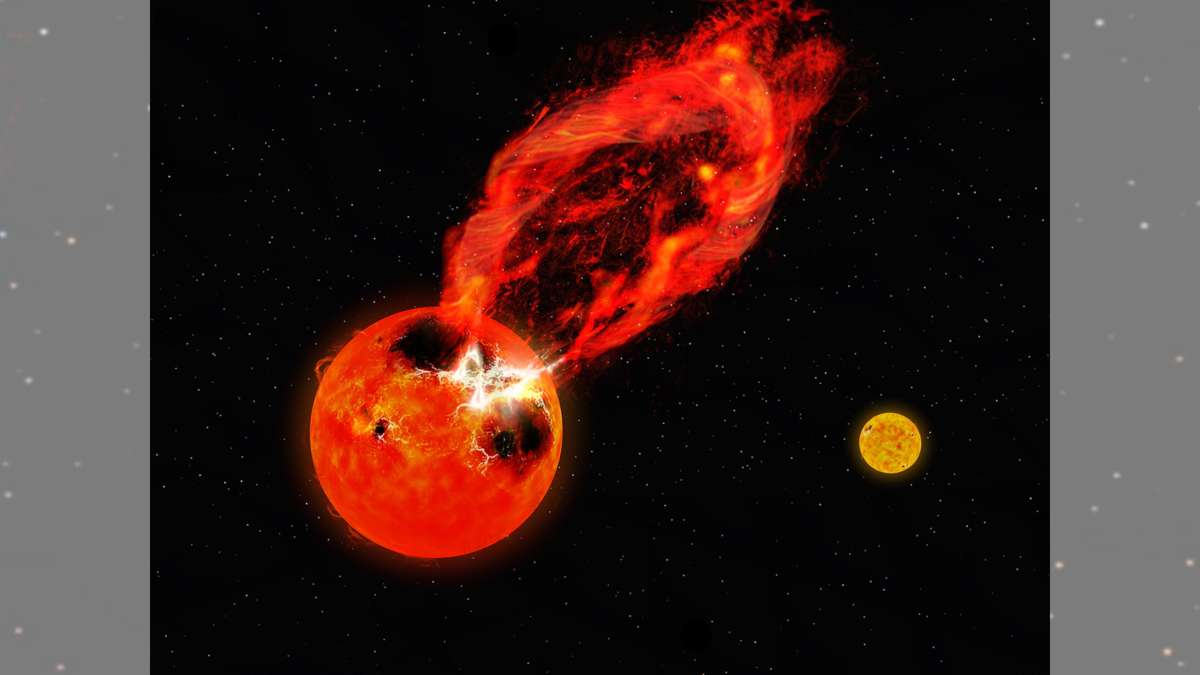
Scientists scoping out a star system in the constellation Orion have witnessed one of the most gargantuan and powerful stellar flares ever seen.

Dubbed a "superflare," the enormous blast of stellar radiation is 10 times more massive than anything ever witnessed erupting from the sun, according to new research published in The Astrophysical Journal (opens in new tab)

While the mechanism behind these monster flares still isn't well understood, the new research suggests that superflares originate from stars that are highly magnetically active. These superflares may be accompanied by enormous eruptions of charged particles that could devastate life on any planets in their firing line, the study authors wrote. (Fortunately for us, Earth is not one of those planets.)

In their new research, the astronomers targeted a star system called V1355 Orionis, which is about 400 light-years from Earth and features two stars orbiting each other. These stars belong to a class of stars known to harbor many sunspots — dark, planet-size regions that form as the result of intense electromagnetic activity — and that have been tied to other observed superflares. 

In general, stellar flares occur when magnetic-field lines in a star's atmosphere tangle, snap and reconnect, releasing a powerful gout of radiation that's visible across the entire electromagnetic spectrum. On the sun, flares may be accompanied by towering loops of plasma, known as prominences, that can rise tens of thousands of miles above the sun's surface. If this solar plasma launches quickly enough, it can break free of the sun and become a coronal mass ejection (CME) — an enormous blob of high-energy particles that can knock satellites out of orbit and short-circuit power grids on Earth, if our planet happens to be in the blob's path. 

Combining observations from the Transiting Exoplanet Survey Satellite and the Seimei Telescope in Japan, the researchers studied the distant star system in multiple wavelengths of light to capture the most complete picture possible of the superflare's evolution. 

They found that the flare began with one of the most powerful stellar eruptions ever seen — a high-velocity prominence that burst out of one of the stars at more than 2.2 million mph (3.5 million km/h). This blast far exceeded the star's escape velocity, launching trillions of tons of electrically charged matter outward into space in what may be one of the largest CMEs ever observed, the authors wrote.

It's not certain how, exactly, such a powerful CME would impact life on any hapless planets that got in the way — but the researchers said the effects would be far more catastrophic than those associated with even the worst CMEs to hit Earth

Ultimately, this mega-flare's discovery is less a cautionary tale for our planet than it is a caveat in the search for life on other worlds: Planets around magnetically hyper star systems like V1355 Orionis may not be the best places to look.

Adblock test (Why?)

Article From & Read More ( Gargantuan 'superflare' from distant star may have launched one of the strongest solar storms ever seen - Livescience.com )
https://ift.tt/kPGeQiU
Science

What time is the lunar eclipse on May 5? - Space.com

Just over two weeks after its dark silhouette crossed in front of the sun for parts of the Indian Ocean, extreme Western Australia, New Guinea and the Pacific Ocean, it is now the moon's turn to undergo an eclipse. 

On May 5, the moon almost drops completely below the Earth's shadow, in the process sampling only the shadow's outermost part — called the penumbra — which is not only pale but grades to even paler outward, away from the dark, central part of the shadow, known as the umbra. As such, this event is called a penumbral lunar eclipse.

The penumbral lunar eclipse will begin at 11:13 a.m. EDT (1513 GMT) on Friday (May 5) and will peak at 1:24 p.m. EDT (1724 GMT). The eclipse will end at 3:31 p.m. EDT (1932 GMT) when the moon emerges from the Earth's shadow.

Related: Lunar eclipses 2023: When, where & how to see them

In a penumbral eclipse, no part of the moon enters the dark umbral shadow of the Earth, so no part of the moon shows the sharp and distinct outline of the Earth's shadow. And since it will pass through the outer extremities of the Earth's shadow, this is a weak eclipse that will do little to moderate or diminish the moon's light. The penumbral shadow is usually faint and difficult to perceive unless at least two-thirds of the moon's disk is immersed within it. That portion of the moon closest to the much darker umbral shadow may exhibit a sensible darkening, but it might still not catch the eye. 

Standing on the moon, an astronaut looking skyward would see the Earth appear to partially eclipse the sun

This eclipse favors the Eastern Hemisphere, most notably an eastern slice of Africa and adjacent Madagascar, as well as much of western Asia. Conversely, the Americas will see none of it, as this event will occur during the daytime when the moon is below the horizon. The dark umbral shadow will lie to the north of the moon's path. 

A map showing the worldwide visibility of the lunar eclipse on May 5, 2023. (Image credit: Dominic Ford/In-The-Sky.org)

Our timetable below, which is adjusted to reflect Greenwich Mean Time (GMT), provides the moment when the moon will start to enter the penumbral shadow, but absolutely nothing unusual will be noticed on the lunar disk at that time. 

At the time of the darkest phase of the eclipse, the eclipse magnitude — that is, the percentage of the moon's diameter that is within the lighter penumbral shadow — will equal 96.4 percent. 

Swipe to scroll horizontally
Penumbral lunar eclipse on May 5
Eclipse event Time
Moon enters penumbra 11:13 a.m. EDT/1513 GMT
Faint smudge/stain appears 12:37 p.m. EDT/1637 GMT
Mid-eclipse 1:22 p.m. EDT/1722 GMT
Faint smudge/stain fades away 2:07 p.m. EDT/1807 GMT
Moon leaves penumbra 3:31 p.m. EDT/1931 GMT

The moon will be passing through the southern part of the Earth's penumbra and its uppermost edge will miss touching the umbra by about only about 78 miles (126 km). So, perhaps for about 45 minutes or so, centered on the time of the middle of the eclipse, those who know to look, may be able to discern a vague grayish or brownish smudge or stain concentrated toward the moon's upper rim. 

The eclipse will also be visible from eastern Asia, Indonesia, Australia and southern New Zealand; however, for these regions, the eclipse occurs after local midnight, so the calendar date will read Saturday (May 6). For parts of Japan and New Zealand, the moon will set while still immersed in the penumbral shadow. For the rest of the world, this event will happen during the daylight hours with the moon below the horizon, hence the eclipse will not be visible. 

If that is the case for you, don't fret too much. This is, after all, a rather underwhelming event compared to more dramatic celestial spectacles like the rare hybrid solar eclipse that recently took place on April 20.

If you hope to take a look at the moon close-up during an eclipse or any other time, our guides to the best telescopes and best binoculars are a great place to start. 

If you live in the path of the penumbral lunar eclipse and want to take photos of it, be sure not to miss our guide on how to photograph a lunar eclipse

And for tips on photographing the night sky in general, check out our guide on how to photograph the moon and our rundowns on the best cameras for astrophotography and best lenses for astrophotography.

Joe Rao serves as an instructor and guest lecturer at New York's Hayden Planetarium (opens in new tab). He writes about astronomy for Natural History magazine (opens in new tab), the Farmers' Almanac (opens in new tab) and other publications. Follow us on Twitter @Spacedotcom (opens in new tab) and on Facebook (opens in new tab).

Adblock test (Why?)

Article From & Read More ( What time is the lunar eclipse on May 5? - Space.com )
https://ift.tt/icSfp4D
Science

Tuesday, May 2, 2023

Who Will Have the Last Word on the Universe? - The New York Times

The End is coming, in maybe 100 billion years. Is it too soon to start freaking out?

“There will be a last sentient being, there will be a last thought,” declared Janna Levin, a cosmologist at Barnard College, near the end of “A Trip to Infinity,” a new Neflix documentary directed by Jonathan Halperin and Drew Takahashi.

When I heard that statement during a showing of the film recently, it broke my heart. It was the saddest, loneliest idea I had ever contemplated. I thought I was aware and knowledgeable about our shared cosmic predicament — namely, that if what we think we know about physics and cosmology is true, life and intelligence are doomed. I thought I had made some kind of intellectual peace with that.

But this was an angle that I hadn’t thought of before. At some point in the future there will be somewhere in the universe where there will be a last sentient being. And a last thought. And that last word, no matter how profound or mundane, will vanish into silence along with the memory of Einstein and Elvis, Jesus, Buddha, Aretha and Eve, while the remaining bits of the physical universe go on sailing apart for billions upon billions upon billions of lonely, silent years.

Will that last thought be a profound pearl of wisdom? An expletive?

How did we humans get into this fix? The universe as we know it originated in a fiery burst 13.8 billion years ago and has been flying apart ever since. Astronomers argued for decades about whether it would go on expanding forever or someday collapse again into a “big crunch.”

All that changed in 1998 when astronomers discovered that the cosmic expansion was speeding up, boosted by an anti-gravitational force that is part of the fabric of spacetime. The bigger the universe gets, the harder this “dark energy” pushes it apart. This new force bears a striking resemblance to the cosmological constant, a cosmic repulsion Einstein had proposed as a fudge factor in his equations as a way of explaining why the universe did not collapse, but later rejected as a blunder.

But the cosmological constant refused to die. And now it threatens to wreck physics and the universe.

In the end, if this dark energy prevails, distant galaxies will eventually be speeding away so fast that we can’t see them anymore. The more time goes on, the less we will know about the universe. The stars will die and not be reborn. It will be like living inside an inside-out black hole, sucking matter, energy and information over the horizon, never to return.

Worse, because thinking takes energy, eventually there will not be enough energy in the universe to hold a thought. In the end there will only be subatomic particles dancing intergalactic distances away from each other in a dark silence, trillions upon trillions of years after there was any light or life in the universe. And then, more uncountable trillions of eons to come, until there is finally no way to count the years, as Brian Greene, the popular Columbia University theorist and author, so elegantly and devastatingly described it in his recent book, “Until the End of Time.”

The globular cluster Messier 92. As the universe expands, eventually there will not be enough energy in the universe to hold a thought.
NASA, ESA, CSA, Alyssa Pagan (STScI)

It’s hard not to want to scream at our own insignificance in all of this. If this is, in fact, what the universe will come to. The universe as we know it is now 14 billion years old, which seems like a long time but is only an infinitesimal sliver of the trillions and quadrillions of years of darkness to come. It will mean that everything interesting in our universe happened in a brief flash, at the very beginning. A promising start, and then an eternal abyss. The finality and futility of it all!

In short, a tale full of sound and fury, signifying nothing. What do we do with a universe like this?

You may point out that it is way too soon to be prescribing a future for the universe. New discoveries in physics could provide an escape hatch. Maybe dark energy will not be constant; maybe it will turn around and recompress the universe. In an email, Michael Turner, the cosmologist emeritus formerly at the University of Chicago who coined the term dark energy, referring to the Greek letter symbolizing Einstein’s cosmological constant said, “Lambda would be the most uninteresting answer to the dark energy puzzle!”

But for now, that is what we have to look forward to.

Our goose will be cooked a billion or so years from now, when the Sun boils away the oceans. A few billion years later the Sun itself will die, burning Earth and anything that remains of us to a crisp.

There is no escaping to space. The galaxies themselves will collapse into black holes in about 10^30 years.

And black holes will finally release all that they have imprisoned as a thin spray of particles and radiation, to be scattered into the prevailing wind of dark energy whisking them apart.

In some variations on the story, known as the Big Rip, dark energy could eventually grow strong enough to tear apart the tombstones that mark your grave.

And so, just as there was a first living creature somewhere, sometime, to emerge from the splendid blaze of the Big Bang, there will be a last creature to die, a last thought. A last sentient being, as Dr. Levin pointed out.

That idea is what stopped me short. It had never occurred to me that some individual being would have the last word on existence, the last chance to curse or be grateful. Part of the pain is that nobody will know who, or what, had the last word, or what was thought or said. Somehow that notion made cosmic extinction more personal, and I wondered what it would be like.

NASA, ESA, CSA, D. Milisavljevic, T. Temim, I. De Looze, J. DePasquale (STScI)

Maybe as all the energy dwindles away over the horizon it will be like falling asleep. Or like Einstein mumbling his last words in German to a nurse who didn’t know the language. Or the computer at the end of time in Isaac Asimov’s classic story “The Last Question,” finally figuring out the secret of the universe and declaring, “Let there be light.” Might it be some blazing realization about the nature of string theory or the final secret about black holes? I hate to miss out on it.

I’d like to think my last thought would be one of love or gratitude or awe or about the face of a loved one, but I worry it would be an expletive.

Wiser people than me ask, when I go on about this, why I don’t whine about the billions of years that passed before I was born? Perhaps it’s because I didn’t know what I was missing, whereas now I’ve had a lifetime to imagine what I’ll miss.

If that worries you, here is an encouraging metaphor straight from Einstein’s equations: When you are inside a black hole, light pours in from the outside universe, which seems to speed up while you appear to be frozen. In principle, you could see the whole future history of the galaxy or even the whole universe speed past you as you fall toward the center, the singularity where space and time stop, and you die.

Maybe death could be like that, a revelation of all of the past and future.

In a sense, when we die the future dies too.

Rather than whine about the end of time, most of the physicists and astronomers I talk to say the notion is a relief. The death of the future frees them to concentrate on the magic of the moment.

The late, great astrophysicist, philosopher and black hole evangelist John Archibald Wheeler, of Princeton, used to say that the past and the future are fiction, that they only exist in the artifacts and the imaginations of the present.

According to that point of view, the universe ends with me, and so in a sense I do have the final word.

“Nothing lasts forever” is a maxim that applies to the stock market and the stars as well as to our lives and Buddhist sand paintings. A whiff of eternity can illuminate an entire lifetime, perhaps even mine.

No matter what happens in the endless eons to come, at least we were here for the party, for the brief shining sliver of eternity when the universe teemed with life and light.

We’ll always have the Milky Way.

Adblock test (Why?)

Article From & Read More ( Who Will Have the Last Word on the Universe? - The New York Times )
https://ift.tt/lrMJoqk
Science

Brain activity decoder can reveal stories in people's minds - Medical Xpress

Brain activity decoder can reveal stories in people's minds
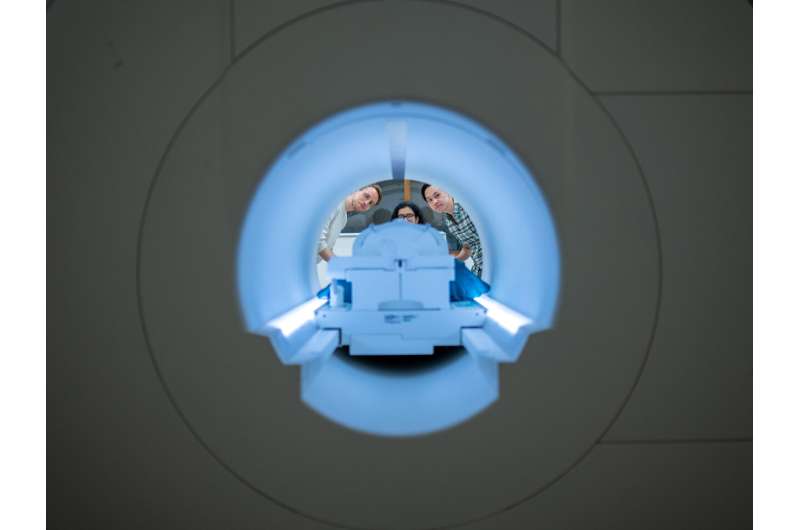
Researchers Alex Huth (left), Jerry Tang (right) and Shailee Jain (center) prepare to collect brain activity data in the Biomedical Imaging Center at The University of Texas at Austin. The researchers trained their semantic decoder on dozens of hours of brain activity data from members of the lab, collected in an fMRI scanner. Credit: Nolan Zunk/University of Texas at Austin

A new artificial intelligence system called a semantic decoder can translate a person's brain activity—while listening to a story or silently imagining telling a story—into a continuous stream of text. The system developed by researchers at The University of Texas at Austin might help people who are mentally conscious yet unable to physically speak, such as those debilitated by strokes, to communicate intelligibly again.

The study, published in the journal Nature Neuroscience, was led by Jerry Tang, a doctoral student in computer science, and Alex Huth, an assistant professor of neuroscience and computer science at UT Austin. The work relies in part on a transformer model, similar to the ones that power Open AI's ChatGPT and Google's Bard.

Unlike other language decoding systems in development, this system does not require subjects to have surgical implants, making the process noninvasive. Participants also do not need to use only words from a prescribed list. Brain activity is measured using an fMRI scanner after extensive training of the decoder, in which the individual listens to hours of podcasts in the scanner. Later, provided that the participant is open to having their thoughts decoded, their listening to a new story or imagining telling a story allows the machine to generate corresponding text from alone.

"For a noninvasive method, this is a real leap forward compared to what's been done before, which is typically single words or short sentences," Huth said. "We're getting the model to decode continuous language for extended periods of time with complicated ideas."

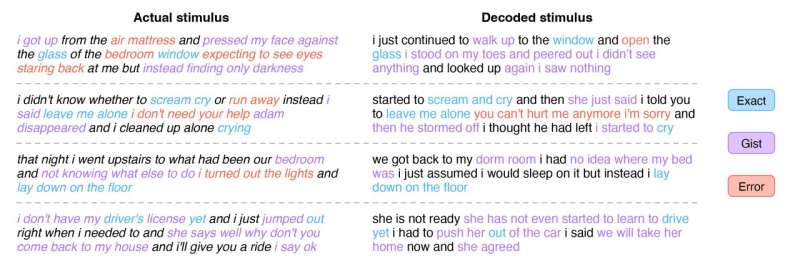
The result is not a word-for-word transcript. Instead, researchers designed it to capture the gist of what is being said or thought, albeit imperfectly. About half the time, when the decoder has been trained to monitor a participant's brain activity, the machine produces text that closely (and sometimes precisely) matches the intended meanings of the original words.

For example, in experiments, a participant listening to a speaker say, "I don't have my driver's license yet" had their thoughts translated as, "She has not even started to learn to drive yet." Listening to the words, "I didn't know whether to scream, cry or run away. Instead, I said, 'Leave me alone!'" was decoded as, "Started to scream and cry, and then she just said, 'I told you to leave me alone.'"

Brain activity decoder can reveal stories in people's minds
This image shows decoder predictions from brain recordings collected while a user listened to four stories. Example segments were manually selected and annotated to demonstrate typical decoder behaviors. The decoder exactly reproduces some words and phrases and captures the gist of many more. Credit: University of Texas at Austin

Beginning with an earlier version of the paper that appeared as a preprint online, the researchers addressed questions about potential misuse of the technology. The paper describes how decoding worked only with cooperative participants who had participated willingly in training the decoder. Results for individuals on whom the decoder had not been trained were unintelligible, and if participants on whom the decoder had been trained later put up resistance—for example, by thinking other thoughts—results were similarly unusable.

"We take very seriously the concerns that it could be used for bad purposes and have worked to avoid that," Tang said. "We want to make sure people only use these types of technologies when they want to and that it helps them."

In addition to having participants listen or think about stories, the researchers asked subjects to watch four short, silent videos while in the scanner. The semantic decoder was able to use their brain activity to accurately describe certain events from the videos.

The system currently is not practical for use outside of the laboratory because of its reliance on the time need on an fMRI machine. But the researchers think this work could transfer to other, more portable brain-imaging systems, such as functional near-infrared spectroscopy (fNIRS).

"fNIRS measures where there's more or less blood flow in the brain at different points in time, which, it turns out, is exactly the same kind of signal that fMRI is measuring," Huth said. "So, our exact kind of approach should translate to fNIRS," although, he noted, the resolution with fNIRS would be lower.

Alex Huth and Jerry Tang discuss their findings and implications, including tests of how users can protect their mental privacy, in these short audio quotes. Credit: Marc Airhart/University of Texas at Austin

The study's other co-authors are Amanda LeBel, a former research assistant in the Huth lab, and Shailee Jain, a computer science graduate student at UT Austin. Alexander Huth and Jerry Tang have filed a PCT patent application related to this work.

Frequently asked questions

Could this technology be used on someone without them knowing, say by an authoritarian regime interrogating political prisoners or an employer spying on employees? No. The system has to be extensively trained on a willing subject in a facility with large, expensive equipment. "A person needs to spend up to 15 hours lying in an MRI scanner, being perfectly still, and paying good attention to stories that they're listening to before this really works well on them," said Huth.

Could training be skipped altogether? No. The researchers tested the system on people whom it hadn't been trained on and found that the results were unintelligible.

Are there ways someone can defend against having their thoughts decoded? Yes. The researchers tested whether a person who had previously participated in training could actively resist subsequent attempts at brain decoding. Tactics like thinking of animals or quietly imagining telling their own story let participants easily and completely thwart the system from recovering the speech the person was exposed to.

What if technology and related research evolved to one day overcome these obstacles or defenses? "I think right now, while the technology is in such an early state, it's important to be proactive by enacting policies that protect people and their privacy," Tang said. "Regulating what these devices can be used for is also very important."

More information: Semantic reconstruction of continuous language from non-invasive brain recordings, Nature Neuroscience (2023). DOI: 10.1038/s41593-023-01304-9

Citation: Brain activity decoder can reveal stories in people's minds (2023, May 1) retrieved 2 May 2023 from https://ift.tt/c5FbrMg

This document is subject to copyright. Apart from any fair dealing for the purpose of private study or research, no part may be reproduced without the written permission. The content is provided for information purposes only.

Adblock test (Why?)

Article From & Read More ( Brain activity decoder can reveal stories in people's minds - Medical Xpress )
https://ift.tt/xUQWow9
Science

Monday, May 1, 2023

Webb Finds Water Vapor, But From a Rocky Planet or Its Star? - NASA

[unable to retrieve full-text content]

Webb Finds Water Vapor, But From a Rocky Planet or Its Star?  NASAView Full Coverage on Google News Article From & Read More ( Webb Finds Water Vapor, But From a Rocky Planet or Its Star? - NASA )
https://ift.tt/wOr6Moj
Science

Stephen Hawking warned AI could mean the 'end of the human race' in years leading up to his death - New York Post

Long before Elon Musk and Apple co-founder Steve Wozniak signed a letter warning that artificial intelligence poses “profound risks” to humanity, British theoretical physicist Stephen Hawking had been sounding the alarm on the rapidly evolving technology.

“The development of full artificial intelligence could spell the end of the human race,” Hawking told the BBC in an interview in 2014.

Hawking, who suffered from amyotrophic lateral sclerosis (ALS) for more than 55 years, died in 2018 at the age of 76. Though he had critical remarks on AI, he also used a very basic form of the technology in order to communicate due to his disease, which weakens muscles and required Hawking to use a wheelchair.

Hawking was left unable to speak in 1985 and relied on various ways to communicate, including a speech-generating device run by Intel, which allowed him to use facial movements to select words or letters that were synthesized to speech.

Hawking’s comment to the BBC in 2014 that AI could “spell the end of the human race” was in response to a question about potentially revamping the voice technology he relied on. He told the BBC that very basic forms of AI had already proven powerful but creating systems that rival human intelligence or surpass it could be disastrous for the human race.

“It would take off on its own and re-design itself at an ever-increasing rate,” he said.

Stephen Hawking as he host press conference to announce Breakthrough Starshot, a new space exploration initiative, at One World Observatory on April 12, 2016 in New York City.
Stephen Hawking as he hosts a press conference to announce Breakthrough Starshot, a new space exploration initiative, at One World Observatory on April 12, 2016, in New York City.
Bryan Bedder

“Humans, who are limited by slow biological evolution, couldn’t compete and would be superseded,” Hawking added.

Months after his death, Hawking’s final book hit the market. Titled “Brief Answers to the Big Questions,” his book provided readers with answers to questions he was frequently asked. The science book hashed out Hawking’s argument against the existence of God, how humans will likely live in space one day and his fears over genetic engineering and global warming.

Artificial intelligence also took a top spot on his list of “big questions,” arguing that computers are “likely to overtake humans in intelligence” within 100 years.

Elon Musk attends The 2022 Met Gala Celebrating "In America: An Anthology of Fashion" at The Metropolitan Museum of Art on May 02, 2022 in New York City.
Elon Musk attends The 2022 Met Gala Celebrating “In America: An Anthology of Fashion” at The Metropolitan Museum of Art on May 2, 2022 in New York City.
Getty Images for The Met Museum/

“We may face an intelligence explosion that ultimately results in machines whose intelligence exceeds ours by more than ours exceeds that of snails,” he wrote.

He argued that computers need to be trained to align with human goals, adding that not taking the risks associated with AI seriously could potentially be “our worst mistake ever.”

“It’s tempting to dismiss the notion of highly intelligent machines as mere science fiction, but this would be a mistake — and potentially our worst mistake ever.”

Hawking’s remarks echo concerns this year from tech giant Elon Musk and Apple co-founder Steve Wozniak in a letter released in March. The two tech leaders, along with thousands of other experts, signed a letter that called for an at least six-month pause on building AI systems more powerful than OpenAI’s GPT-4 chatbot.

Professor Stephen Hawking attends the gala screening of "Hawking" on the opening night of the Cambridge Film Festival held at Emmanuel College on September 19, 2013 in Cambridge, Cambridgeshire.
Professor Hawking attends the gala screening of “Hawking” on the opening night of the Cambridge Film Festival held at Emmanuel College on Sept. 19, 2013 in Cambridge, Cambridgeshire.
Getty Images

“AI systems with human-competitive intelligence can pose profound risks to society and humanity, as shown by extensive research and acknowledged by top AI labs,” reads the letter, published by nonprofit Future of Life.

OpenAI’s ChatGPT became the fastest-growing user base with 100 million monthly active users in January as people across the world rushed to use the chatbot, which ​​simulates human-like conversations based on prompts it is given. The lab released the latest iteration of the platform, GPT-4, in March. 

Despite calls to pause research at AI labs that are working on tech that would surpass GPT-4, the release of the system served as a watershed moment that reverberated across the tech industry and catapulted various companies to compete on building their own AI systems.

Google is working to overhaul its search engine and even create a new one that relies on AI; Microsoft has rolled out the “new Bing” search engine described as users’ “AI-powered copilot for the web”; and Musk said he will launch a rival AI system that he described as “maximum truth-seeking.”

Hawking advised in the year prior to his death that the world needed to “learn how to prepare for, and avoid, the potential risks” associated with AI, arguing that the systems “could be the worst event in the history of our civilization.” He did note, however, that the future is still unknown and AI could prove beneficial for humanity if trained correctly.

“Success in creating effective AI could be the biggest event in the history of our civilization. Or the worst. We just don’t know. So, we cannot know if we will be infinitely helped by AI, or ignored by it and sidelined, or conceivably destroyed by it,” Hawking said during a speech at the Web Summit technology conference in Portugal in 2017.

Adblock test (Why?)

Article From & Read More ( Stephen Hawking warned AI could mean the 'end of the human race' in years leading up to his death - New York Post )
https://ift.tt/ZsYlqC4
Science

Search

Featured Post

Two meteor showers will peak tonight. How to watch the Southern Delta Aquariids and the Alpha Capricornids. - Yahoo

[unable to retrieve full-text content] Two meteor showers will peak tonight. How to watch the Southern Delta Aquariids and the Alpha Caprico...

Postingan Populer