Rechercher dans ce blog

Sunday, June 4, 2023

Do all animals go through adolescence? - Livescience.com

Looking back on our teenage years often elicits a grimace — it's an awkward time, full of social faux pas, uncertainty and acne — but it's one that we all must pass through on our way to adulthood. 

But do other animals also experience adolescence? This period of life comprises both physiological and social changes. Unquestionably, other animals experience puberty, the cascade of hormonal and physiological changes that enable mating. But researchers such as Dr. Barbara Natterson-Horowitz, a cardiologist and evolutionary biologist at the University of California, Los Angeles, and Harvard University, argue that most, if not all, animals experience a period of adolescence too — what Natterson-Horowitz calls "wildhood" — that also includes the social shifts that youngsters must navigate as they transition into adulthood.

Years allocated to adolescence in the life history of chimpanzees (Pan troglodytes) compared with three widely studied model species: Rhesus macaques (Macaca mulatta), laboratory rats (Rattus norvegicus) and laboratory mice (Mus musculus). (Image credit: Reddy et al. (2022))

For a long time, adolescence was thought to be unique to humans, Natterson-Horowitz told Live Science. "But the more you peel that back, the more you find that while there are certain aspects of adolescence that are uniquely human, that period of transition that starts with the onset of puberty and ends when a mature adult emerges — that's universal."

Perhaps not surprisingly, in the species that are most closely related to us, such as chimpanzees (Pan troglodytes), some of these changes are easily recognizable to humans. Aaron Sandel, a biological anthropologist and primatologist at the University of Texas at Austin, published a paper showing that young chimps experience a growth spurt that leaves them clumsy as they adjust to their new bodies.

Related: Do any animals know their grandparents?

During adolescence, young Laysan albatross (Phoebastria immutabilis) learn intricate courtship behaviors by watching experienced adults and then practicing with their peers.  — Barbara Natterson-Horowitz

At the same time, these juveniles are learning to integrate into adult society. They begin spending less time with their parents and more time with their peers, including members of the opposite sex. Young male chimps aren't aggressive during this time, deferring instead to the guidance of older adult chimps that serve as mentors and teach them social cues. "It's a period where you're really attentive to what will give you status and you're really attentive to what it means to be an adult," Sandel said.

But do these characteristics extend beyond our closest relatives? Indeed, scientists have documented forms of adolescence across the animal kingdom that highlight how common this period may be.

Christine Ribic, a landscape ecologist at the University of Wisconsin-Madison, found that young grassland birds buck the "early bird gets the worm" trend and instead sleep late into the day, "mooching food off of their parents for as long as possible" before they finally go out on their own. Even after fledgling, young birds are not always self-sufficient. Other researchers have noted that, in challenging years, juvenile Gentoo penguins (Pygoscelis papua) return to their parents for help, mirroring a trend of young adults moving back in with their parents amid an economic downturn.

Gentoo penguin juveniles sometimes return to their parents for help before they reach adulthood. (Image credit: Manuel ROMARIS via Getty Images)

Animal experiments have also demonstrated how juveniles become more tolerant of risk. Young rats raised on the same nutritious diet as their mothers will intentionally choose to eat less-tasty foods, or even ones that make them sick, to fit in with a group of peers, and adolescent mice drink more alcohol among peers than they do when alone. When in groups, many animals — including fish, gazelles and bats — engage in predator inspection, in which packs of juveniles intentionally approach a predator. This group think is the same reason new drivers usually aren't allowed to drive with their friends in the car for a period of time after getting their license.

While we should be mindful of projecting our own biases and judgments onto other animals, probing these links between humans and their wild kin can be unifying and may help us navigate our own challenges, Natterson-Horowitz said. 

"It really is recognizing that whatever struggles you may be going through, there's an animal and an evolutionary story behind them — that actually, adolescence has a function," which is to help animals survive and thrive in adulthood," she said. "Their struggles are not exactly the same as humans', but there are some pretty remarkable similarities in what they're going through."

Adblock test (Why?)

Article From & Read More ( Do all animals go through adolescence? - Livescience.com )
https://ift.tt/PUfRKT5
Science

Saturday, June 3, 2023

The strawberry moon will illuminate the sky this weekend - CNN

Sign up for CNN’s Wonder Theory science newsletter. Explore the universe with news on fascinating discoveries, scientific advancements and more.

CNN  — 

The strawberry moon will light up the night sky this weekend.

You can watch the full moon’s rise just after sunset in the southeast direction. The orb will reach peak illumination at 11:42 p.m. ET Saturday and appear full for three days, according to NASA. Find out your local peak time using The Old Farmer’s Almanac’s full moon calculator and check the local forecast.

The name of this last full moon of the spring, which is sometimes the first full moon of the summer, has nothing to do with the moon’s appearance or color. The strawberry moon got its name from Native American tribes “to mark the ripening of ‘June-bearing’ strawberries that are ready to be gathered,” according to The Old Farmer’s Almanac, which notes, “As flowers bloom and early fruit ripens, June is a time of great abundance for many.”

This year, according to NASA, some moon gazers will get an additional treat. People in Argentina and the Atlantic Daylight Time zones “eastward across the rest of North America, Europe, Africa, Asia, and Australia to the International Date Line in the mid-Pacific” will see Antares, the most luminous star in the Scorpius constellation, a few degrees right of the moon.

What’s more, at dusk Saturday two striking planets will be on display.

“We can see Venus setting in the west,” said Mike Hankey, operations manager for the American Meteor Society, via email. “This will appear as a ‘very bright star’ near the horizon. It is the brightest object in the sky next to the sun and moon. Mars is also visible just next to Venus and can be seen at dark and will look like a dim reddish star to the top left of Venus.”

June full moon and traditions

People of other regions have also given the June moon names that represent their seasonal or cultural customs — such as the Europeans’ honey moon since June “was traditionally the month of marriage, and is even named after the Roman goddess of marriage, Juno,” according to The Old Farmer’s Almanac.

For believers of Hinduism, this moon and the three days it appears full mark Vat Purnima, when women demonstrate their love for their husbands by “tying a ceremonial thread around a banyan tree,” according to NASA.

The strawberry full moon isn’t your last chance to catch a cool celestial event this year. Here are the full moons, eclipses and meteor showers to watch out for through the rest of 2023.

Full moons and supermoons

Most years have 12 full moons, but 2023 will have 13, with two — which are supermoons — happening in August. Supermoons are brighter and closer to Earth than normal and therefore appear larger in the sky. There are four supermoon events in 2023, including one on July 3 and September 29.

Here are the full moons remaining in 2023, according to the Farmer’s Almanac:

● July 3: Buck moon

● August 1: Sturgeon moon

● August 30: Blue moon

● September 29: Harvest moon

● October 28: Hunter’s moon

● November 27: Beaver moon

● December 26: Cold moon

Lunar and solar eclipses

An annular solar eclipse will occur on October 14 and be visible for people across North, Central and South America. This is when the moon passes between the sun and Earth at or near its farthest point from Earth — making the moon appear smaller than the sun and creating a glowing ring around the moon.

When viewing solar eclipses, wear eclipse glasses to avoid eye-damaging sunlight.

On October 28, a partial lunar eclipse will be viewable by people in Europe, Asia, Australia, Africa, parts of North America and much of South America. In this type of event, the sun, Earth and moon don’t completely align, so only part of the moon passes into shadow.

Meteor showers

There are nine more meteor showers that peak this year, all of which are most visible from late evening until dawn in areas without light pollution. Catch these events on their peak dates:

● Southern Delta Aquariids: July 30-31

● Alpha Capricornids: July 30-31

● Perseids: August 12-13

● Orionids: October 20-21

● Southern Taurids: November 4-5

● Northern Taurids: November 11-12

● Leonids: November 17-18

● Geminids: December 13-14

● Ursids: December 21-22

Adblock test (Why?)

Article From & Read More ( The strawberry moon will illuminate the sky this weekend - CNN )
https://ift.tt/XxTlSYN
Science

Earth picked up a new moon about 2,100 years ago. Astronomers just found it - National Post

Article content

Earth has a new moon. Or, to be more precise, a quasi-moon.

Article content

A tiny asteroid discovered this year, dubbed 2023 FW13, has been found to circle the sun in sync with the Earth, in an eccentric orbit that takes it halfway to neighbouring Mars and Venus while it executes a long, lazy orbit around our planet.

The little moon is only about 20 metres wide and never comes closer than about 14 million km from Earth, so it’s too small to be seen with the naked eye. It was discovered by the Pan-STARRS survey telescope on the Hawaiian island of Maui, and confirmed by the Minor Planet Center on April 1.

Earth’s main moon, in comparison, has a diameter of 3,500 km, and orbits the Earth at an average distance of about 380,000 km. 2023 FW13 is some 36 times farther away at the nearest point in its orbit.

Scientists calculated the path of the space rock and hypothesized that it’s been circling the Earth for at least 2,100 years and will keep it up for another 1,700 years or so until it wanders off into deep space again. “It seems to be the longest quasi-satellite of Earth known to date,” French astronomer Adrien Coffinet told Sky & Telescope magazine after running the numbers on the moonlet.

Article content

Alan Harris of the Space Science Institute noted that, with an estimated 2 million near-Earth asteroids of 2023 FW13’s size or larger, the odds are that there are several quasi-moons circling the Earth at any one time.

In fact, in 2016 astronomers discovered another quasi-moon, 2016 HO3, which eventually took the name Kamo’oalewa, a Hawaiian word meaning “oscillating fragment.” It’s been a companion of Earth for at least a hundred years and is expected to hang around for several hundred more.

Scientists think Kamo’oalewa may be a piece of the moon that was knocked off by an asteroid collision. China plans to launch a probe to visit the roughly 50-metre wide moonlet in 2025 and collect a sample.

  1. An image from the International Gemini Observatory in Hawaii shows new moon 2020 CD3 as a white spot against a background of stars, which appear as trails because the telescope tracked the new moon.

    New moon 2020 CD3 is no match for our old Moon

  2. The launch site for China's Shenzhou-16 and Long March-2F rocket is seen at the Jiuquan Launch Centre on May 29.

    China plans to land astronauts on moon before 2030

Adblock test (Why?)

Article From & Read More ( Earth picked up a new moon about 2,100 years ago. Astronomers just found it - National Post )
https://ift.tt/nQYztbj
Science

Friday, June 2, 2023

European Space Agency hosts first Mars live stream - CNN

CNN  — 

Here is Mars in real time.

The European Space Agency is streaming on YouTube the first live images directly from Mars.

Over the course of an hour, new images of Mars are expected about every 50 seconds, according to statement from the agency. Updates will also be available at ESA’s Twitter account and the hashtag #MarsLIVE, the agency said.

The images, shared on YouTube, ESA’s Twitter account and with #MarsLIVE, will show the planet as it has never been seen before, ESA said.

The event is celebrating the 20th anniversary of the launch of the agency’s Mars Express orbiter — a mission to take three-dimensional images of the planet’s surface to see it in more complete detail.

“Normally, we see images from Mars and know that they were taken days before,” said James Godfrey, spacecraft operations manager at ESA’s mission control center in Darmstadt, Germany, in a statement. “I’m excited to see Mars as it is now — as close to a martian ‘now’ as we can possibly get!”

But haven’t we seen images of Mars before? Yes, but not live, the ESA said.

Often data and observations of the red planet are taken when a spacecraft is not in direct contact with Earth, so the images are stored until they can be sent back, ESA said.

Depending on where Mars and Earth are in their orbits around the sun, the messages that journey through space can take anywhere from 3 to 22 minutes.

The ESA estimated it would take about 17 minutes for the light needed to form the images to travel directly from Mars to Earth and then another minute to get through the wires and servers on the ground to get the livestream started, the agency said.

ESA shared images it deemed as close to live as physically possible during a June 2, 2023, event. The images were pinged back to Earth with about a 16-minute delay, or as much time as it takes for the information to travel between Mars and Earth.

“Note, we’ve never tried anything like this before, so exact travel times for signals on the ground remain a little uncertain,” the agency said in a statement.

No stars were visible in the background of the images because Mars is quite bright, noted Colin Wilson, a project scientist at ESA.

“If you’re very close to it, it is even brighter,” Wilson noted, and that obscures the surrounding stars in this particular angle the spacecraft is snapping images from.

But, if you were on the Mars Express spacecraft, you would be able to see much of the cosmos, Wilson added. “And that is in fact critical to how Mars Express navigates,” he said. The spacecraft uses an on board map and its imaging of the stars to orient itself in space, much the way humans have navigated the oceans going back centuries.

For some time, the transmissions from Mars were interrupted, the ESA scientists noted, as a ground station near Madrid experienced bad weather.

Mars appeared to move across the image frames throughout the live stream, as the Mars Express spacecraft moved past the planet. The back part of the planet also appeared shaded because it was in Martian night, much as half the Earth is in darkness at any given point in time.

Adblock test (Why?)

Article From & Read More ( European Space Agency hosts first Mars live stream - CNN )
https://ift.tt/QYSkvO2
Science

World's 1st 'hacking sandbox' satellite and more to ride on SpaceX's next NASA cargo launch - Space.com

SpaceX's 28th commercial resupply mission (CRS-28) is poised to launch new science experiments and provisions to the International Space Station (ISS) on Saturday (June 3). 

The CRS-28 cargo mission is set to liftoff in a SpaceX Cargo Dragon capsule atop one of the company's Falcon 9 rockets at 12:35 p.m. EDT, from Launch Complex-39A at NASA's Kennedy Space Center in Florida. After a short stint playing orbital catch-up, the spacecraft is scheduled to rendezvous with the ISS around 5:30 a.m. ET (0930 GMT) on Monday, June 5.

CRS-28 will carry research, logistical supplies and necessities to the Expedition 69 crew currently aboard the ISS, according to a NASA briefing on the mission Tuesday (May 30). In addition to the host of new experiments headed to the laboratory in low-Earth orbit, CRS-28 will also resupply over 30 ongoing investigations already aboard the ISS, according to ISS chief scientist Kurt Costello.

Costello described the mission manifest as "a very good mix of biological payloads, tech demos and some earth science monitoring." Indeed, the new research headed to the station includes studies exploring DNA changes in microgravity, automated spacecraft docking prototypes, a study into blue energy discharges from thunderstorms, a handful of cubesats from student project groups across Canada and the IROSA solar arrays to augment electricity generation at the station. 

Related: International Space Station — Everything you need to know

Moonlighter, one of the cubesats launching on SpaceX's CRS-28 mission, was developed to enable real-time cybersecurity testing in orbit. (Image credit: Aerospace Corporation)

Six cubesats are launching on CRS-28, and will be released into orbit as a part of the Nanoracks-26 mission. One cubesat, named Moonlighter, is being flown as a cybersecurity testing target. It was developed by the Aerospace Corporation with help from the Air Force Research Laboratory and Space Systems Command, who are challenging industry professionals to compete to successfully hack the small satellite in order to test cybersecurity systems in space.

The issue of satellite cybersecurity became even more relevant after SpaceX CEO Elon Musk reported last year that Starlink satellites in Ukraine are experiencing a high level of cyberattacks from Russia.

Plant Habitat-03 (PH-03) is a project led by University of Florida researchers Dr. Ann-Lisa Paul and Robert Ferl, and comes from the 2022 Genes in Space competition winner Pristine Onohua. Onohua is a student at East Chapel Hill High School in North Carolina, and her project was selected from amongst over 600 proposals from students ranging in grades 7-12. 

PH-03 focuses on measuring telomeres. Telomeres are genetic structures that function to protect chromosomes. Over time, these structures shorten and wear with age, but telomeres have been observed to lengthen while in space. That discovery was made through NASA's Twin Study with astronauts Scott and Mark Kelly, whose telomeres were measured and compared to one another's following Scott's year in space. 

A previous study flown to the ISS using a plant called arabidopsis thaliana observed the the same genetic changes to the length of their telomeres. Paul explained the versatility of that particular plant during Tuesday's briefing. 

"It is a member of a mustard family. And so it's really closely related to things like well, mustard greens and collard greens and broccoli and, and a lot of the things that do comprise the crop venue for for exploration habitats," Paul said. "And so a lot of things that we are learning about how arabidopsis responds to spaceflight is directly translatable to how similar family crop plants will also respond."

Advanced Plant Habitat (APH) during experiment verification testing for the Plant Habitat-03 investigation. The image shows the arabidopsis plants growing in the APH just before the four seed bags are installed.  (Image credit: Anna-Lisa Paul)

Seedlings from the previously flown arabidopsis thaliana are now being sent as a part of PH-03. The project will test methods for measuring telomeres in space, the process for which gets complicated when you remove gravity, and also whether or not any of the mutated genes from the first generation of arabidopsis thaliana was passed down to these new, space-bound samples. 

Also stowed within the hold for CRS-28 is University of Southern California docking prototype CLINGERS. Once aboard the ISS, CLINGERS will be making quick robotic friends with the station's resident Astrobee helper-droids. CLINGERS is designed to test a new autonomous rendezvous system that enables both active and passive docking.

The test hardware for the CLINGERS experiment launching aboard the CRS-28 cargo mission to the ISS. (Image credit: USC Space Engineering Research Center)

CLINGERS will float alongside the Astrobees to test its maneuverability software. If successful, the system could allow future space stations modules to configure and arrange themselves with other modules, allowing for far easier on-orbit assembly. 

Thor-Davis is a project from the European Space Agency (ESA) to investigate newly discovered blue discharges that occur in high altitudes above thunderstorms. "We want to take advantage of the vantage point of the International Space Station," said Thor-Davis principal investigator Olivier Chorion during the mission briefing. "Since from from there, we can look at thunderstorms from above. In fact, with this investigation, we want to focus on the activity at the top of the clouds and above."

The five other cubesats flying on CRS-28 are all student-led projects supported by the Canadian Space Agency (CSA) under the Canadian CubeSat Project (CCP). "It's a very exciting moment for several young Canadian students who worked very hard over the past five years to design and build their cubesat," said CSA's manager of space science and technology Tony Pellerin. 

The stated primary goal for each of the student groups' cubesat missions is also the cornerstone of the CCP mission to empower Canadian students to take part in real-life space missions. However, each of the CRS-28 cubesats' mission focus differs from the others. 

RADSAT was designed by students from the University of Saskatchewan to test a new kind of radiation dosimeter. An onboard camera was also included to capture orbital views of Saskatchewan in the hopes of sharing the images with the Canadian province. 

Equipped with a different kind of camera, the UKPIK cubesat comes from the Western University - Nunavut Arctic College in Ontario. UKPIK will fly with a virtual reality camera attached, and researchers are hoping to give NAC students the opportunity to operate an immersive virtual reality experience. 

SC-ODIN, from Concordia University in Quebec, is Space Concordia's Orbital Dust Imaging Nanosat. SC-ODIN researchers hope to characterize aerosol particles from dust storms near Lake Colhué Huapí in Argentina, and Namibian coastal regions.

"Two of these missions, ESSENCE and IRIS carry novel science payloads," explained Pellerin during the CRS-28 press call. ESSENCE is an Earth observation mission from New York University in Ontario. The mission will monitor permafrost thaws and deterioration in Canada's northern regions. The probe also carries an instrument for measuring the density of solar protons, charged particles shot out of the sun during coronal mass ejections.

"This type of mission will bring great benefits to Canadians, and not only Canadians, but the world population, in making sure that we understand those climate change effects," Pellerin said.

RELATED STORIES:

The IRIS cubesat was developed by research students at the University of Manitoba and middle school students in Canada. IRIS contains 20 geological samples that will be monitored for their deterioration when exposed to an in-space environment. For comparison, observation of the materials will be used alongside analyses of past asteroid samples to help better understand asteroid origins and the effects space has on other planetary bodies. 

CRS-28 arrives on the heels of a recent departure from the ISS. Axiom Space's second crewed mission to the station (Ax-2) departed from its berth at the orbital lab, returning four private astronauts from an eight-day mission. 

The CRS-28 cargo Dragon will occupy the zenith docking port on the ISS's Harmony for about a month before splashing down off the coast of Florida to return experiment samples and station waste from ongoing crew rotations.  

Adblock test (Why?)

Article From & Read More ( World's 1st 'hacking sandbox' satellite and more to ride on SpaceX's next NASA cargo launch - Space.com )
https://ift.tt/4ETQtYy
Science

Don't Miss the Star-Studded June Sky: Mars, Venus, Spica, Arcturus, and the Summer Triangle! - SciTechDaily

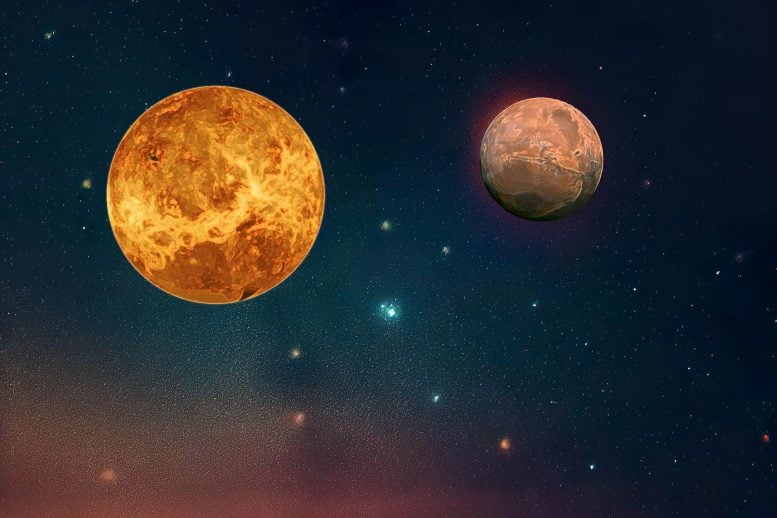
Illustration of Venus and Mars

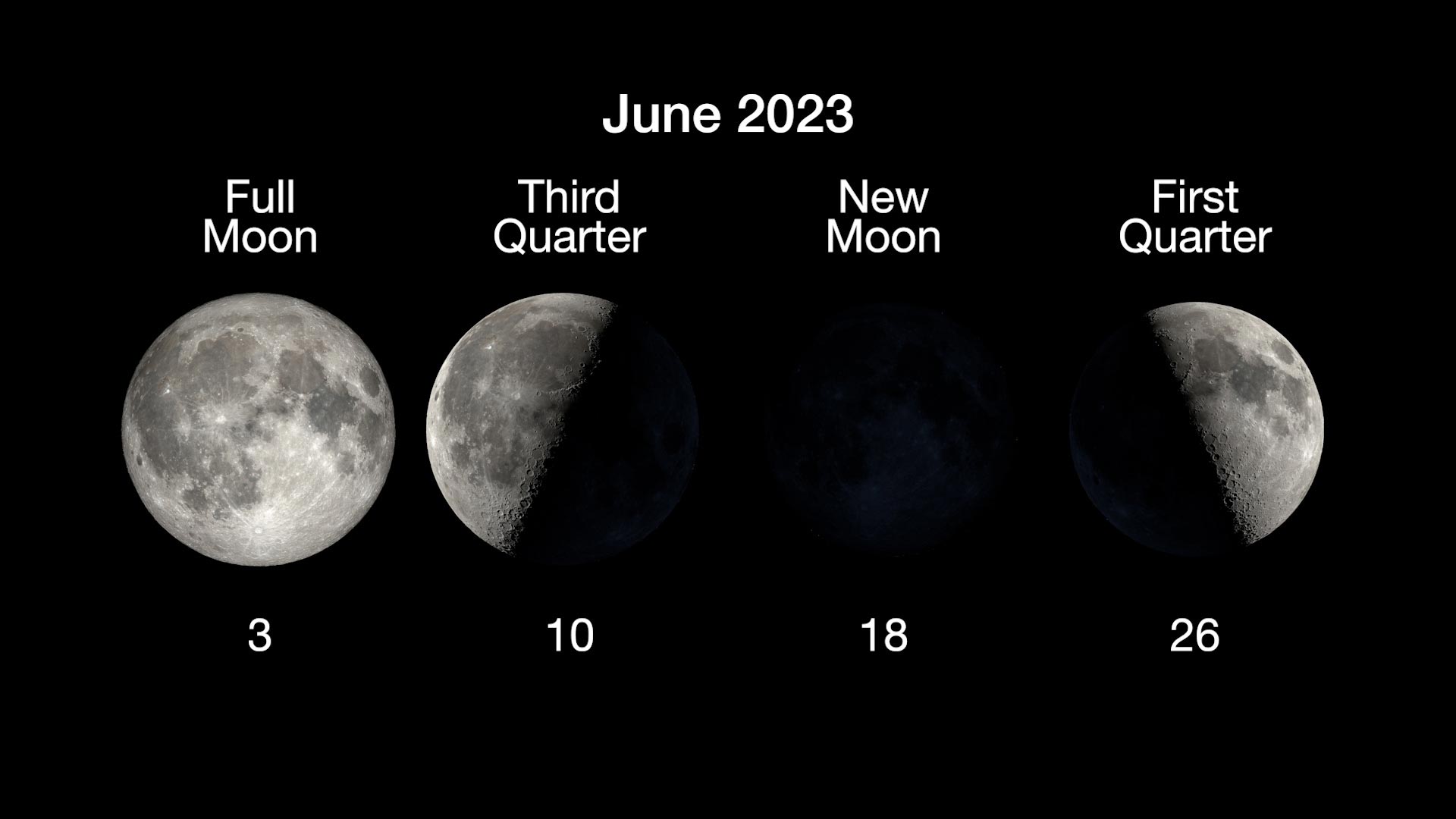
In June 2023, skywatching highlights include the nearing of Mars and Venus, the leading of Saturn into the dawn by Jupiter, and the bright evening stars Spica and Arcturus. Key events are Mars in the Beehive Cluster on June 1-2, a full moon on June 3, a new moon on June 18, and the June solstice on June 21, which also marks a unique alignment of the crescent Moon, Venus, and Mars.

Mars and Venus, Summer Stars, and the June Solstice!

The planets of war and love draw nearer each night, as the bright stars of Northern Hemisphere summer rise. And note the June solstice on the 21st.

What are some skywatching highlights in June 2023?

Mars and Venus draw closer throughout the month, while Saturn leads Jupiter into the morning sky. Bright stars Spica and Arcturus shine brightly overhead on June evenings, along with the Summer Triangle. And the June solstice, on the 21st, has a special claim to fame.

Monthly Highlights

  • June 1-2 – Mars is in the Beehive Cluster (M44). Look for the Red Planet in the west after dark, where binoculars or a small telescope will reveal a backdrop of glittering stars in this open star cluster.
  • June 3 – Full moon
  • June 18 – New moon
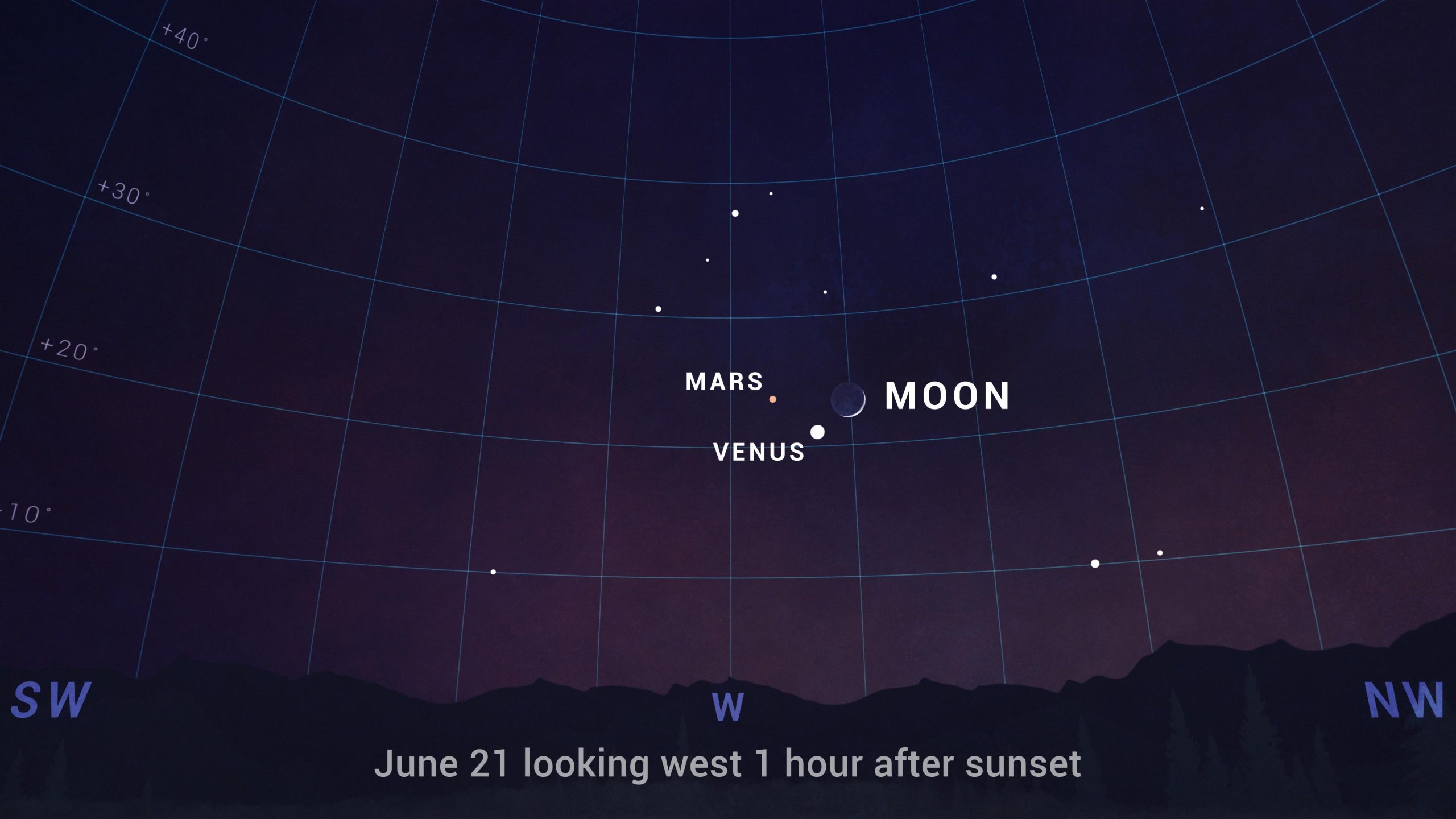
  • June 21 – The crescent Moon makes a lovely grouping with Venus and Mars tonight. Find them in the west following sunset.
  • June 21 – June Solstice. For the north, it’s the longest day of the year, as the Sun traces its highest, longest path across the sky. The situation is reversed in the Southern Hemisphere, where it’s the shortest day of the year, during the cool months of winter.
  • All month – Mars and Venus draw nearer each evening in the western sky following sunset. The pair will appear a bit lower in the sky each night.
  • All month – Saturn leads Jupiter into the new day. The Ringed Planet rises around midnight, with Jupiter trailing behind a couple of hours later.
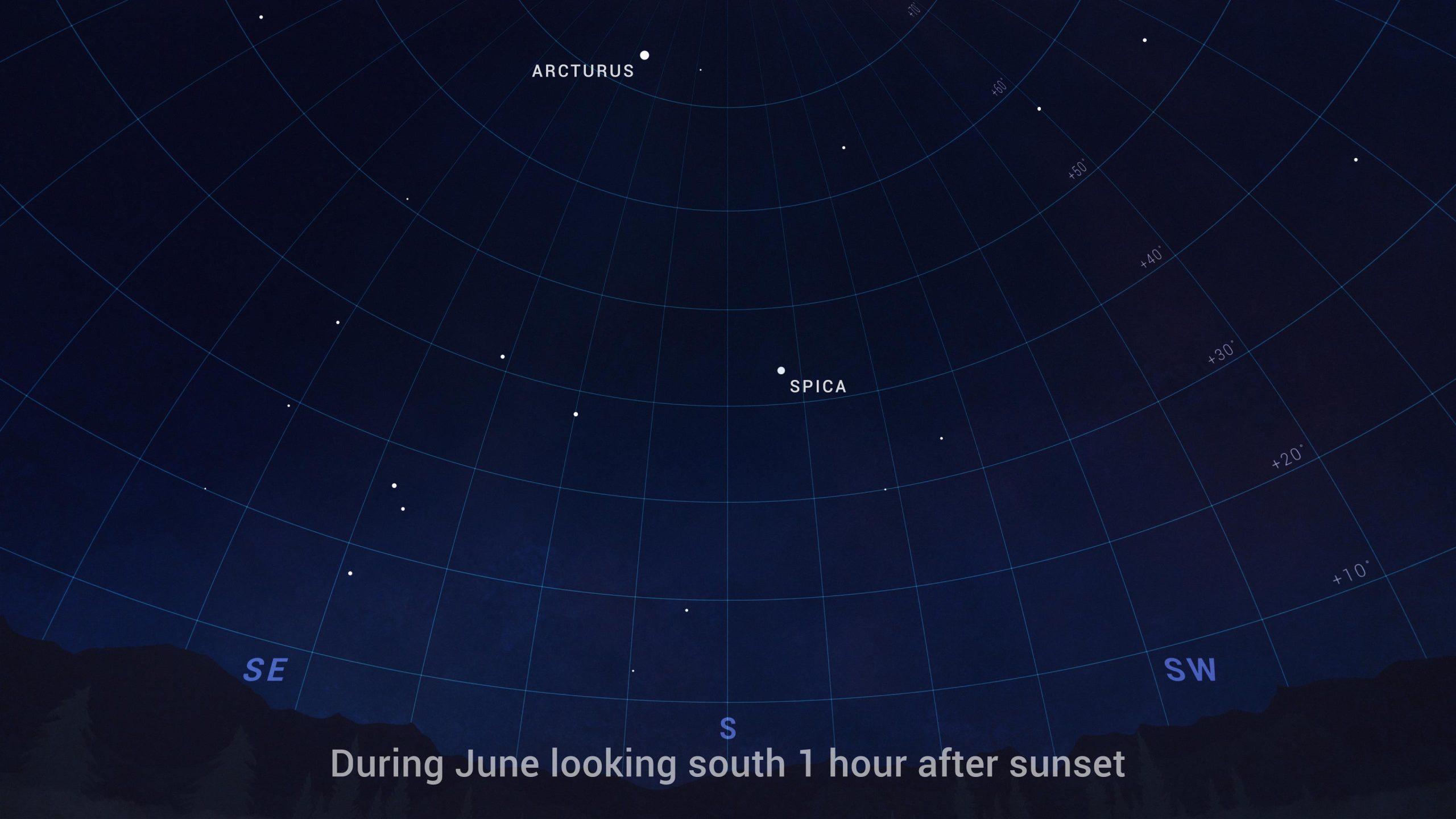
  • All month – The two bright stars high overhead in the first few hours after dark are Spica and Arcturus (for Northern Hemisphere skywatchers).
    • Southern Hemisphere observers will find bright stars Alpha Centauri and Hadar, along with the stars of constellation Crux, in their south-facing view.
  • All month – Notice the stars of the Summer Triangle – Vega, Deneb, and Altair – rising in the east in the couple of hours after dark. They rise earlier each month throughout the summer.

Video Transcript

What’s Up for June? Planets buzz the Beehive, your bright evening stars, and how the Summer Solstice revealed the size of planet Earth.

June 2023 Sky Chart Looking West

Sky chart with the crescent Moon near Mars and Venus in the evening sky on June 21. Credit: NASA/JPL-Caltech

On June 1st and 2nd, Mars will be in the Beehive. The Red Planet passes through the Beehive Cluster, also known as Praesepe or M44. It’s a well-known open cluster of stars located around 600 light-years away in the constellation Cancer, the crab. The pairing will make for great viewing through binoculars or a small telescope, with a sparkle of faint stars surrounding the rust-colored disk of Mars.

You can watch Mars and Venus draw closer together throughout the month in the western sky following sunset. Nearby is brilliant, blue-white star Regulus – the heart of Leo, the lion. And on the 20th through the 22nd the crescent Moon passes through, making an especially lovely grouping at dusk on June 21st.

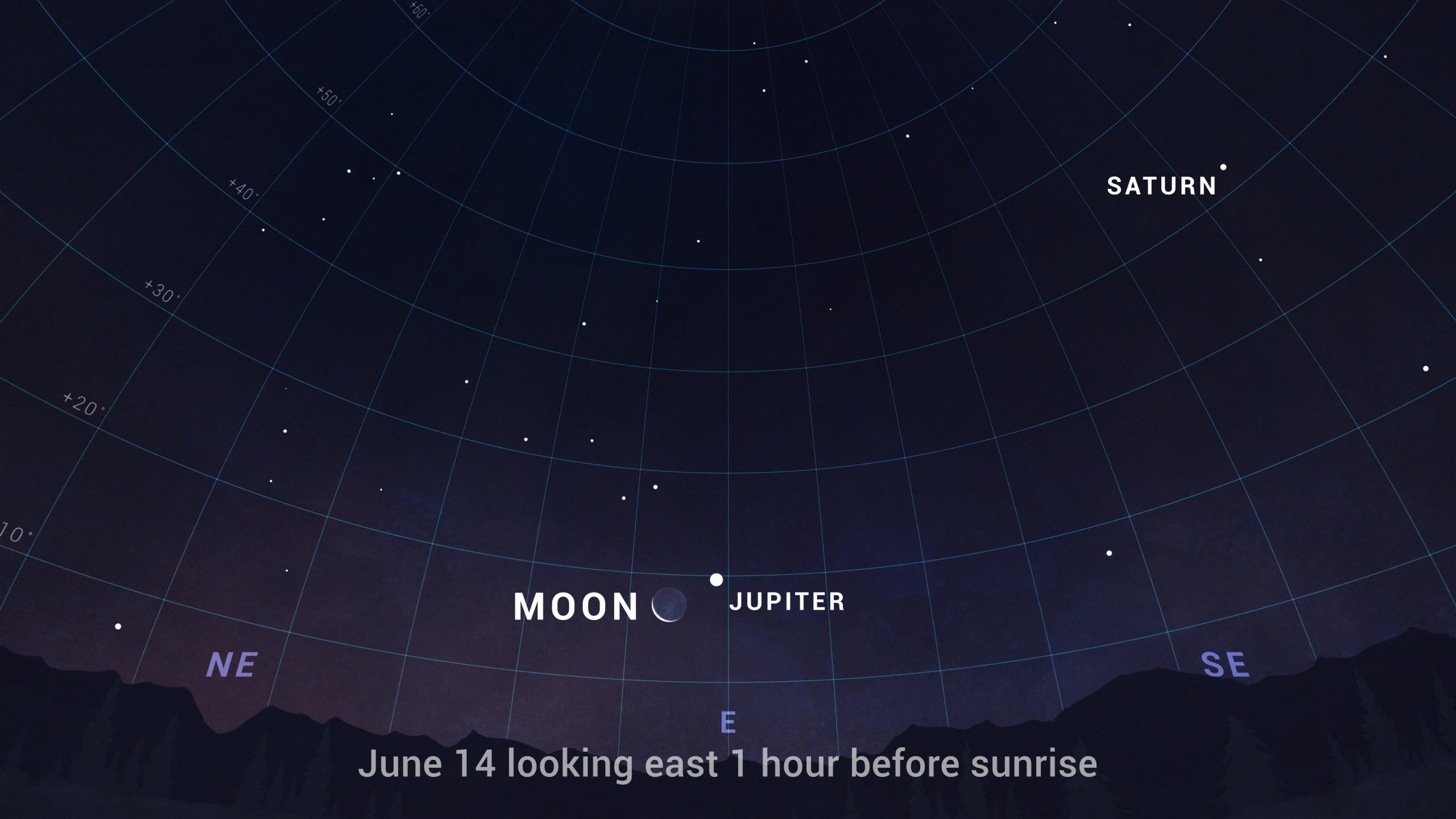
Turning to the morning sky, Saturn and Jupiter rise before dawn, with the Ringed Planet rising around midnight and leading brilliant Jupiter into the new day. Early risers will find them on the eastern side of the sky before sun-up all month long. And you’ll find Jupiter rising with the crescent Moon on June 14th.

June 2023 Sky Chart Looking South

Facing south on June evenings, the bright stars Northern Hemisphere observers will notice are Spica and Arcturus. Credit: NASA/JPL-Caltech

Facing southward early on June evenings, you’ll notice two particularly bright stars high in the sky. They are Spica and Arcturus.

Blue-white Spica is the brightest star in the constellation Virgo, the maiden. It’s located about 250 light years away, and is actually two stars orbiting each other every 4 days at a distance far closer than Mercury orbits our Sun.

Orange giant Arcturus is the brightest star in Bootes, the herdsman. It’s the fourth brightest star in the sky. It’s much closer than Spica, at a distance of about 37 light years. It’s also quite an old star, compared to our Sun, at an age of 7-8 billion years.

June 2023 Sky Chart Looking East

This sky chart for June 14 shows Jupiter with the Moon in the east before sunrise, with Saturn farther up the sky toward the south. Credit: NASA/JPL-Caltech

Also on June evenings, you’ll notice the stars of the Summer Triangle – Vega, Deneb, and Altair – rising in the couple of hours after dark, and heralding the long, warm nights of Northern summer. The Triangle rises earlier each month as summer progresses.

June 21 is the Summer Solstice for the Northern Hemisphere, and Winter Solstice in the Southern Hemisphere. For the north, it’s the longest day of the year, as the Sun traces its highest, longest path across the sky. More hours of sunlight, in addition to the more direct angle of the Sun overhead, translate into warmer summertime temperatures for our planet’s summer hemisphere. The situation is reversed for those living south of the equator, where it’s the shortest day of the year, during the cool months of winter.

The June summer solstice has another interesting claim to fame. It helped the Ancient Greeks, 2,200 years ago, to understand the size of our planet with remarkable accuracy. A scholar named Eratosthenes noted the difference in the length of the shadows cast by poles placed in the ground in two cities, 800 kilometers apart, at noon on the day of the solstice. One cast no shadow at all and the other cast a significant shadow. By comparing the shadows with the separation of the two cities, Eratosthenes deduced that Earth was about 40,000 kilometers in circumference, which is the actual value.

He was also the first to calculate the tilt of Earth’s axis – which, after all, is what’s responsible for the solstices and for the seasons themselves.

Here are the phases of the Moon for June.

Moon Phases June 2023

The phases of the Moon for June 2023. Credit: NASA/JPL-Caltech

Stay up to date with all of NASA’s missions to explore the solar system and beyond at nasa.gov. I’m Preston Dyches from NASA’s Jet Propulsion Laboratory, and that’s What’s Up for this month.

Adblock test (Why?)

Article From & Read More ( Don't Miss the Star-Studded June Sky: Mars, Venus, Spica, Arcturus, and the Summer Triangle! - SciTechDaily )
https://ift.tt/suRWPDK
Science

Search

Featured Post

Two meteor showers will peak tonight. How to watch the Southern Delta Aquariids and the Alpha Capricornids. - Yahoo

[unable to retrieve full-text content] Two meteor showers will peak tonight. How to watch the Southern Delta Aquariids and the Alpha Caprico...

Postingan Populer