A giant sunspot exploded on Sunday, July 2, creating a powerful solar flare that lashed Earth's atmosphere and caused a radio blackout over parts of the U.S. and the pacific ocean.
The solar flare erupted from the sunspot AR3354 which is seven times the width of the Earth. The flare which blasted out of the sun at 15:14 EDT (1914 GMT), was seen as a bright ultraviolet flash by NASA's Solar Dynamic Observatory (SDO). It was classified as an X-flare, the strongest type of solar flare that exists.
Spaceweather.com reports that radiation from the flare ionized the top of Earth's atmosphere, resulting in a deep shortwave radio blackout over western parts of the U.S. and the Pacific Ocean that lasted around 30 minutes. Solar physicist Keith Strong shared stunning footage of the flare on Twitter, writing "X FLARE IN PROGRESS!!! Sunspot region AR3354 near the NW limb just produced an X1.07 Flare (between the 10th and 14th biggest flare so far, this solar cycle). That is the 18th X flare during SC25 [Solar cycle 25, the current solar cycle] (compared to just 14 from SC24)."
An image of the sun on July 2, 2023 showing a powerful solar flare.(Image credit: NASA/SDO)
Strong also pointed out on Twitter that June 2023 marked the highest monthly average for sunspot numbers in 21 years. In a separate tweet, the solar physicist wrotethat June 2023 marked the "HIGHEST MONTHLY AVERAGED SUNSPOT NUMBER SINCE SEPTEMBER 2002! The June 2023 SNN was 163.4 the highest value for over 20 years. The CM model is now forecasting a peak for SC25 of just under 200, the CM model at 125 (SC42 was 116). Any Grand Solar Minimum believers left out there?"
Solar flares are created when magnetic fields around sunspots become tangled, break, and then reconnect, a process called reconnection. This footage of this flare appears to show that it was helped along by a plume of plasma, causing magnetized material to land on sunspot AR3354.
An image of sunspots dotting the face of the sun on July 3, 2023 as imaged by NASA's Solar Dynamics Observatory.(Image credit: NASA/SDO)
Flares are grouped according to their strength, with the smallest flares called B-flares, which are followed by C-flares, then M-flares. The strongest class of solar flares are X-flares like that which was seen from AR3354 on Sunday.
Solar flare classes increase in strength by magnitude, much as the Richter scale ranks earthquakes. That means that an X-class flare is ten times the strength of a M-class flare, and is 1,000 more powerful than a B-class flare.
RELATED STORIES:
Long-lasting flares such as this one are sometimes accompanied by coronal mass ejections (CMEs), events in which magnetic fields lash out a huge amount of stellar material in the form of plasma shooting out from the sun.
Though Sunday's X-flare was long-lasting enough to trigger a CME, sun observatories have yet to see a significant ejection of plasma associated with either this flare or the sunspot AR3354.
Article From & Read More ( Sun blasts out powerful X-class solar flare causing radio blackouts on Earth (video) - Space.com )
https://ift.tt/Q9vyxJf
Science
ESA's Euclid space telescope was launched for a six-year mission to shed light on dark energy and matter and chart the largest-ever map of the universe.
A European space telescope blasted off on Saturday on a quest to explore the mysterious and invisible realm known as the dark universe.
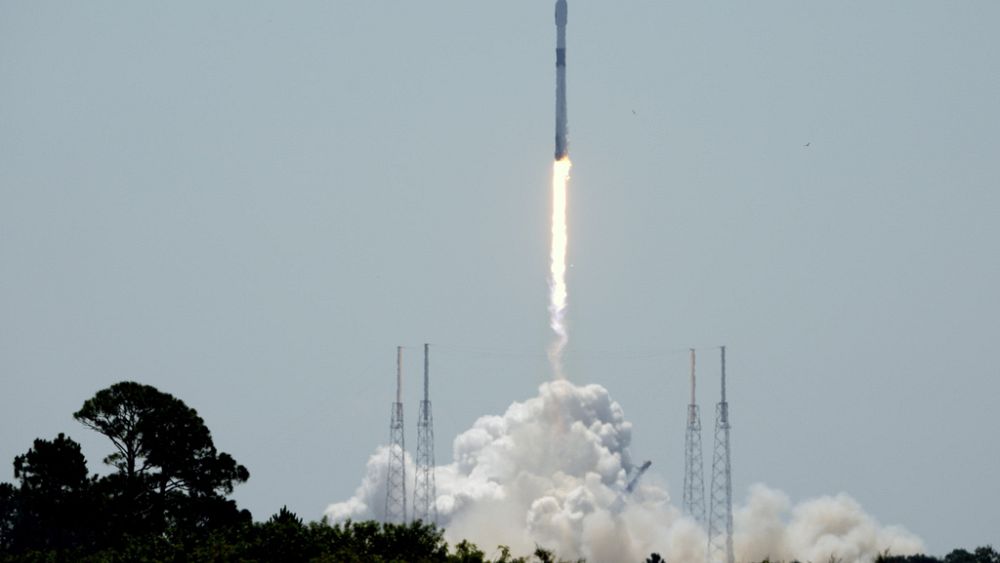
SpaceX launched the European Space Agency’s (ESA) Euclid observatory toward its ultimate destination 1.5 million km away, close to where the James Webb Space Telescope is in orbit.
It will take a month to get there and another two months before it starts its ambitious six-year survey this fall.
Flight controllers in Germany declared success nearly an hour into the flight, applauding and shouting "yes" as the telescope phoned home after a smooth lift-off.
What is Euclid's mission?
Named for antiquity's Greek mathematician, Euclid will scour billions of galaxies covering more than one-third of the sky.
By pinpointing the location and shape of galaxies up to 10 billion light-years away - almost all the way back to the cosmos-creating Big Bang, scientists hope to glean insight into the dark energy and dark matter that make up most of the universe and keep it expanding.
Scientists understand only 5 per cent of the universe: stars, planets, and us.
The telescope's highly anticipated 3D map of the cosmos will span both space and time in a bid to explain how the dark universe evolved and why its expansion is speeding up.
The lead scientist for the €1.4 billion said Euclid would measure dark energy and dark matter with unprecedented precision.
"It’s more than a space telescope, Euclid. It’s really a dark energy detector," Rene Laureijs noted.
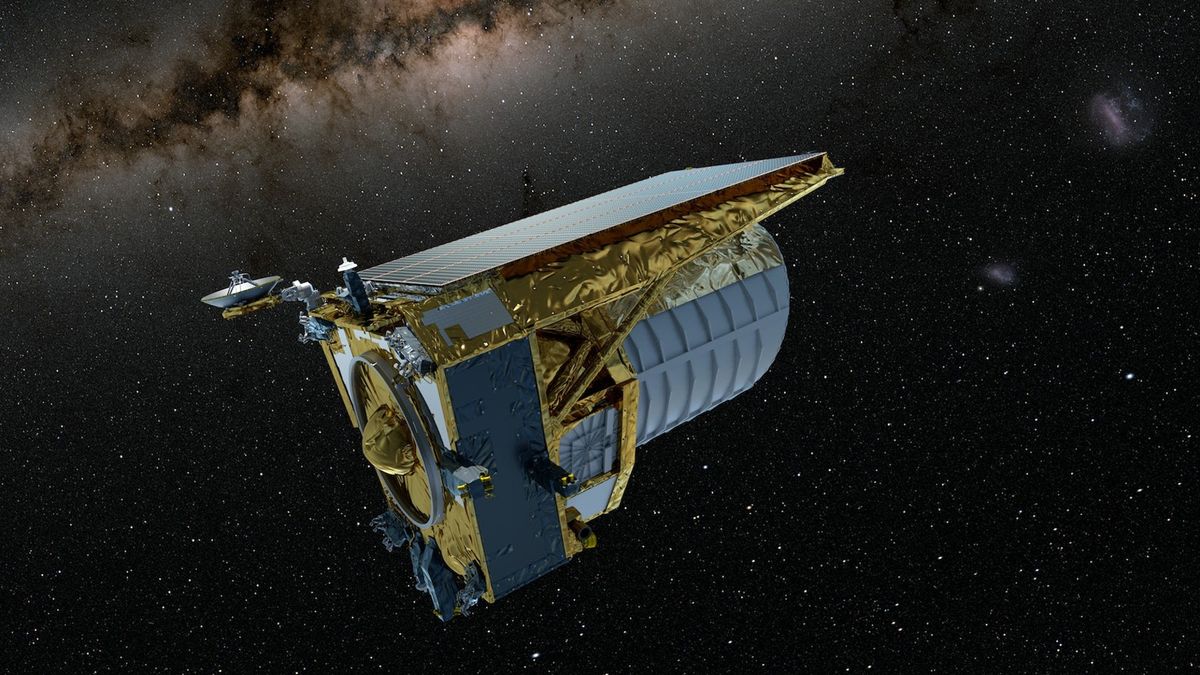
Euclid - which is 4.7 m tall and almost as wide, sports a 1.2-metre telescope and two scientific instruments capable of observing the cosmos in both visible light and the near-infrared.
A huge sun-shield is designed to keep the sensitive systems at properly frigid temperatures.
Upcoming Roman telescope mission
NASA, which contributed Euclid’s infrared detectors, has its own mission coming up to better understand dark energy and dark matter: the Roman Space Telescope, which is due to launch in 2027.
Billed as NASA's successor to the James Webb telescope, the Nancy Grace Roman Space Telescope will usher in "a new age for astronomy," one of the ESA scientists working on the project told Euronews Next.
Its lenses will allow it to capture a more panoramic view of the universe, allowing it to collect an unprecedented amount of data.
Just as NASA contributed to Euclid, ESA is contributing some of the technology for Roman, in exchange for access to the data.
The data gathered by Euclid will complement that collected by Roman, as scientists attempt to map the universe with the largest amount of data ever collected on a NASA mission.
The US-European James Webb telescope, which went into service in July last year, can also join in this quest, officials said.
Euclid was supposed to launch on a Russian rocket from French Guiana in South America, Europe’s main spaceport.
The European and Russian space agencies cut ties following the invasion of Ukraine last year, and the telescope switched to a SpaceX ride from Cape Canaveral.
Waiting for Europe's next-generation, yet-to-fly Ariane rocket would have meant a two-year-plus delay, according to project manager Giuseppe Racca.
Article From & Read More ( Euclid Space Telescope: Europe's mission to discover dark energy and dark matter launches - Euronews )
https://ift.tt/7REFpxv
Science
July's full moon, also known as the Buck Moon, rises tonight (July 3) as a supermoon.
An exciting event for skywatchers, supermoons see the lunar disk appearing larger and brighter in the night sky, but the Buck Moon of 2023 will be even more thrilling as it kicks off a season of four supermoons in a row. Supermoons can lead to a 30% brightening of the moon and a 14% increase in the lunar disk as seen from Earth, but these differences usually aren't noticeable with the unaided eye unless one pays a lot of attention to the moon nightly.
Supermoons are the result of the moon being closer to Earth at the time of a full moon. Eclipse expert and retired NASA astrophysicist Fred Espanak told Space.com that during the July Buck Moon, the moon will be just 224,895 miles (361,934 kilometers) from Earth in comparison to its average distance of around 238,000 miles (382,900 km).
Supermoons occur because the orbit of the moon around Earth is not a perfect circle; as a result of Earth's gravitational influence, the moon's orbit is elliptical, appearing like an elongated circle or oval. This means there are times in the moon's 27-day orbit that it is closer to Earth and other times that it is further away. A supermoon happens when the moon is both in the full moon phase of its 29.5 day lunar cycle and is at perigee, the closest point to Earth in its orbit.
According to In the Sky from New York, July's Full Buck Moon will rise at 7:10 p.m. EDT (2310 GMT) on Monday (July 3) and will set at 4:33 a.m. EDT (0833 GMT) on Tuesday (July 4).
After July, the next supermoon will rise on Tuesday, August 1 in the form of the Full Sturgeon Moon. Espanak said that during this supermoon, the distance between Earth and its natural satellite will be 222,158 miles (357,530 km).
August will see a second supermoon in the form of the Blue Moon on Aug. 30. This will be a particularly special event for moonwatchers as it will see the moon at its closest during this "supermoon summer" period, at just 222,043 miles (357,344 km) away.
Just after summer 2023 draws to a close on Sept. 23, so too does this festival of supermoons, which ends on Sept. 28 with the rise of September's Full Corn Moon when the moon will be 224,657 miles (361,552 km) from Earth.
The Full Corn Moon will also mark the final supermoon of 2023, with the next supermoon scheduled to fall on Sept. 18, 2024, according to In the Sky. Next year will only have two supermoons, with the next after September occurring a month later on Oct. 18, 2024.
If you are hoping to catch a look at the Buck Moon or other supermoons, our guides to the best telescopes and best binoculars are a great place to start.
Editor's Note:If you snap an image of July's Full Buck Moon, and would like to share it with Space.com's readers, send your photo(s), comments, and your name and location tospacephotos@space.com.
The very fabric of the universe is ringing with gravitational waves from its earliest epoch, and researchers have finally "heard" this cosmic symphony.
On Thursday, June 28, the North American Nanohertz Observatory for Gravitational Waves (NANOGrav) revealed the detection of low-frequency gravitational waves, a historic breakthrough that represents 15 years of searching. Yet, this isn't the first time that humanity has detected gravitational waves. Scientists have been detecting these ripples in the fabric of space using facilities like the Laser Interferometer Gravitational-Wave Observatory (LIGO) since 2015.
So, with that in mind, why isn't this just another — inarguably impressive — detection of gravitational waves? The answer is all about three connected qualities: The frequency, the wavelength and the period of gravitational waves, and what these tell scientists about the objects and events that first sent them rippling through space.
Albert Einstein's 1915 theory of gravity, general relativity, predicts that objects with mass have a warping effect on the very fabric of space and time — unified as "spacetime" — and gravity arises from this warping. General relativity also suggests that when objects accelerate, they should generate ripples in spacetime, a kind of gravity radiation we call gravitational waves. The effect becomes significant when the acceleration involves massive objects like supermassive black holes and neutron stars.
Gravitational waves, like electromagnetic radiation, come in a range of frequencies with high-frequency gravitational waves, like high-frequency light, having shorter wavelengths and being more energetic while low-frequency gravitational waves have longer wavelengths and are less energetic. Low-frequency longwave gravitational waves also have long periods, the time it takes between one peak of the wave passing a set point to the next peak passing that point.
Not all gravitational waves are created equal
The discovery announced on June 28 marks the first detection of low-frequency gravitational waves. The source of these low-frequency gravitational waves is believed to be supermassive black hole binaries in the very early universe. Think of this in terms of an orchestra. LIGO can hear the dramatic single "crash" of symbols from violent events like collisions and mergers. What the low-frequency gravitational wave signal NANOGrav heard is akin to the gentle background harmony of violins.
The strength of this signal indicates that a gravitational wave orchestra of hundreds of thousands or even millions of supermassive black hole binaries existed in the early universe.
"This finding opens up a new low-frequency window on the gravitational universe which will let us study how galaxies and their central black holes merge and grow with time," National Radio Astronomy Observatory (NRAO) astronomer Scott Ransom, one of the around 190 scientists working with NANOGrav, told Space.com.
The closer orbiting objects are, the faster they emit gravitational waves and the higher the frequency of this gravity radiation becomes; additionally, the closer they are, the more rapidly they lose angular momentum and the quicker they spiral together until they collide and merge. This violent collision sends a blast of high-frequency gravitational waves barreling through space.
Additionally, there are also more exotic possible explanations for these faint ripples in space-time. A fraction of this signal could be a gravitational wave background predating even these early black hole pairs and originating from the Big Bang and the origin of the universe itself.
An artist's depiction of colliding black holes causing ripples in the fabric of space-time.(Image credit: R. Hurt/Caltech-JPL)
Why NANOGrav can do what LIGO and LISA can't (and vice versa)
Just like it takes different telescopes to see different frequencies of light in the electromagnetic spectrum, it takes different gravitational wave detectors to "hear" different frequencies of this gravity-based spectrum of radiation.
Facilities like LIGO have been very successful in detecting higher-frequency gravitational waves caused by collisions between black holes, neutron stars, and even mixed mergers between the two, but lower-frequency gravitational waves have been evasive.
This is because the influence of gravitational waves is already tiny, with NANOGrav estimating the effect on spacetime as being as small as around one part in 1,000,000,000,000,000!
The gravitational waves that LIGO and other ground-based detectors can hear gravitational waves with wavelengths of around thousands of miles, about the size of Earth, with periods ranging from milliseconds to seconds. LISA will cover wavelengths the size of millions to billions of miles; think the distance from Earth to the sun or the distance of Earth or Pluto. The periods of these gravitational waves last from seconds to hours.
The gravitational waves that NANOGrav is designed to hear are at nanoHertz frequencies and have wavelengths on the scale of trillions of miles, making them light-years in length. And according to NANOGrav, these nanoHertz gravitational waves can have periods of months, years, or even decades.
For this detection to take place, astronomers needed a gravitational wave antenna the size of the entire galaxy and an incredibly precise way of measuring time consisting of a network of "cosmic clocks." That's where NANOGrav comes in.
Aerial view of LIGO Hanford Observatory.(Image credit: Public domain/LIGO Hanford Observatory)
How were low-frequency waves picked up by NanoGrav?
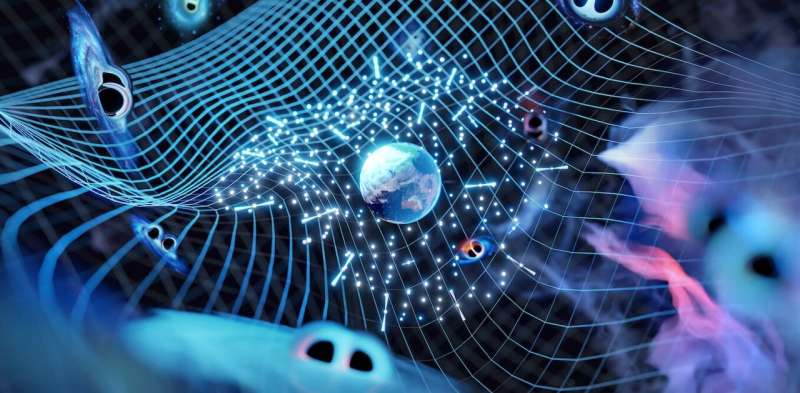
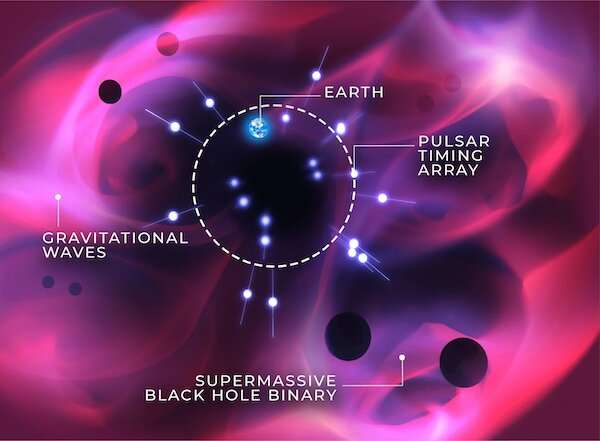
Via three radio observatories, the now destroyed Arecibo Observatory in Puerto Rico, the Green Bank Telescope in West Virginia, and the Very Large Array in New Mexico, NanoGrav turned 68 pulsars within the Milky Way into a huge gravitational wave antenna the size of the entire galaxy. This unique and sensitive gravitational wave detector is called a pulsar timing array.
Like all neutron stars, pulsars form when massive stars exhaust their fuel for nuclear fusion, and the outward "push" of the energy produced in this process ceases. This results in the core of these stars collapsing under their own gravity and the outer layers being blasted away in a supernova explosion.
The width of the stellar core shrinks to such an extent that neutron stars have a mass from around that of the sun and up to twice our star's mass crammed into a body no wider than that of the average city here on Earth. Due to the conservation of angular momentum, the reduction in diameter also causes the rotation of the stellar remnant to "spin up," with some neutron stars spinning as fast as 700 times per second! Think of this as being like a figure skater drawing in their arms to increase their spin, just on a whole different scale!
An artist's depiction of a pulsar.(Image credit: NASA's Goddard Space Flight Center)
The collapse of stellar cores has another consequence; the magnetic field of the original star is also squashed down. When magnetic field lines are crammed closer together, this increases the strength of the magnetic field they comprise.
As a result, neutron stars have some of the most powerful magnetic fields in the known universe. These magnetic fields act to channel particles to the poles of pulsars, where they are blasted out as jets at near-lightspeed from each pole. Pulsars appear to blink "on and off" — hence why astronomers initially believed they were pulsing stars — but this is the result of the light these jets create turning towards us at incredibly precise regular intervals. This means pulsars can be used as an excellent timing device.
The compression and stretching of spacetime as gravitational waves wash through it should have a discernible on the timing of pulsars, either slowing them down or speeding them up as they pass. This causes a very slight difference in the arrival time of light from these pulsars. Because the effect is small, pulsar timing arrays need to consist of many widely dispersed pulsars that have to be monitored for years.
For NANOGrav, patience has now paid off with this effect on pulsars now revealing a sign from low-frequency signal gravitational waves.
"Basically, the Earth is bobbing around — a tiny bit — on gravitational waves that are light-years in length," Ransom said. "And we have seen this using an array of almost 70-millisecond pulsars scattered around our part of the Milky Way."
The reason this discovery is important is we've now detected gravitational waves from sources we hadn't investigated before. It has revealed that the early universe was packed with supermassive black hole binaries.
This matter because though scientists now know most, if not all, galaxies have at their heart a supermassive black hole, they aren't yet sure how these cosmic titans grow. One suggested mechanism is a series of mergers between subsequently larger and larger black hole binary pairs.
This low-frequency gravitational wave signal hints at a way to understand how this could have proceeded in the early universe leading to some supermassive black holes that have masses millions or even billions of times that of the sun.
Additionally, because these black holes are likely delivered into the spiral dance of death that results in their merger by the collisions of galaxies, a better understanding of this black hole binary merger process means a better understanding of how galaxies grow and how the universe as a whole has evolved.
There is also the small chance that a tiny fragment of the gravitational wave signal this pulsar timing array the size of the Milky Way has picked up comes from gravitational waves created at the beginning of time during the Big Bang, which would have wavelengths ranging from around the size of the Milky Way — around 100,000 light-years — to the size of the Virgo Supercluster of galaxies — around 100 million light-years.
"This is exciting. The evidence reported by NANOGrav shows once again that gravitational wave observations are opening up a whole new window onto the universe," KU Leuven, cosmologist and long-time Spethen Hawking collaborator Thomas Hertog, who was not involved in the study, told Space. "In the coming years and decades, we'll be patching together the entire history of the universe in great detail by listening to the hum of gravitational waves passing through our planet. Exciting times indeed!"
RELATED STORIES:
With regards to the future, Ransom explained how NANOGrav will now look for a sensitive radio telescope in the northern hemisphere to substitute for the Arecibo telescope, which collapsed in Dec. 2020. Until that is found, the collaboration will compare data with other pulsar timing arrays to hone in on the source of low-frequency gravitational wave signals.
"With continued observations, we should start seeing individual sources as pure tones above this gravitational wave background. Those sources could be pinpointed and studied with electromagnetic waves as well — a new type of extragalactic multi-messenger astronomy," Ransom concluded. "I'm very excited about this development! We've been working on this for over 15 years, and I'm not a very patient person!"
When black holes and other enormously massive, dense objects whirl around one another, they send out ripples in space and time called gravitational waves. These waves are one of the few ways we have to study the enigmatic cosmic giants that create them.
Astronomers have observed the high-frequency "chirps" of colliding black holes, but the ultra-low-frequency rumble of supermassive black holes orbiting one another has proven harder to detect. For decades, we have been observing pulsars, a type of star that pulses like a lighthouse, in search of the faint rippling of these waves.
In 1915, German-born physicist Albert Einstein presented a breakthrough insight into the nature of gravity: the general theory of relativity.
The theory describes the universe as a four-dimensional "fabric" called spacetime that can stretch, squeeze, bend and twist. Massive objects distort this fabric to give rise to gravity.
A curious consequence of the theory is that the motion of massive objects should produce ripples in this fabric, called gravitational waves, which spread at the speed of light.
It takes an enormous amount of energy to create the tiniest of these ripples. For this reason, Einstein was convinced gravitational waves would never be directly observed.
A century later, researchers from the LIGO and Virgo collaborations witnessed the collision of two black holes, which sent a burst of gravitational waves chirping throughout the universe.
Now, seven years after this discovery, radio astronomers from Australia, China, Europe, India, and North America have found evidence for ultra-low-frequency gravitational waves.
A slow rumbling of gravitational waves
Unlike the sudden burst of gravitational waves reported in 2016, these ultra-low-frequency gravitational waves take years or even decades to oscillate.
They are expected to be produced by pairs of supermassive black holes, orbiting at the cores of distant galaxies throughout the universe. To find these gravitational waves, scientists would need to construct a detector the size of a galaxy.
Or we can use pulsars, which are already spread across the galaxy, and whose pulses arrive at our telescopes with the regularity of precise clocks.
CSIRO's Parkes radio telescope, Murriyang, has been observing an array of these pulsars for almost two decades. Our Parkes Pulsar Timing Array team is one of several collaborations around the world that have today announced hints of gravitational waves in their latest data sets.
Other collaborations in China (CPTA), Europe and India (EPTA and InPTA), and North America (NANOGrav) see similar signals.
As gravitational waves warp spacetime around Earth, they distort the arrival times of radio waves from distant pulsars. Credit: OzGrav / Swinburne / Carl Knox
The signal we are searching for is a random "ocean" of gravitational waves produced by all the pairs of supermassive black holes in the universe.
Observing these waves is not only another triumph of Einstein's theory, but has important consequences for our understanding of the history of galaxies in the universe. Supermassive black holes are the engines at the heart of galaxies that feed on gas and regulate star formation.
The signal appears as a low-frequency rumble, common to all pulsars in the array. As the gravitational waves wash over Earth, they affect the apparent rotation rates of the pulsars.
The stretching and squeezing of our galaxy by these waves ultimately changes the distances to the pulsars by just tens of meters. That's not much when the pulsars are typically about 1,000 light-years away (that's about 10,000,000,000,000,000,000 meters).
Remarkably, we can observe these shifts in spacetime as nanosecond delays to the pulses, which radio astronomers can track with relative ease because pulsars are such stable natural clocks.
What has been announced?
Because the ultra-low-frequency gravitational waves take years to oscillate, the signal is expected to emerge slowly.
First, radio astronomers observed a common rumble in the pulsars, but its origin was unknown.
Now, the unique fingerprint of gravitational waves is beginning to appear as an attribute of this signal, observed by each of the pulsar timing array collaborations around the world.
This fingerprint describes a particular relationship between the similarity of pulse delays and the separation angle between pulsar pairs on the sky.
The relationship arises because spacetime at Earth is stretched, changing the distances to pulsars in a way that depends on their direction. Pulsars close together in the sky show a more similar signal than pulsars separated at right angles, for example.
The breakthrough has been enabled by improved technology at our observatories. The Parkes Pulsar Timing Array has the longest high-quality data set, thanks to the advanced receiver and signal processing technology installed on Murriyang. This technology has enabled the telescope to discover many of the best pulsars used by collaborations around the globe for the gravitational wave searches.
Earlier results from our collaboration and others showed the signal expected from gravitational waves was missing from pulsar observations.
Now, we seem to be seeing the signal with relative clarity. By segmenting our long data set into shorter "time-slices," we show the signal appears to be growing with time. The underlying cause of this observation is unknown, but it may be that the gravitational waves are behaving unexpectedly.
The new evidence for ultra-low-frequency gravitational waves is exciting for astronomers. To confirm these signatures, the global collaborations will need to combine their data sets, which increases their sensitivity to gravitational waves many-fold.
Efforts to produce this combined data set are now in progress under the International Pulsar Timing Array project, whose members met in Port Douglas in Far North Queensland last week. Future observatories, like the Square Kilometre Array under construction in Australia and South Africa, will turn these studies into a rich source of knowledge about the history of our universe.
Citation: Using a detector the size of a galaxy, astronomers detect gravitational waves from supermassive black hole pairs (2023, July 1) retrieved 2 July 2023 from https://ift.tt/EIUJGOl
This document is subject to copyright. Apart from any fair dealing for the purpose of private study or research, no part may be reproduced without the written permission. The content is provided for information purposes only.
Article From & Read More ( Using a detector the size of a galaxy, astronomers detect gravitational waves from supermassive black hole pairs - Phys.org )
https://ift.tt/6hTerDH
Science
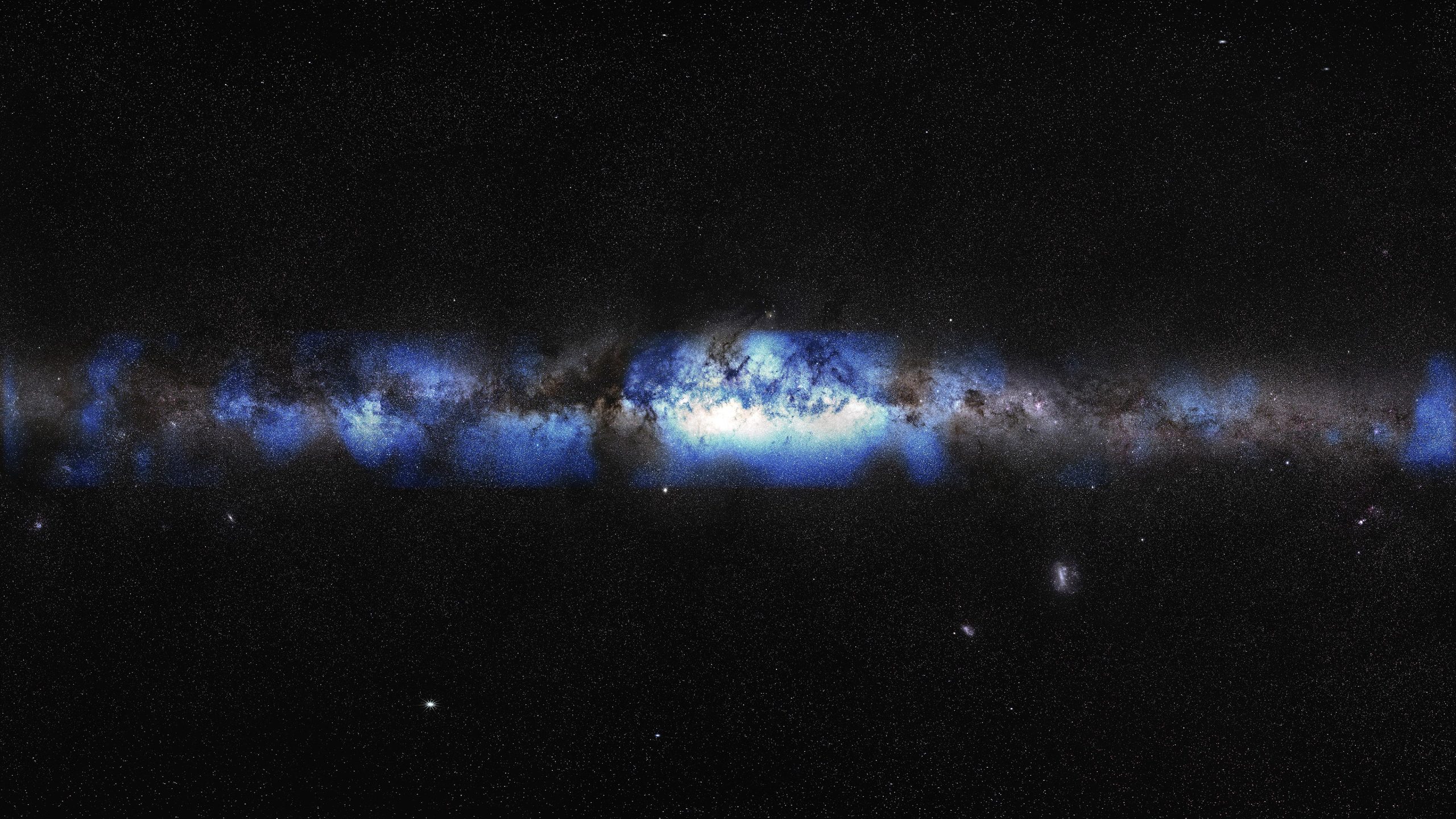
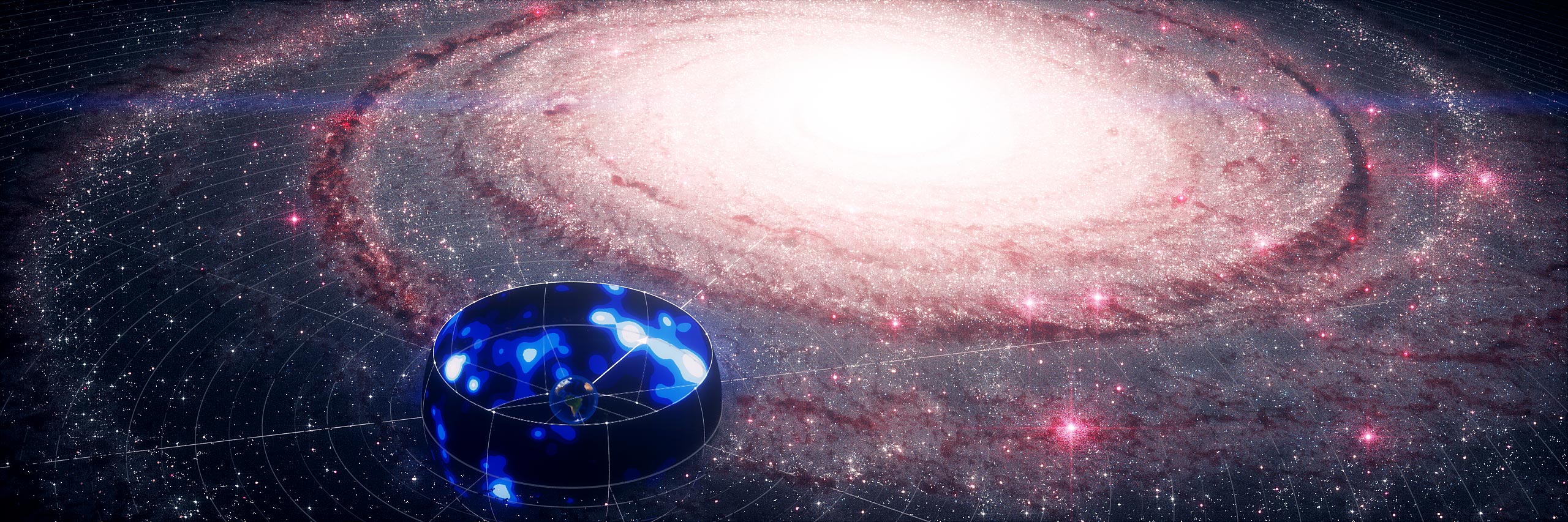
An artist’s composition of the Milky Way seen with a neutrino lens (blue). Credit: IceCube Collaboration/U.S. National Science Foundation (Lily Le & Shawn Johnson)/ESO (S. Brunier)
For the first time, the IceCube Neutrino Observatory has created an image of the Milky Way using neutrinos—minuscule, elusive particles of the cosmos. This revolutionary data comes from an international collaboration of over 350 scientists and is backed by the National Science Foundation and fourteen additional countries. The groundbreaking observatory is located at the South Pole and employs over 5,000 light sensors to detect high-energy neutrinos that originate from both our galaxy and beyond.
Our Milky Way galaxy is an awe-inspiring feature of the night sky, viewable with the naked eye as a horizon-to-horizon hazy band of stars. Now, for the first time, the IceCube Neutrino Observatory has produced an image of the Milky Way using neutrinos—tiny, ghostlike astronomical messengers. In an article published on June 30 in the journal Science, the IceCube Collaboration, an international group of over 350 scientists, presents evidence of high-energy neutrino emission from the Milky Way.
The high-energy neutrinos, with energies millions to billions of times higher than those produced by the fusion reactions that power stars, were detected by the IceCube Neutrino Observatory, a gigaton detector operating at the Amundsen-Scott South Pole Station. It was built and is operated with National Science Foundation (NSF) funding and additional support from the fourteen countries that host institutional members of the IceCube Collaboration.
The neutrino view (blue sky map) in front of an artist’s impression of the Milky Way. Credit: IceCube Collaboration/Science Communication Lab for CRC 1491
This one-of-a-kind detector encompasses a cubic kilometer of deep Antarctic ice instrumented with over 5,000 light sensors. IceCube searches for signs of high-energy neutrinos originating from our galaxy and beyond, out to the farthest reaches of the universe.
“What’s intriguing is that, unlike the case for light of any wavelength, in neutrinos, the universe outshines the nearby sources in our own galaxy,” says Francis Halzen, a professor of physics at the University of Wisconsin–Madison and principal investigator of IceCube.
“As is so often the case, significant breakthroughs in science are enabled by advances in technology,” says Denise Caldwell, director of NSF’s Physics Division. “The capabilities provided by the highly sensitive IceCube detector, coupled with new data analysis tools, have given us an entirely new view of our galaxy—one that had only been hinted at before. As these capabilities continue to be refined, we can look forward to watching this picture emerge with ever-increasing resolution, potentially revealing hidden features of our galaxy never before seen by humanity.”
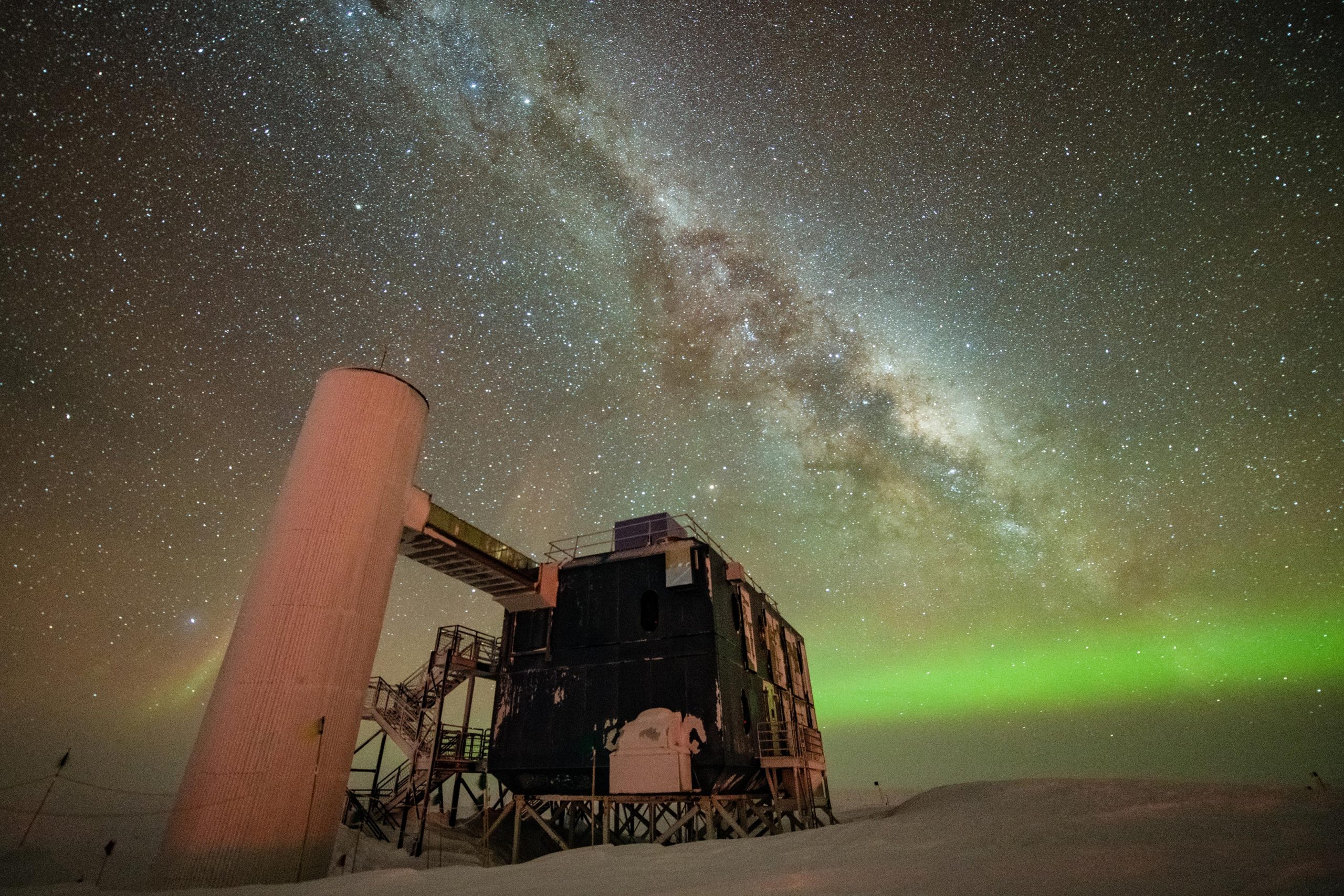
A view of the IceCube Lab with a starry night sky showing the Milky Way and green auroras. Credit: Yuya Makino, IceCube/NSF
Interactions between cosmic rays–high-energy protons and heavier nuclei, also produced in our galaxy–and galactic gas and dust inevitably produce both gamma rays and neutrinos. Given the observation of gamma rays from the galactic plane, the Milky Way was expected to be a source of high-energy neutrinos.
“A neutrino counterpart has now been measured, thus confirming what we know about our galaxy and cosmic ray sources,” says Steve Sclafani, a physics PhD student at Drexel University, IceCube member, and co-lead analyzer.
The search focused on the southern sky, where the bulk of neutrino emission from the galactic plane is expected near the center of our galaxy. However, until now, the background of muons and neutrinos produced by cosmic-ray interactions with the Earth’s atmosphere posed significant challenges.
Francis Halzen, IceCube PI and professor at UW–Madison. Credit: EL PAIS/BERNARDO PÉREZ
To overcome them, IceCube collaborators at Drexel University developed analyses that select for “cascade” events, or neutrino interactions in the ice that result in roughly spherical showers of light. Because the deposited energy from cascade events starts within the instrumented volume, contamination of atmospheric muons and neutrinos is reduced. Ultimately, the higher purity of the cascade events gave a better sensitivity to astrophysical neutrinos from the southern sky.
However, the final breakthrough came from the implementation of machine learning methods, developed by IceCube collaborators at TU Dortmund University, which improve the identification of cascades produced by neutrinos as well as their direction and energy reconstruction. The observation of neutrinos from the Milky Way is a hallmark of the emerging critical value that machine learning provides in data analysis and event reconstruction in IceCube.
“The improved methods allowed us to retain over an order of magnitude more neutrino events with better angular reconstruction, resulting in an analysis that is three times more sensitive than the previous search,” says IceCube member, TU Dortmund physics PhD student, and co-lead analyzer Mirco Hünnefeld.
The dataset used in the study included 60,000 neutrinos spanning 10 years of IceCube data, 30 times as many events as the selection used in a previous analysis of the galactic plane using cascade events. These neutrinos were compared to previously published prediction maps of locations in the sky where the galaxy was expected to shine in neutrinos.
The maps included one made from extrapolating Fermi Large Area Telescope gamma-ray observations of the Milky Way and two alternative maps identified as KRA-gamma by the group of theorists who produced them.
“This long-awaited detection of cosmic ray-interactions in the galaxy is also a wonderful example of what can be achieved when modern methods of knowledge discovery in machine learning are consistently applied,” says Wolfgang Rhode, professor of physics at TU Dortmund University, IceCube member, and Hünnefeld’s advisor.
The power of machine learning offers great future potential, bringing other observations closer within reach.
“The strong evidence for the Milky Way as a source of high-energy neutrinos has survived rigorous tests by the collaboration,” says Ignacio Taboada, a professor of physics at the Georgia Institute of Technology and IceCube spokesperson. “Now the next step is to identify specific sources within the galaxy.”
These and other questions will be addressed in planned follow-up analyses by IceCube.
“Observing our own galaxy for the first time using particles instead of light is a huge step,” says Naoko Kurahashi Neilson, professor of physics at Drexel University, IceCube member, and Sclafani’s advisor. “As neutrino astronomy evolves, we will get a new lens with which to observe the universe.”
Reference: “Observation of high-energy neutrinos from the Galactic plane” by IceCube Collaboration, 29 June 2023, Science. DOI: 10.1126/science.adc9818
CAPE CANAVERAL, FLORIDA — Europe's dark universe hunter is ready to leave its home planet.
Euclid, a dark matter and dark energy mission, is set to launch from Cape Canaveral Space Force Station here tomorrow (July 1) aboard a SpaceX Falcon 9 rocket. Launch is scheduled for July 1 at 11:11 a.m. EDT (1511 GMT). A live webcast from NASA Television will be carried here at Space.com for free starting at 10:30 a.m. EDT (1430 GMT).
After liftoff, Euclid will spend about a month journeying to the distant Sun-Earth Lagrange Point 2, on the opposite side of the sun to us and about 1 million miles (1.5 million kilometers) from Earth. After another seven months of commissioning, the probe will spend six years studying the dark universe, gathering data that will shed light on the evolution of galaxies, the expansion of the universe and other physical phenomena.
"This is 15 years of people's lives," Carole Mundell, the European Space Agency's (ESA) director of science, said during a prelaunch briefing on June 23. "There were two teams that originally proposed missions, one to study dark energy and one to study dark matter. Both were incredibly challenging, but we thought, 'Well, that's not hard enough. Let's put them both together on a single spacecraft and do the impossible.' "
Dark matter is believed to make up most of the material universe, but we can only see it through its gravitational effects. Dark energy is the force believed to be pushing along the accelerating expansion of the universe. Euclid aims to bring sharper eyes to the sky than ever before to try to demystify dark matter and dark energy.
As Mundell noted, the 1.4 billion-euro ($1.5 billion USD) Euclid was originally split among two mission concepts proposed to ESA in 2007: Dune (Dark Universe Explorer) and Space (Spectroscopic All Sky Cosmic Explorer). Euclid, selected in 2011, forges the complementary studies of these proposals to examine dark matter and dark energy across time and space.
Euclid will include two complementary experiments. The first examines lensing — the "precise detail, the shapes of galaxies ... that goes back to 10 billion light-years," said Gaitee Hussain, head of ESA's science division, during the same briefing. The second study will scrutinize the redshifting of galaxies, or the light of receding galaxies being stretched into the red parts of the wavelength spectrum.
The images by Euclid will be four times sharper than equivalent ground surveys looking at large swaths of the sky, Hussain added. "That also requires really working hard on the technology to get the most out of the instrumentation we possibly can," Hussain said.
RELATED STORIES:
Euclid will carry out this work using two instruments. One will focus on visible light, whereas the other is optimized for infrared (heat) wavelengths.
Euclid is also complementary to other missions with ESA involvement that look at cosmic time, such as Europe's Gaia, which tracks the location of more than a billion objects in space, and the NASA-led James Webb Space Telescope, which is peering at some of the universe's first-ever stars and galaxies, among other tasks.
The forecast for launch on Saturday appears excellent. For the early morning before 8 a.m. local (the longest-range data available in the 24-hour forecast), Cape Canaveral Space Force Station will have clear skies and no chance of rain or lightning, with light winds of just five knots, according to the forecast from the U.S. Space Force's Space Launch Delta 45.
Elizabeth Howell is in Florida to cover Euclid's launch under co-sponsorship by Canadian Geographic magazine and Canada's University of Waterloo. Space.com has independent control of its news coverage.