The supermoon rises behind a hill at Pera Chorio Nisou, outskirts of Nicosia, Cyprus, Tuesday, Aug. 1, 2023. The moon appears slightly brighter and bigger than normal because it is closer than usual, just 222,159 miles away, thus the moon is given the supermoon label. (AP Photo/Petros Karadjias)
Tuesday night brought the first of two full supermoons that will appear in the August night sky.
The second full moon within one month is called a blue moon.
The first of two August full supermoons graced the sky last night. The Sturgeon Moon reached full illumination Tuesday afternoon, and is actually the second of four consecutive full supermoons this year, according to almanac.com.
Photos show the full Sturgeon Supermoon as it rose around the world, from Istanbul's Galata Tower to the New York City skyline and beyond.
Advertisement
A full supermoon is the term for when the full moon occurs when or very near to when the Moon is closest to Earth in its orbit. This makes the moon appear up to 8% larger and 16% brighter than the average moon.
Senior editorNicole Bonaccorsoworks as weather.com's photo editor and writes about breaking news, travel, climate and more.
The Weather Company’s primary journalistic mission is to report on breaking weather news, the environment and the importance of science to our lives. This story does not necessarily represent the position of our parent company, IBM.
Shortly before the rover’s 11th anniversary on the Red Planet, its team helped guide it up a steep, slippery slope to examine meteor craters.
On Aug. 5, NASA’s Curiosity rover will notch its 11th year on Mars by doing what it does best: studying the Red Planet’s surface. The intrepid bot recently investigated a location nicknamed “Jau” that is pockmarked with dozens of impact craters. Scientists have rarely gotten a close-up view of so many Martian craters in one place. The largest is estimated to be at least as long as a basketball court, although most are much smaller.
Jau is a pit stop on the rover’s journey into the foothills of Mount Sharp, a 3-mile-tall (5-kilometer-tall) mountain that was covered with lakes, rivers, and streams billions of years ago. Each layer of the mountain formed in a different era of Mars’ ancient climate, and the higher Curiosity goes, the more scientists learn about how the landscape changed over time.
Curiosity's Big Climb: Find out how NASA's Curiosity Mars rover faced one of the hardest climbs of the mission. Credits: NASA/JPL-Caltech. Download Video ›
On Aug. 5, NASA’s Curiosity rover will notch its 11th year on Mars by doing what it does best: studying the Red Planet’s surface. The intrepid bot recently investigated a location nicknamed “Jau” that is pockmarked with dozens of impact craters. Scientists have rarely gotten a close-up view of so many Martian craters in one place. The largest is estimated to be at least as long as a basketball court, although most are much smaller.
The path up the mountain over the last several months required the most arduous climb Curiosity has ever made. There have been steeper climbs and riskier terrain, but the mission has never faced the trifecta of challenges posed by this slope: a sharp 23-degree incline, slippery sand, and wheel-size rocks. This trifecta left the rover struggling through a half-dozen drives in May and June, vexing Curiosity’s drivers back on Earth.
“If you’ve ever tried running up a sand dune on a beach – and that’s essentially what we were doing – you know it’s hard, but there were boulders in there as well,” said Amy Hale, a Curiosity rover driver at NASA’s Jet Propulsion Laboratory in Southern California.
Curiosity Views a Crater at 'Jau': NASA’s Curiosity used its Mastcam to capture this impact crater in a location nicknamed “Jau” on July 25, the 3,899th Martian day, or sol, of the mission. This was one of dozens of impact craters Curiosity stopped by after completing one of its most difficult climbs ever. Download Image ›
How to Drive a Rover
Hale is one of 15 “rover planners” who write hundreds of lines of code to command Curiosity’s mobility system and robotic arm each day. (They don’t operate the rover in real time; instructions are sent to Mars the night before, and data comes back to Earth only after the rover has completed the work.) These engineers collaborate with scientists to figure out where to direct the rover, what pictures to take, and which targets to study using the instruments on its 7-foot (2-meter) robotic arm.
But rover planners are also constantly on the lookout for hazards. They have to write commands to steer around pointy rocks and minimize wear on Curiosity’s battered wheels. Geologists on the team use their field experience here on Earth to help look out for deep sand and unstable rock formations. There’s even a role on the mission to gauge whether a canyon wall could obstruct radio communications with Earth.
A Map of Curiosity’s Difficult Climb: This map shows the route NASA’s Curiosity Mars rover took from May into July 2023 to complete the most difficult climb of the mission. Credits: NASA/JPL-Caltech/USGS-Flagstaff/University of Arizona. Download Image ›
Six-Wheeled Ascent
Curiosity was never in danger while climbing to Jau: The team doesn’t plan anything that could damage the rover, and the planners write commands so that Curiosity will stop moving if it encounters any surprises. Unexpected stoppages – referred to as “faults” – can occur when the wheels slip too much or a wheel is raised too high by a large rock. On the route to Jau, the rover found itself in both scenarios on several occasions.
“We were basically playing fault bingo,” said Dane Schoelen, Curiosity’s strategic route planning lead at JPL. “Each day when we came in, we’d find out we faulted for one reason or another.”
Instead of continuing to struggle with the original course, Schoelen and his colleagues put together a lateral detour, eyeing a spot roughly 492 feet (150 meters) away where the incline leveled out. At least, it seemed to: Planners rely on imagery from NASA’s Mars Reconnaissance Orbiter to get a rough sense of the terrain, but images captured from space can’t show exactly how steep a slope is or whether boulders are there.
The detour would add a few weeks to the journey to Jau – unless the terrain was hiding more surprises. If that were the case, the detour might have been for nothing, and the team’s scientists would have to keep looking for another path up Mount Sharp.
Fortunately, the detour paid off, allowing Curiosity to crest the slope.
“It felt great to finally get over the ridge and see that amazing vista,” Schoelen said. “I get to look at images of Mars all day long, so I really get a sense of the landscape. I often feel like I’m standing right there next to Curiosity, looking back at how far it has climbed.”
Since the difficult ascent, Curiosity’s scientists have wrapped an investigation of the Jau crater cluster. Common on Mars, clusters can form when a meteor breaks up in the planet’s atmosphere or when fragments are tossed by a large, more distant meteoroid impact. Scientists want to understand how the relatively soft rocks of the salt-enriched terrain affected the way the craters formed and changed over time.
Despite all that Mars has thrown at Curiosity, the rover isn’t slowing down. It’ll soon be off again to explore a new area higher up on Mount Sharp.
More About the Mission
Curiosity was built by JPL, which is managed by Caltech in Pasadena, California. JPL leads the mission on behalf of NASA’s Science Mission Directorate in Washington.
Article From & Read More ( NASA's Curiosity Rover Faces Its Toughest Climb Yet on Mars – NASA Mars Exploration - NASA Mars Exploration )
https://ift.tt/0gq2sSn
Science
A coronal mass ejection erupted from the sun on 28 October 2021 and was so big that Mars and Earth, while on opposite sides of the sun, both received an influx of solar energetic particles. Credit: ATG, ESA, CC BY-SA 3.0 IGO
A coronal mass ejection erupted from the sun on 28 October 2021 and was spread over such a wide area that Mars and Earth, while on opposite sides of the sun and around 250 million kilometers apart, received an influx of energetic particles.
This marks the first time that a solar event was measured simultaneously on the surfaces of Earth, the moon and Mars. The outburst was detected by an international fleet of spacecraft including ESA's ExoMars Trace Gas Orbiter (TGO), NASA's Curiosity Mars rover, the CNSA Chang'e-4 moon lander, NASA's Lunar Reconnaissance Orbiter (LRO), and DLR's Eu:CROPIS Earth orbiter. "The first ground level enhancement seen on three planetary surfaces: Earth, moon, and Mars," is published in Geophysical Research Letters.
These simultaneous measurements on different worlds help improve our knowledge of the impact of solar outbursts and how a planet's magnetic field and atmosphere can help protect astronauts against them.
Comparing different worlds
The event that took place on 28 October 2021 is an example of a rare "ground level enhancement." During these events, particles from the sun are energetic enough to pass through the magnetic bubble that surrounds Earth and protects us from less energetic solar outbursts. This was only the 73rd ground level enhancement since records began in the 1940s, and none have been recorded since.
As the moon and Mars do not generate their own magnetic fields, particles from the sun can easily reach their surfaces, and even interact with the soil to generate secondary radiation. But Mars does have a thin atmosphere that stops most of the lower energy solar particles and slows down the highly energetic ones.
With the moon and Mars as the focus of future human exploration, it is extremely important to understand these solar events and their potential impact on the human body. Astronauts face the risk of radiation sickness. A radiation dose above 700 milligray—the unit for the absorption of radiation—may induce radiation sickness via destruction of the bone marrow, resulting in symptoms such as infection and internal bleeding.
A coronal mass ejection as seen by SOHO on 28 October 2021. This event is an example of a rare ‘ground level enhancement’. During these events, particles from the sun are energetic enough to pass through the magnetic bubble that surrounds Earth and protects us from less energetic solar outbursts. This was only the 73rd ground level enhancement since records began in the 1940s, and none have been recorded since. Credit: SOHO (ESA & NASA), CC BY-SA 3.0 IGO
If an astronaut receives more than 10 gray, they are extremely unlikely to survive more than two weeks. One solar outburst in August 1972 would have given such a high radiation dose to an astronaut on the lunar surface, but it fortunately fell between the crewed Apollo 16 and 17 missions.
By comparison, during the event on 28 October 2021 the dose in lunar orbit, measured by NASA's Lunar Reconnaissance Orbiter, was only 31 milligray. "Our calculations of the past ground level enhancement events show that on average one event every 5.5 years may have exceeded the safe dose level on the moon if no radiation protection had been provided. Understanding these events is crucial for future crewed missions to the surface of the moon," says scientist Jingnan Guo who researched the 28 October event.
When we compare the measurements made by ExoMars TGO and by the Curiosity rover, the protection offered by Mars's atmosphere becomes clear: TGO measured 9 milligray, 30 times more than the 0.3 milligray detected on the surface.
ESA's inner solar system missions Solar Orbiter, SOHO and BepiColombo were also caught in the blast of the outburst, providing even more vantage points to study this solar event.
"Currently, we live in a golden age of solar system physics. Radiation detectors aboard planetary missions such as BepiColombo, on its way to Mercury, and Juice, cruising to Jupiter, add a much-needed coverage to study the acceleration and propagation of solar energetic particles," remarks Marco Pinto, ESA research fellow working on radiation detectors.
Protecting our astronauts
Protecting astronauts as they venture into space is an essential and important task for ESA. Understanding and predicting intense radiation events is a vital part of this. Dedicated instruments measure the radiation environment in space and are used to protect critical spaceborne and ground-based infrastructure but also astronauts. If warned on time, astronauts could seek protection such as bodywear or shelter in caves. Current policy on the International Space Station is to retreat to the sleeping quarters or the kitchen, where walls shield against radiation.
Two radiation dummies are destined for a pioneering lunar flyby to help protect space travelers from cosmic rays and energetic solar storms. These two female phantoms will occupy the passenger seats during Orion’s first mission around the moon, going further than any human has flown before. Fitted with more than 5,600 sensors, the pair will measure the amount of radiation astronauts could be exposed to in future missions with unprecedented precision. The flight test will take place during NASA’s Exploration Mission-1, an uncrewed trip to the vicinity of the moon and back to Earth. Credit: Lockheed Martin
Lunar Gateway
The Artemis program that is sending astronauts to the moon includes a space station in lunar orbit, called the Gateway. On the Gateway three suites of instruments will monitor the radiation environment around the moon: ESA's European Radiation Sensors Array (ERSA), NASA's Heliophysics Environmental and Radiation Measurement Experiment Suite (HERMES) and the ESA/JAXA Internal Dosimeter Array (IDA).
Together these experiments will measure the radiation environment outside Gateway while monitoring the specific radiation doses inside, between 3,000 km and 70,000 km from the lunar surface. These measurements will be critical for better understanding the environment astronauts will experience in interplanetary space.
Luna twins
Space agencies are also looking into protective attire to minimize the impact of space radiation on the body. Two identical mannequins, developed by the German Aerospace Center (DLR), were passengers on the Artemis I test flight, which flew by the moon during November and December 2022.
The mannequins, nicknamed Helga and Zohar, were modeled based on the female body and were equipped with radiation sensors provided by DLR and NASA. Helga flew unprotected, but Zohar wore a newly developed radiation protection vest covering her torso. Researchers at DLR are currently comparing the two datasets measured by Helga and Zohar.
Colin Wilson, ExoMars TGO project scientist, concludes: "Space radiation can create a real danger to our exploration throughout the solar system. Measurements of high-level radiation events by robotic missions is critical to prepare for long-duration crewed missions. Thanks to data from missions like ExoMars TGO we can prepare for how best to protect our human explorers."
More information: Jingnan Guo et al, The First Ground Level Enhancement Seen on Three Planetary Surfaces: Earth, Moon, and Mars, Geophysical Research Letters (2023). DOI: 10.1029/2023GL103069
Citation: Giant solar eruption felt on Earth, moon and Mars (2023, August 3) retrieved 3 August 2023 from https://ift.tt/VGxgtmR
This document is subject to copyright. Apart from any fair dealing for the purpose of private study or research, no part may be reproduced without the written permission. The content is provided for information purposes only.
Rocket launch over the Rodanthe Pier. Photo by Sally Jo Hanson
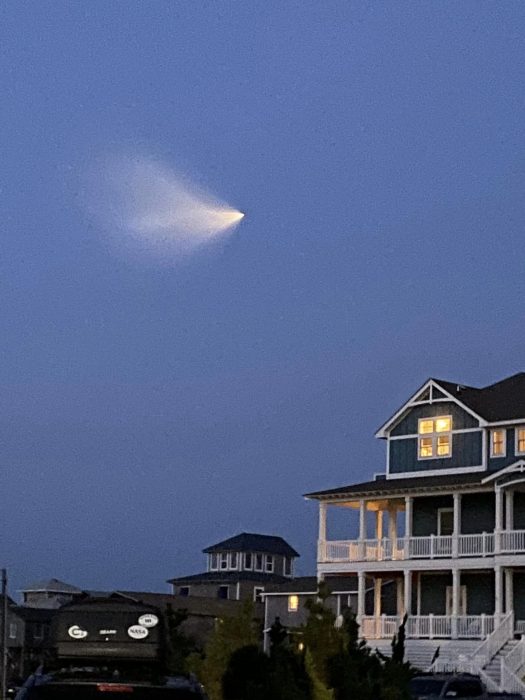
Evening beachgoers on Tuesday, August 1, caught a stellar show over Hatteras Island, as a rocket that was launched from the NASA Wallops Flight Facility in eastern Virginia was clearly visible from multiple locations along the Outer Banks.
The Northrop Grumman Cygnus resupply spacecraft successfully launched at 8:31 p.m. on Tuesday from the Mid-Atlantic Regional Spaceport’s Pad 0A on Wallops Island, Virginia, which is approximately 200 miles away from Hatteras Island.
The rocket is on its way to the International Space Station and is carrying more than 8,200 pounds of science investigation materials, supplies, and equipment.
This is Northrop Grumman’s 19th commercial resupply services mission, and the eighth mission under its Commercial Resupply Services 2 contract with NASA.