Rechercher dans ce blog

Monday, January 1, 2024

Space photo of the week: Uranus 'rings' in the New Year in stunning James Webb telescope image - Livescience.com

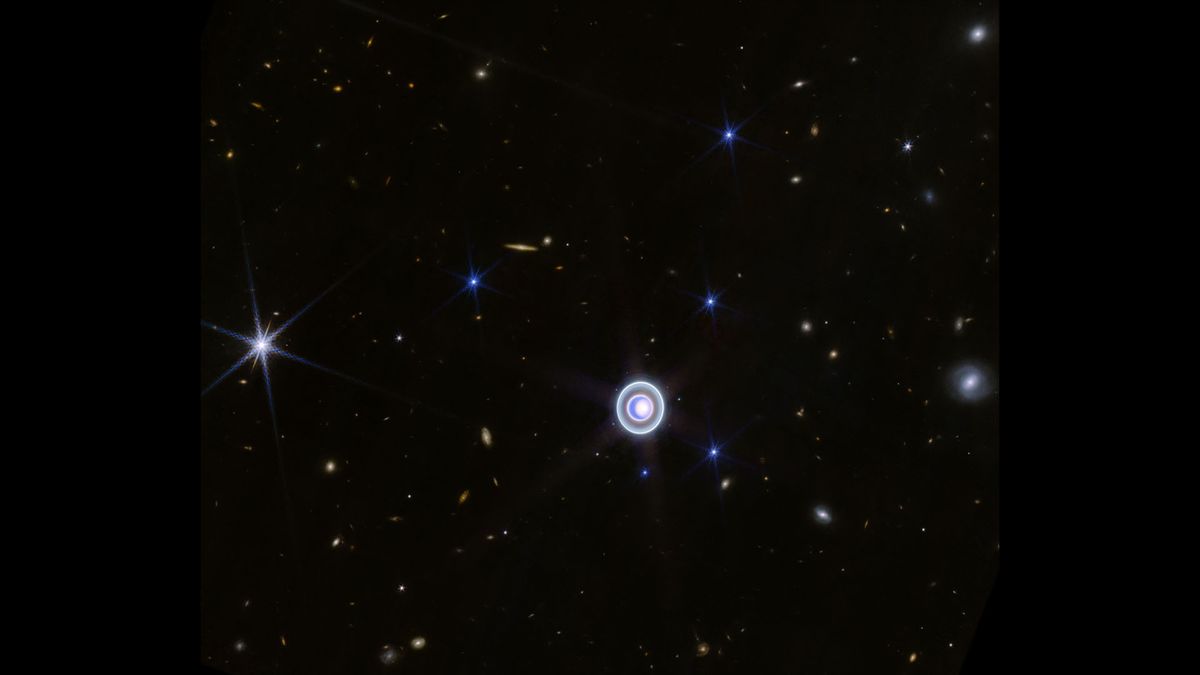
What it is: Uranus and 14 of its 27 moons

When it was taken: Dec. 18, 2023

Where it is: 1.8 billion miles (2.9 billion kilometers) from the sun

Why it's so special: This photo of Uranus, captured by the James Webb Space Telescope, reveals the ice giant planet in exquisite detail. The wide-field image shows Uranus' rings, a polar ice cap, 14 of the planet's 27 moons, background stars and galaxies.

The close-up image, snapped by JWST's Near Infrared Camera and released by NASA this week, is a follow-up to a set of photos taken in February. The new image features an extra wavelength of light, revealing a hidden ring. Although Uranus is known to have 13 distinct inner and outer rings, NIRCam revealed the planet's elusive "Zeta ring," a faint, diffuse ring nestled close to the planet.

Of Uranus' 27 moons, 14 are featured in this image: Oberon, Titania, Umbriel, Juliet, Perdita, Rosalind, Puck, Belinda, Desdemona, Cressida, Ariel, Miranda, Bianca and Portia.

It's a much more detailed view of Uranus than humankind's first close-up of the seventh planet, taken by NASA's Voyager 2 probe in 1986. That featureless image showed a solid bluish orb with no detail. JWST, by contrast, has captured atmospheric features such as a north polar cloud cap. That growing and receding cap is fascinating to planetary scientists because it's visible evidence that Uranus spins on an axis tilted by 98 degrees, producing seasonal and meteorological effects that create storms.

Uranus takes 84 Earth years to orbit the sun once. That slow orbit, plus the extreme tilt of Uranus, means the ice giant experiences extreme seasons, with the polar cap visible in the image resulting from its north polar region being in the depths of a 21 Earth-year-long winter that will end in 2028.

Dozens of background galaxies are visible in this wide-field image. Most have an orange tint, but if you look to the right of Uranus, you'll see two sizable white spiral galaxies.

In October, scientists at the University of Leicester in the U.K. published a paper in the journal Nature Astronomy revealing the presence of infrared aurorae around Uranus.

In April 2022, a Decadal Survey report by the National Academy of Sciences recommended that NASA probe the atmosphere, clouds and storms of the turquoise planet as part of the Uranus Orbiter and Probe Flagship mission.

Adblock test (Why?)

Article From & Read More ( Space photo of the week: Uranus 'rings' in the New Year in stunning James Webb telescope image - Livescience.com )
https://ift.tt/Gyz5ebw
Science

Nasa's Parker mission poised for solar 'landing' in 2024 - FRANCE 24 English

Since its launch in 2018, NASA’s Parker Solar Probe has inched closer to the sun with each passing year, shedding light on key solar processes. By the end of 2024, it will have set a new record by grazing our star from a distance of just over 6 million kilometres, delving deep into its scorching outer layers.

Issued on:

2 min

One of the most audacious missions in the history of space exploration, the Parker Solar Probe is the first spacecraft to have flown through the sun’s outer atmosphere, known to scientists as the corona. It is set to break new ground in late December by covering 96% of the distance separating our planet from its fiery star.

In doing so, Parker will hit speeds of around 700,000 km/h (or 435,000 mph), enough to fly from New York to Tokyo in one minute – making it the fastest human-made craft in history. It will achieve such velocity by swinging around Venus, using the planet’s gravity to tighten its orbit around the sun and acquire extra speed.

“This will be a monumental achievement for all humanity. This is equivalent to the Moon landing of 1969,” said Parker project scientist Dr Nour Raouafi of Johns Hopkins University, in an interview with the BBC. “We are basically almost landing on a star.”

Into the furnace 

Parker’s mission is to make repeated passes of the sun, drawing ever closer to the star as it travels through its outer atmosphere – which, paradoxically, is 300 times hotter than its actual surface. That means weathering unimaginable conditions, including temperatures of close to 1,400 degrees Celsius and solar winds charged with high-energy particles.

The trick for Parker is to make rapid dives into this hellscape, relying on its blistering speed and a thick heat shield made of carbon composite. The shield protects an array of instruments that  measure charged particles and magnetic fluctuations, capturing both images and sounds.

In 2020, recordings made close to the star provided the first sound clips of the solar wind – a stream of high-energy particles that flows continuously from the sun. 

Forecasting solar storms

The mission’s aim is to gain a better understanding of solar activity and to shed light on the many mysteries surrounding the corona, where temperatures can reach a million degrees Celsius and above – compared with just 6,000C at the sun's surface. Scientists hope data collected by Parker will help understand why the sun’s outer atmosphere is so much hotter than its surface.

The corona is also where the solar wind is generated and sometimes whipped up into solar “flares” and “storms”, potentially disrupting our planet’s magnetic field, degrading communications and posing health risks to astronauts. Ultimately, Parker’s findings could pave the way for a space weather service capable of forecasting and tracking such events.

An image of the sun, taken roughly halfway from our planet by the European Space Agency's Solar Orbiter on July 16, 2020.
An image of the sun, taken roughly halfway from our planet by the European Space Agency's Solar Orbiter on July 16, 2020. © ESA/EUI/NASA via AFP

The probe’s end-of-year voyage will mark its best chance of acquiring a greater understanding of key solar processes. It will also be its last: beyond December, the probe’s orbit will no longer allow it to swing around Venus, effectively precluding an even closer encounter with the sun.

This article has been translated from the original in French.

Adblock test (Why?)

Article From & Read More ( Nasa's Parker mission poised for solar 'landing' in 2024 - FRANCE 24 English )
https://ift.tt/EwtJWac
Science

Quadrantid meteor shower 2024: The year's 1st meteor shower blazes over North America on Jan. 3 - Livescience.com

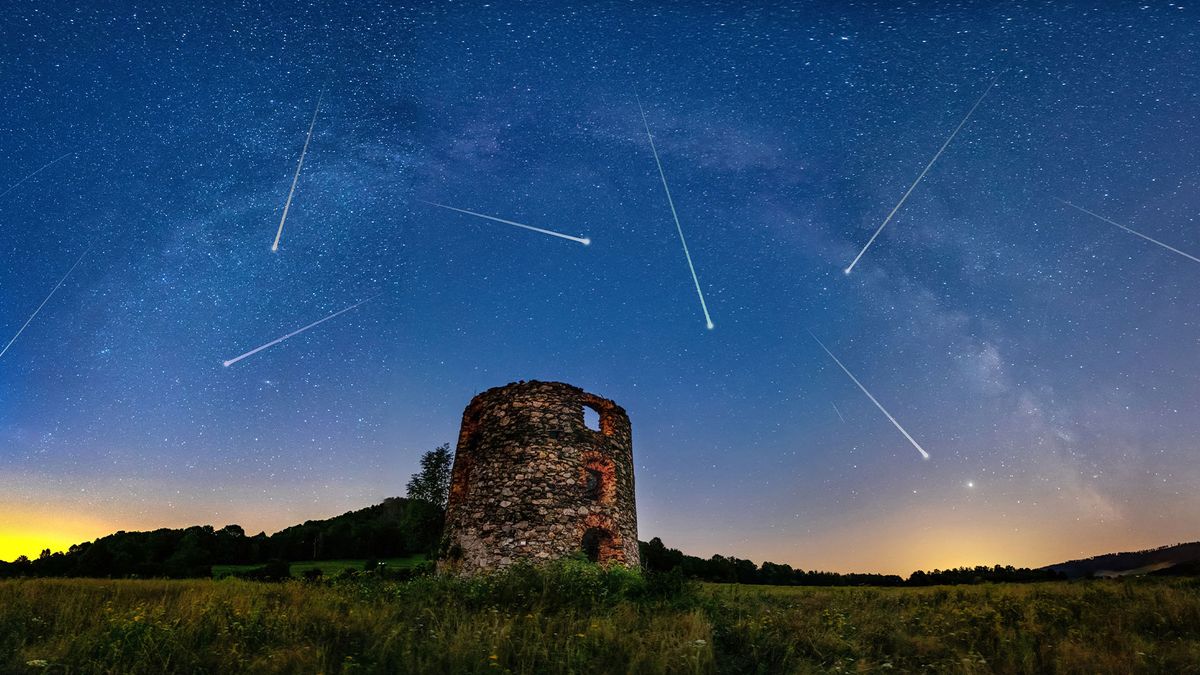
The Quadrantid meteor shower will peak this week and could bring up to 120 shooting stars per hour to the night sky.

It has the potential to be the strongest meteor shower of 2024, according to the American Meteor Society, but with such a short peak — just six hours — the shower's climax can often occur in daylight.

This year, the predicted peak is 7:53 a.m. EST (12:53 GMT) on Jan. 4, according to EarthSky. That makes the pre-dawn hours — from around 4:53 a.m. EST to dawn — the best time to observe the shower from North America. Those in western regions of the continent will have the best chance to watch for Quadrantids earlier at night. (If you got a new pair of stargazing binoculars or a nice beginner telescope for the holidays, they sadly will not help you spot any fast-moving meteors. However, here are the best skywatching events of 2024 to look forward to.)

About 25 shooting stars per hour are typically seen in a dark sky during the peak of the Quadrantids, according to the American Meteor Society. However, it's likely not worth traveling to dark skies for this event in 2024 because a bright last quarter moon will be in the sky just as the Quadrantids peak. Moonlight bleaches the sky and makes it more challenging to see fainter shooting stars, though the Quadrantids are known to produce bright fireballs that cut through light pollution of all kinds.

Meteor showers are typically named after the constellation from which they appear to come from. In the case of the Quadrantids, that's the constellation of Quadrans Muralis, though it is no longer recognized as a constellation. It's between the constellations of Bootes and Draco, near the end of the handle of the Big Dipper in the northern sky, according to NASA. Because of its position in the sky, the Quadrantid meteor shower is only visible in the Northern Hemisphere.

Shooting stars are meteoroids — small, rocky particles that strike Earth's atmosphere. These tumbling particles heat up and vaporize, releasing energy that's visible as streaks of light in the night sky. The Quadrantid meteor shower is thought to be caused by dust and debris left in the inner solar system by the asteroid 2003 EH1, which orbits the sun every 5.5 Earth years.

Adblock test (Why?)

Article From & Read More ( Quadrantid meteor shower 2024: The year's 1st meteor shower blazes over North America on Jan. 3 - Livescience.com )
https://ift.tt/GCfQjZ7
Science

Saturday, December 30, 2023

New Hampshire 100 days away from total solar eclipse - WMUR Manchester

OF THE MONEY APRIL 8, 2024 IS OFFICIALLY SOLAR ECLIPSE DAY IN NEW HAMPSHIRE. THAT’S WHEN WE’LL BEING SEEING A TOTAL SOLAR ECLIPSE. THE STATE EXPECTS A LOOFT TOURISTS, ESPECIALLY IN THE NORTH COUNTRY WHERE IT WILL BE PEAK VIEWING. THIS MORNING, THE GOVEORRN SIGNED A BILL MAKING THE DAY’S SPECIAL DESIGNATION OFFICI.AL AFTER 2024, THE NEXT TOTAL ECLIPSE WILL NOT HAPPEN UNTIL 2079. KEVIN: YOU KNOW WHAT MAKES ME NERVOUS ABOUT THAT?

Advertisement

New Hampshire 100 days away from total solar eclipse

Eclipse on April 8, 2024, will be New Hampshire’s first total solar eclipse since 1959

Some Granite Staters and people around the world are counting down the days until the total solar eclipse crosses the U.S. in 2024.Granite Staters have been fortunate enough to see this breathtaking phenomenon in the past.New Hampshire saw its only total solar eclipses over the last 150 years, in 1932 and 1959.>> Download the FREE WMUR app1932On Aug. 31, 1932, the path of totality began in the Arctic Sea and crossed through central and southeastern Canada before passing through Vermont and New Hampshire, with slivers of Massachusetts and Maine seeing totality.In New Hampshire, the path covered all of the North Country and the White Mountains, covering Mount Washington and the Old Man of the Mountain. The path then crossed through part of the central and southeastern parts of the state, including Plymouth, Tilton, Laconia, Lake Winnipesaukee, Rochester, Somersworth, Dover, Portsmouth, Hampton Beach and Seabrook.A Granite Stater wrote to the Plaistow Historical Society in 2008 with his memories of the “striking” 1932 event. He recalled that birds seemed to stop flying by or chirping when the sun was blocked, and roosters began crowing as if it was sunrise when the sun reemerged in the sky.1959On Oct. 2, 1959, a solar eclipse began its path of totality at sunrise in extreme southern New Hampshire and central Massachusetts.Communities like Jaffrey, Rindge, New Ipswich, Greenville, Hollis, Nashua, Windham, Salem and Plaistow were all in the path. In Nashua, for example, the totality peaked at 6:50 a.m. and lasted for about 35 seconds.The totality path also crossed through Boston, where rainy weather prevented viewing of the eclipse, but the “sudden brightening of the sky at the end of totality was a startling and impressive sight,” Margaret Mayall wrote in the 1960 version of the Journal of the Royal Astronomical Society of Canada.2017 and other notable close callsThe eclipse in 2017 did not reach totality in New Hampshire, but about 60% of the sun was be covered by the moon at the eclipse’s peak.Granite Staters may recall other close calls in the past, including:Jan. 24, 1925 – The totality path crossed through New York City and southern New England, with New Hampshire seeing a near-total eclipse at 98% coverage in southern areas.July 20, 1963 – The totality path only crossed through Alaska and central Maine in the US, but New Hampshire’s view of the sun was obscured by more than 90%.March 7, 1970 – Much of New Hampshire saw the more than 90%t of the sun blocked by the moon as the totality path crossed over Nantucket but missed the rest of New England.May 10, 1994 - An eclipse crossed through the Granite State at about 1:42 p.m. It was annular — and not total — because the moon was further away from the Earth than normal in its orbit. So while the entire moon blocked our view of the sun, it covered only about 89% of the sun at its peak, with a ring of sunlight forming around the moon.2024The eclipse on April 8, 2024, will be New Hampshire’s first total solar eclipse since 1959.The totality path will cross northern Vermont (including Burlington), southern Canada (including Montreal), northern New Hampshire and a large swath of northern Maine.New Hampshire communities along the path include Lancaster, Stark, Northumberland, Milan, Dummer, Errol, Dixville Notch and Pittsburg.Totality will last about 3 minutes and 30 seconds. The peak in New Hampshire will be about 3:30 p.m. For the rest of the state, the sun will be obscured by 95% or more at the peak. 2079In 56 years, on May 1, 2079, New Hampshire will experience totality again. Like its eclipse in 1959, this one will occur around sunrise. This eclipse will begin in the northeastern United States before crossing the Atlantic Ocean and into Greenland and later the Arctic Ocean.A large swath of southern New Hampshire will be in its path, with the eclipse peaking at about 6:07 a.m. Communities in the totality path include Wolfeboro, Rochester, Somersworth, Dover, Hampton, Epping, Exeter, Manchester, Concord, Loudon, Nashua, Salem, Jaffrey and Keene.
Some Granite Staters and people around the world are counting down the days until the total solar eclipse crosses the U.S. in 2024.

1932 eclipse in NH

Furnished by Plaistow Historical Society

Granite Staters have been fortunate enough to see this breathtaking phenomenon in the past.

New Hampshire saw its only total solar eclipses over the last 150 years, in 1932 and 1959.

>> Download the FREE WMUR app

1932

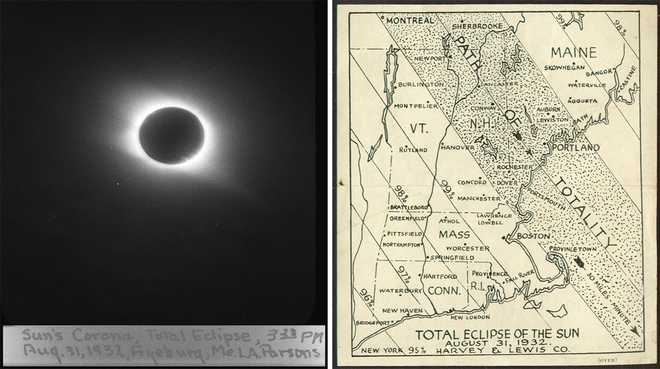
On Aug. 31, 1932, the path of totality began in the Arctic Sea and crossed through central and southeastern Canada before passing through Vermont and New Hampshire, with slivers of Massachusetts and Maine seeing totality.

In New Hampshire, the path covered all of the North Country and the White Mountains, covering Mount Washington and the Old Man of the Mountain. The path then crossed through part of the central and southeastern parts of the state, including Plymouth, Tilton, Laconia, Lake Winnipesaukee, Rochester, Somersworth, Dover, Portsmouth, Hampton Beach and Seabrook.

Solar eclipse glasses

Hearst Owned

A Granite Stater wrote to the Plaistow Historical Society in 2008 with his memories of the “striking” 1932 event. He recalled that birds seemed to stop flying by or chirping when the sun was blocked, and roosters began crowing as if it was sunrise when the sun reemerged in the sky.

1959

On Oct. 2, 1959, a solar eclipse began its path of totality at sunrise in extreme southern New Hampshire and central Massachusetts.

Communities like Jaffrey, Rindge, New Ipswich, Greenville, Hollis, Nashua, Windham, Salem and Plaistow were all in the path. In Nashua, for example, the totality peaked at 6:50 a.m. and lasted for about 35 seconds.

The totality path also crossed through Boston, where rainy weather prevented viewing of the eclipse, but the “sudden brightening of the sky at the end of totality was a startling and impressive sight,” Margaret Mayall wrote in the 1960 version of the Journal of the Royal Astronomical Society of Canada.

2017 and other notable close calls

The eclipse in 2017 did not reach totality in New Hampshire, but about 60% of the sun was be covered by the moon at the eclipse’s peak.

Granite Staters may recall other close calls in the past, including:

  • Jan. 24, 1925 – The totality path crossed through New York City and southern New England, with New Hampshire seeing a near-total eclipse at 98% coverage in southern areas.
  • July 20, 1963 – The totality path only crossed through Alaska and central Maine in the US, but New Hampshire’s view of the sun was obscured by more than 90%.
  • March 7, 1970 – Much of New Hampshire saw the more than 90%t of the sun blocked by the moon as the totality path crossed over Nantucket but missed the rest of New England.
  • May 10, 1994 - An eclipse crossed through the Granite State at about 1:42 p.m. It was annular — and not total — because the moon was further away from the Earth than normal in its orbit. So while the entire moon blocked our view of the sun, it covered only about 89% of the sun at its peak, with a ring of sunlight forming around the moon.

2024

The eclipse on April 8, 2024, will be New Hampshire’s first total solar eclipse since 1959.

2024 total solar eclipse

Hearst Owned

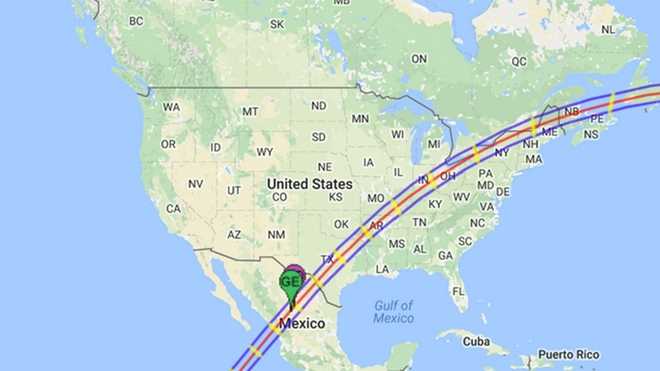
The totality path will cross northern Vermont (including Burlington), southern Canada (including Montreal), northern New Hampshire and a large swath of northern Maine.

New Hampshire communities along the path include Lancaster, Stark, Northumberland, Milan, Dummer, Errol, Dixville Notch and Pittsburg.

Totality will last about 3 minutes and 30 seconds.

The peak in New Hampshire will be about 3:30 p.m. For the rest of the state, the sun will be obscured by 95% or more at the peak.

2079

In 56 years, on May 1, 2079, New Hampshire will experience totality again. Like its eclipse in 1959, this one will occur around sunrise. This eclipse will begin in the northeastern United States before crossing the Atlantic Ocean and into Greenland and later the Arctic Ocean.

A large swath of southern New Hampshire will be in its path, with the eclipse peaking at about 6:07 a.m. Communities in the totality path include Wolfeboro, Rochester, Somersworth, Dover, Hampton, Epping, Exeter, Manchester, Concord, Loudon, Nashua, Salem, Jaffrey and Keene.

Adblock test (Why?)

Article From & Read More ( New Hampshire 100 days away from total solar eclipse - WMUR Manchester )
https://ift.tt/nWZjSl5
Science

Friday, December 29, 2023

'God of Chaos': NASA sends spacecraft to study asteroid approaching earth - FRANCE 24 English

A NASA spacecraft, recently returned from a mission to asteroid Bennu, has been relaunched to study another asteroid as it approaches Earth’s orbit: Apophis, named after the Egyptian god of Chaos. The space rock is expected to pass within 32,000 kilometres of the Earth's surface on April 13, 2029.

Issued on:

3 min

On December 22, NASA announced it had relaunched its OSIRIS-REx spacecraft to study a 370-metre-diameter asteroid approaching Earth's orbit named Apophis.

In Egyptian mythology, Apophis is a serpent-shaped god and an embodiment of darkness and disorder which seeks to eradicate the world. Thankfully, the asteroid bearing its name has no such intention. 

Like Earth, Apophis orbits the sun and now and again, it almost comes into contact with our planet. On April 13, 2029, the 40-50 million ton asteroid is expected to get within 32,000 kilometres of Earth, closer than some artificial satellites – something that has never occurred in recorded history.

Weather permitting, five years from now, Apophis’s passage may be visible to the naked eye in Asia, the Indian Ocean, Australia, most of Africa and Europe, and part of the Pacific Ocean.

Old spacecraft, new mission

After a seven-year journey to the Bennu asteroid, the OSIRIS-REx returned to Earth in September. After the 4 billion kilometre journey, the spacecraft still had a quarter of its fuel left and was thus sent off to intercept Apophis.

Several other destinations, including Venus, were considered though the voyage to Apophis won out. For its new mission, the spacecraft was renamed OSIRIS-APEX (Origins, Spectral Interpretation, Resource Identification, and Security – Apophis Explorer).

The mission will cost an estimated $200 million, according to NASA.

Apophis is an “S-type” asteroid composed of silicate and nickel-iron materials, distinguishing it from “C-type” asteroids, rich in carbon, like Bennu. 

When the asteroid gets closer to Earth, OSIRIS-APEX will get within 25 metres of Apophis’s surface to extract as much information as possible. Of particular interest to scientists is "how the surface changes when interacting with Earth's gravity", said Amy Simon, the mission's principal investigator at NASA's Goddard Space Flight Center, in the NASA press release announcing the mission.

Coming into contact with Earth’s gravitational field could trigger earthquakes and landslides on the asteroid, which would then stir up matter. "Apophis’s close encounter with Earth will change the asteroid’s orbit and the length of its 30.6-hour day,” said NASA.

"We know that tidal forces and the accumulation of rubble pile material are foundational processes that could play a role in planet formation," said Dani Mendoza DellaGiustina, principal investigator of the OSIRIS-APEX mission at the University of Arizona. "They could shed light on how we evolved from the debris of the early solar system to full-blown planets."

While most known potentially hazardous asteroids (whose orbits approach within 4.6 million kilometres of Earth) are S-type, Apophis’s proximity to Earth allows NASA to research planetary defence, one of the organisation’s top priorities.

Collision with Earth ruled out

The discovery of the Apophis at Arizona’s Kitt Peak Observatory in 2004 raised concerns and still fuels theories about a potential collision with Earth. "Apophis is coming, that's why they're building their bunkers," reads a post from a user on X.

In the early stages of discovery, the asteroid was classed as a level 4 on the Torino Scale (used to categorise the risks of impacts from near-Earth objects, such as asteroids or comets, on a scale from 0 to 10), the highest-ever classification.

But in December 2004, just a few months after the asteroid's discovery, updated modelling demonstrated the possibility of impact with Earth was nearly zero. 

Furthermore, in June 2021, Apophis passed 17 million kilometres from Earth, allowing NASA to adjust calculations and definitively rule out the possibility of a collision. 

Dismissing a "Don't Look Up" scenario, NASA officially removed Apophis from its Earth Close Approaches list.

After the asteroid passes, OSIRIS-APEX will operate near it for 18 months to study the changes caused to Aophis by its proximity to the Earth.

This article has been translated from the original in French.

Adblock test (Why?)

Article From & Read More ( 'God of Chaos': NASA sends spacecraft to study asteroid approaching earth - FRANCE 24 English )
https://ift.tt/8wpd0sn
Science

US military space plane blasts off on another secretive mission expected to last years - ABC News

The U.S. military's X-37B space plane blasted off Thursday on another secretive mission that’s expected to last at least a couple of years.

Like previous missions, the reusable plane resembling a mini space shuttle carried classified experiments. There's no one on board.

The space plane took off aboard SpaceX’s Falcon Heavy rocket from NASA's Kennedy Space Center at night, more than two weeks late because of technical issues.

It marked the seventh flight of an X-37B, which has logged more than 10 years in orbit since its debut in 2010.

The last flight, the longest one yet, lasted 2 1/2 years before ending on a runway at Kennedy a year ago.

Space Force officials would not say how long this orbital test vehicle would remain aloft or what's on board other than a NASA experiment to gauge the effects of radiation on materials.

Built by Boeing, the X-37B resembles NASA’s retired space shuttles. But they're just one-fourth the size at 29 feet (9 meters) long. No astronauts are needed; the X-37B has an autonomous landing system.

They take off vertically like rockets but land horizontally like planes, and are designed to orbit between 150 miles and 500 miles (240 kilometers and 800 kilometers) high. There are two X-37Bs based in a former shuttle hangar at Kennedy.

___

The Associated Press Health and Science Department receives support from the Howard Hughes Medical Institute’s Science and Educational Media Group. The AP is solely responsible for all content.

Adblock test (Why?)

Article From & Read More ( US military space plane blasts off on another secretive mission expected to last years - ABC News )
https://ift.tt/wc5AbSf
Science

NASA Juno probe to produce 'firehose of data' during close flyby of Jupiter moon - The Register

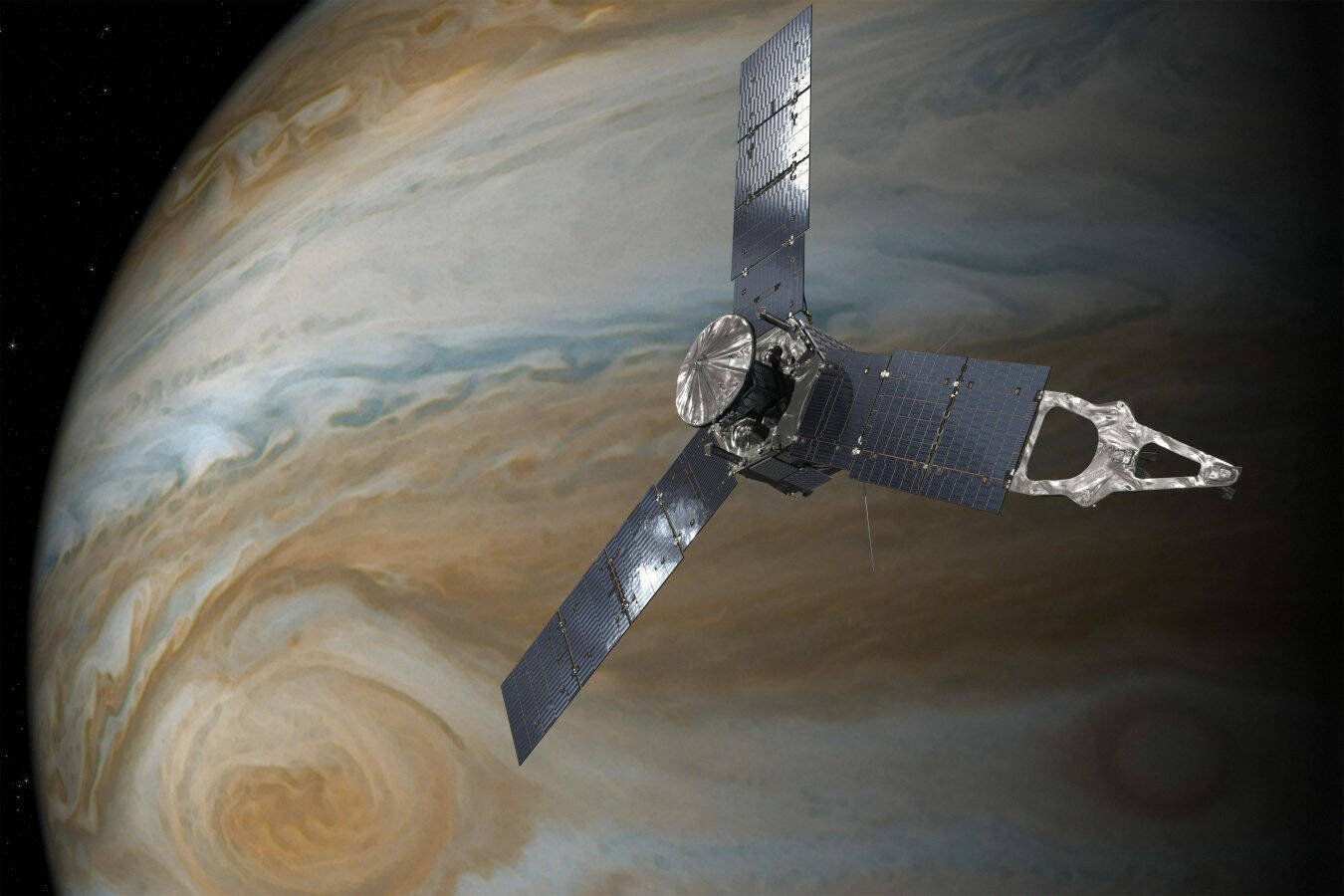
NASA's Juno mission is to close out 2023 with a low pass over Io, one of Jupiter's many moons.

The spacecraft will come within 930 miles (1,500 kilometres) of the surface on December 30. According to NASA this week, "The pass is expected to allow Juno instruments to generate a firehose of data."

We're sure beaming back that sensor data will be a lot of fun. The probe's computer system includes 256 MB of flash memory, 128 MB of DRAM, a radiation-hardened PowerPC processor, and a set of radio communication uplinks and downlinks.

Io is slightly larger than Earth's moon and is said to be the most geologically active object in the Solar System. Its volcanoes produce plumes of sulfur that can reach 300 miles (500 kilometres) above the surface as Jupiter and the other moons of the gas giant pull on Io.

Juno is one of many spacecraft to snap shots of Jupiter and its moons. Pioneer 10 and 11 got there in 1973 and 1974 respectively, followed by the Voyagers, which featured far more advanced imaging systems. The Voyager images provided evidence of plumes emanating from the surface of Io, and the pair were followed by the Galileo probe, which arrived in 1995.

Other craft – Cassini and New Horizons – also made observations as they hurtled toward their ultimate destinations.

Juno is now in the third year of its extended mission to study Jupiter, and a second close flyby – also within approximately 930 miles (1,500 kilometers) is planned for February 3, 2024. Quite a bit closer than the 6,830 miles (11,000 kilometres) to 62,100 miles (100,000 kilometres) from where the spacecraft had been monitoring the moon.

The spacecraft's three cameras will be running during the flyby, and the highest-resolution images to date are expected to be produced by the Stellar Reference Unit. This navigation camera has proven useful for scientific purposes.

However, all is not entirely well with Juno's payload. While the JunoCam – added for public engagement purposes – will be running, this imager is showing signs of deterioration, having passed its expected lifespan. It was, after all, only supposed to operate for up to seven Jupiter orbits. This week's Io pass will be Juno's 57th orbit around Jupiter.

"The cumulative effects of all that radiation has begun to show on JunoCam over the last few orbits," said Ed Hirst, project manager of Juno at NASA's Jet Propulsion Laboratory in Southern California.

"Pictures from the last flyby show a reduction in the imager's dynamic range and the appearance of 'striping' noise."

Engineers are working to alleviate the damage and keep the imager going. The JunoCam kicked off 2023 with some technical issues, including an odd rise in temperature when the device was switched on. It is not, however, considered part of the science instruments, although the images have proven useful to scientists.

The Juno team has slightly tweaked the spacecraft's planned future trajectory to add more Io flybys after February 3. However, these will get progressively more distant, with the last being about 71,450 miles (115,000 kilometres) from the moon.

But all good things must come to an end. The mission is scheduled to run through September 2025 unless something breaks sooner. The data collected has and will prove invaluable for the upcoming Europa Clipper mission and the European Space Agency's Jupiter Icy Moons Explorer – JUICE – which is due to arrive at Jupiter in 2031 following its launch on April 14, 2023. ®

Adblock test (Why?)

Article From & Read More ( NASA Juno probe to produce 'firehose of data' during close flyby of Jupiter moon - The Register )
https://ift.tt/MInGasb
Science

Search

Featured Post

Two meteor showers will peak tonight. How to watch the Southern Delta Aquariids and the Alpha Capricornids. - Yahoo

[unable to retrieve full-text content] Two meteor showers will peak tonight. How to watch the Southern Delta Aquariids and the Alpha Caprico...

Postingan Populer