Rechercher dans ce blog

Wednesday, January 3, 2024

Study Aims to Bring a Tinier Tyrannosaur Back From Oblivion - The New York Times

New research is trying to remake the case that fossils known as Nanotyrannus were their own species, rather than a teenage Tyrannosaurus rex.

It is only 23 inches long, but one tyrannosaur skull has been a bone of serious contention among paleontologists for decades.

In 1988, a team of researchers named it Nanotyrannus lancensis, suggesting that it represented a distinct animal that lived in the shadow of Tyrannosaurus rex. In 1999, another group argued that the skull and similar specimens were T. rex as a teenager, before the species underwent an extraordinary growth spurt that preceded adulthood.

For years, the teen T. rex hypothesis gained traction.

“Most people bought into it, including me,” said Nick Longrich, a paleontologist with the University of Bath in England.

But Dr. Longrich has changed his tune. In a study published Wednesday in the journal Fossil Studies, he and colleagues argue that enough evidence exists to resurrect Nanotyrannus as its own species among the larger Tyrannosaur family. Based on anatomical features, they argue, it isn’t even particularly closely related to T. rex.

Other experts say the study is unlikely to end the debate.

“It’s sort of like Schrodinger’s dinosaur,” said Thomas Holtz, a paleontologist at the University of Maryland who was not involved with the paper. “This paper’s going to keep people talking about it, but it’s not going to really resolve it.”

To make its case, Dr. Longrich’s team studied the original 23-inch skull and more recent finds named Jane and Petey, as well as a long-disputed tyrannosaur specimen, the “dueling dinosaurs.” All of these have been argued to represent adolescent T. rex, Dr. Longrich said. But his team said it found around 150 differences in their anatomy, including skull details; an extended, bladelike snout; and longer arms and claws than adult T. rex.

He also said the specimens had features consistent with mature animals, not adolescents. The growth rings inside the bone from three specimens — including Jane and Petey — likewise suggest slowing growth rates. The animals were on track to weigh over a ton, rather than the T. rex, which was four to five tons, the researchers estimated.

“We have three individuals, which basically rules out an individual variation or aberrant growth pattern,” Dr. Longrich said. “What we’re seeing is that the growth patterns are inconsistent with these animals being juveniles.”

A comparison of skulls, a T. rex, top, and the Nanotyrannus lancensis specimen found in the Hell Creek Formation of Montana.Larry Witmer; American Museum of Natural History
A fragment of juvenile T. rex skull bone from the Hell Creek of Montana.Nick Longrich

Where, then, are the actual juvenile T. rex? Dr. Longrich believes he’s found a fragment of one — a piece of skull from the University of California, Berkeley, collections described in the paper. “In every single feature it was T.rex,” he said.

Other paleontologists are not ready to throw out the teenage T. rex hypothesis, and they raised strong objections to the paper.

The specimens in question do show features in common with adult T. rex — among them the forehead, snout and braincase, said Thomas Carr, a paleontologist at Carthage College who first made the case that Nanotyrannus represented young T. rex. Moreover, he disagrees with the claim that they don’t fit the growth pattern in other tyrannosaur skulls.

“With T. rex and tyrannosaurs in general, differences between juveniles and adults are quite extreme and people are easily thrown,” Dr. Carr said.

Holly Woodward, a paleontologist at Oklahoma State University who produced some of the growth data used by Dr. Longrich’s team, also disputed their conclusions. The spacing of the innermost growth rings in the bone tissue of nearly full grown adult T. rex suggest “lower growth rates at younger ages before the big growth spurt,” she said.

Dr. Woodward added that the team’s choice of mathematical models risks producing a distorted picture that shows younger animals that are done growing, even if that isn’t the case.

“I’m just not convinced that the growth curve arguments support that hypothesis,” she said.

Dr. Longrich responded that teenage T. rex proponents haven’t proven their case either: “I’d throw it back in their camp and say, ‘Where is the evidence for your hypothesis?’”

He explained that “for Nanotyrannus to turn into T. rex, this requires an extraordinary number of transformations.” No other dinosaur develops like this, Dr. Longrich argues: Everything his team studied fits neatly into the Nanotyrannus form or the T. rex one.

Credible paleontologists have historically argued both sides of the issue, Dr. Holtz said. Part of the issue is that most T. rex specimens are adults, with only a few subadults. Everyone acknowledges that gap; they simply disagree about its meaning.

The discovery of either an older adult Nanotyrannus or a young T. rex distinct from the Nanotyrannus form would help clarify things, Dr. Holtz said. So could forthcoming data about Jane and the “dueling dinosaurs” tyrannosaur. While the team’s paper provides interesting suggestions, Dr. Holtz said it isn’t enough for him to reject the hypothesis “that these are juvenile T.rex.”

The argument continues. For an animal that may or may not have existed, Nanotyrannus is proving curiously difficult to kill.

Adblock test (Why?)

Article From & Read More ( Study Aims to Bring a Tinier Tyrannosaur Back From Oblivion - The New York Times )
https://ift.tt/Pxg4mqe
Science

Tuesday, January 2, 2024

Quadrantid Meteor Shower Set To Produce 120 Shooting Stars An Hour This Week - IFLScience

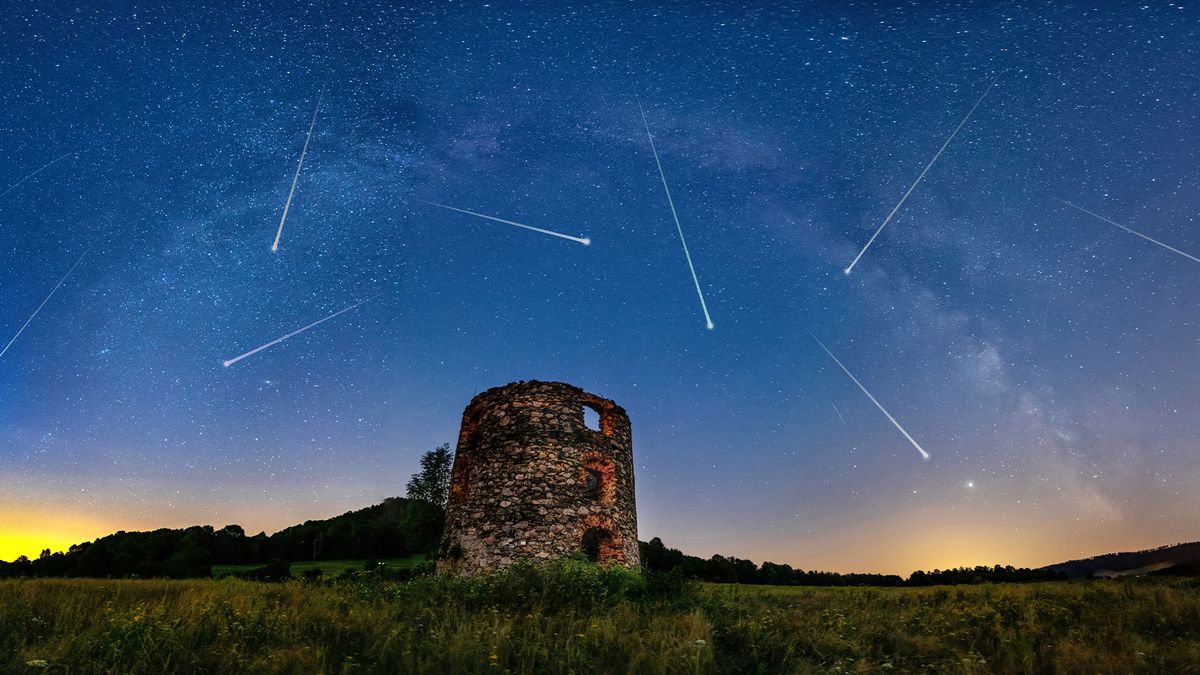
The Quadrantid meteor shower will peak this week and it’s set to be one of the strongest showers of 2024 with up to 120 shooting stars being visible each hour.

The Quadrantids are due to reach peak activity on the night of January 3 to 4, according to the American Meteor Society. 

The Quadrantid meteor shower started on December 26, 2023, and will continue until January 16, 2024. For star-gazers in North America, the shower will be at its most active in the early hours of January 4. 

The moon will be 51 percent full on this night, which may slightly interfere with the spectacle. Likewise, cloudy January weather often puts a dampening on this annual meteor shower.

However, the Quadrantids are widely considered to be one of the best annual meteor showers. As per NASA, you can expect to see approximately 120 meteors per hour during periods of peak activity. They’re also known for their bright fireball meteors that can persist longer than an average meteor streak.

To get the best view of the meteor shower, head outside in a dark place that’s far away from street lamps and other artificial lighting, including phone screens. You should be patient and go outside early to let your eyes acclimatize to the lower light conditions. 

In case you can't catch them in person, there will also be a live stream of the event broadcasted by the Virtual Telescope Project, which you can view in this link here.

Meteor showers occur when Earth passes through the debris left behind by a comet or asteroid. Tiny pieces of debris from these objects enter Earth’s atmosphere at approximately 41 kilometers (25.5 miles) per second for the Quadrantids. This intense amount of energy causes the debris to burn up when it smacks into Earth's atmosphere, leaving behind a bright streak of light in the sky.

In the case of the Quadrantids, the parent object is 2003 EH1, a near-Earth object that’s either a rocky asteroid or a possible "rock comet”, aka a "dead comet”. This is essentially a once-icy comet that has expelled all of its ice and other volatiles. Discovered in 2003, its diameter measures just 3 kilometers (2 miles) or so. 

There are plenty of other major meteor showers to look forward to in 2024. In mid-April, Earth's skies will be graced by the Lyrids, followed by the Aquariids in early May.

Adblock test (Why?)

Article From & Read More ( Quadrantid Meteor Shower Set To Produce 120 Shooting Stars An Hour This Week - IFLScience )
https://ift.tt/OkClnJ9
Science

NASA flies extremely close by volcano world, captures wild footage - Mashable

A NASA spacecraft survived extreme radiation and captured rich images of the most volcanic world in our solar system, the tortured moon Io.

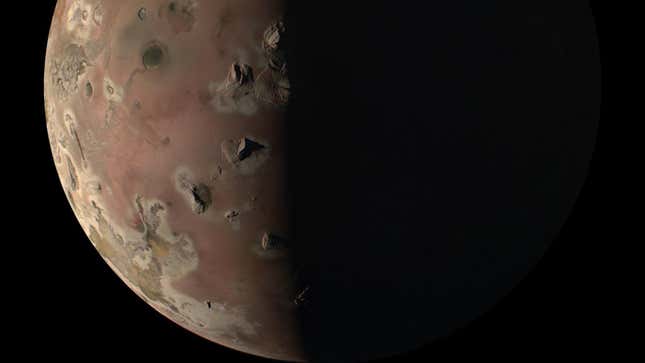
Over the last year, the legendary Juno craft has been swooping progressively closer to Jupiter's volcano-blanketed moon, and on Dec. 30 passed just some 930 miles (1,500 kilometers) from Io's surface. That's quite close — only about three times farther than the Hubble telescope orbits Earth. You can clearly see some impressive volcanoes.

To make such a near pass, Juno had to endure profoundly high levels of radiation around Jupiter — the type that could damage the spacecraft's instruments. In 2022, for example, a radiation spike during an Io fly-by caused the loss of some images.

NASA scientists had their fingers crossed. Alas, the spacecraft, which arrived around Jupiter in 2016 following a 1,740-million-mile journey, endured.

These impressive views are processed (removing noise and distortion, etc.) by both professional and amateur image processors, some of whom work for NASA or related space research programs. These are the closest views of Io captured in over two decades. (And more images will be added as they become available.)

Mashable Light Speed
Want more space and science stories in your inbox?
Sign up for Mashable's weekly Light Speed newsletter.
By signing up you agree to our Terms of Use and Privacy Policy.
Thanks for signing up!
a close view of Jupiter's moon Io.
Jupiter's moon Io with visible volcanoes. Credit: NASA / SwRI / MSSS

Io is blanketed in erupting volcanoes (there are currently 266 active hot spots on the surface) because it's relentlessly locked in a tug-of-war between nearby objects. "Not only is the biggest planet in the solar system forever pulling at it gravitationally, but so are Io’s Galilean siblings — Europa and the biggest moon in the solar system, Ganymede," NASA explained in a statement. "The result is that Io is continuously stretched and squeezed, actions linked to the creation of the lava seen erupting from its many volcanoes."

In the coming years, we'll also learn considerably more about the moon Europa, a world planetary scientists say harbors a salty sea beneath its thick, icy shell. "Europa may be the most promising place in our solar system to find present-day environments suitable for some form of life beyond Earth," NASA explains. In 2024, NASA will launch the much-anticipated Europa Clipper spacecraft to Jupiter, where the probe will repeatedly sweep close to the moon.

For now, expect more detailed views of Io. NASA plans another "ultra-close flyby" on Feb. 3, 2024. This data may help answer big, looming questions about the volcano world. Is there a grandiose global sea of magma swirling beneath Io's surface? Or, perhaps, is the lava pouring onto the moon largely created by a process more similar to Earth's, whereby a great amount of heat flow is created below the hard crust (in the upper mantle), which ultimately gives rise to regions where magma erupts onto the surface?

"That's the big question," Ashley Davies, a planetary scientist at NASA's Jet Propulsion Laboratory who researches Io, recently told Mashable.

Topics NASA

Adblock test (Why?)

Article From & Read More ( NASA flies extremely close by volcano world, captures wild footage - Mashable )
https://ift.tt/dFcfilK
Science

See Wild New Close-Up Images of Jupiter's Volcanic Moon Io - Gizmodo

NASA’s Juno mission captured Jupiter’s moon Io on December 30 during its closest flyby.
Image: NASA/Image processed by Kevin M. Gill

The mutilated surface of Jupiter’s moon Io was revealed in great detail by the Juno spacecraft, which has been exploring the Jovian system since 2016 and recently pulled off the closest flyby of the volcanic world.

NASA’s Jupiter probe had its close encounter with Io on Saturday, December 30, flying at a distance of 930 miles (1,500 kilometers) away from its hellish surface. This marked not only the closest flyby of Io by Juno, but by any spacecraft in the past 20 years, according to NASA.

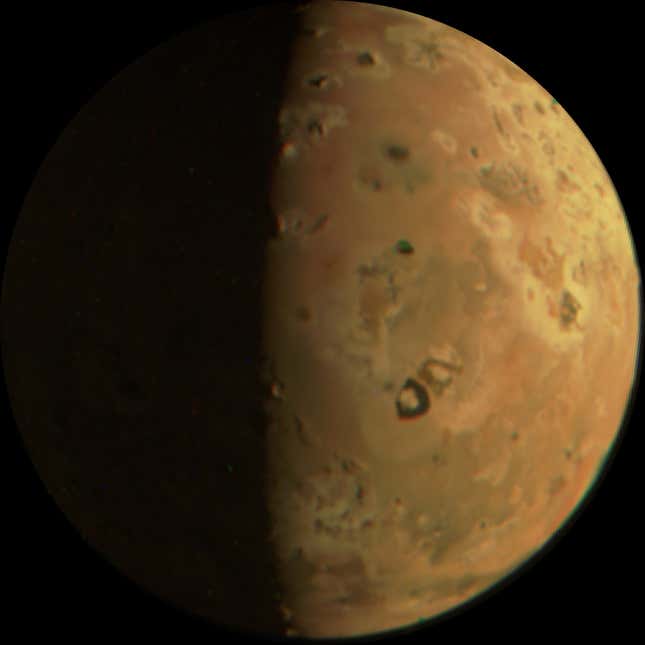
During this rare rendezvous, Juno captured intimate views of Jupiter’s moon using all three of its on board cameras. On Sunday, NASA released six images of the moon Io as seen by the spacecraft.

A raw image of Io.
A raw image of Io.
Image: NASA

Jupiter’s rocky moon is the most volcanically active body in the solar system. As revealed in the new images, the surface of Io is mangled by hundreds of volcanoes and lakes of molten silicate lava that appear as burnt scarring across its tortured landscape. As the innermost of Jupiter’s four Galilean moons, Io is stuck between the planet’s immense gravitational force and the gravitational tug of its sister moons Europa and Ganymede. This contributes to the moon’s volcanic activity as Io is constantly being stretched and squeezed due to its position.

With its close flybys of Io, the team behind the Juno mission is investigating the source of the moon’s volcanic activity and hoping to find out whether it is harboring a magma ocean underneath its crust, according to NASA. The Juno science team will study how often the volcanoes on Io erupt, how bright and hot they are, and how the shape of the lava flow changes.

Io is also the main source of most of the charged particles in Jupiter’s magnetosphere, creating a donut-shaped cloud of ions and electrons that surround the planet. The cloud, known as Io Plasma Torus, is formed when the atmospheric gases escaping from Io are ionized. A group of scientists from the Southwest Research Institute in San Antonio, Texas, will also study how Io’s volcanic activity is connected to the flow of charged particles in Jupiter’s magnetosphere by combining Juno data with remote observations by the Hubble and Webb space telescopes.

In October, Juno captured an ominous view of Io, revealing its charred surface in the closest view of the moon thus far. Juno also captured a cozy family photo of Jupiter and Io in September, revealing the gas giant and its moon side by side.

Juno’s recent flyby of Io marked the spacecraft’s 57th orbit of the Jovian system, enduring years of radiation from the gas giant’s environment. “The cumulative effects of all that radiation has begun to show on JunoCam over the last few orbits,” Ed Hirst, project manager of Juno at NASA’s Jet Propulsion Laboratory, said in a statement. “Our engineering team has been working on solutions to alleviate the radiation damage and to keep the imager going.”

Juno is scheduled for a second close flyby of Io on February 3, in which the spacecraft will come within a distance of 930 miles (1,500 kilometers) from the moon’s surface.

For more spaceflight in your life, follow us on X (formerly Twitter) and bookmark Gizmodo’s dedicated Spaceflight page.

Adblock test (Why?)

Article From & Read More ( See Wild New Close-Up Images of Jupiter's Volcanic Moon Io - Gizmodo )
https://ift.tt/pwuq7v5
Science

Monday, January 1, 2024

Space photo of the week: Uranus 'rings' in the New Year in stunning James Webb telescope image - Livescience.com

What it is: Uranus and 14 of its 27 moons

When it was taken: Dec. 18, 2023

Where it is: 1.8 billion miles (2.9 billion kilometers) from the sun

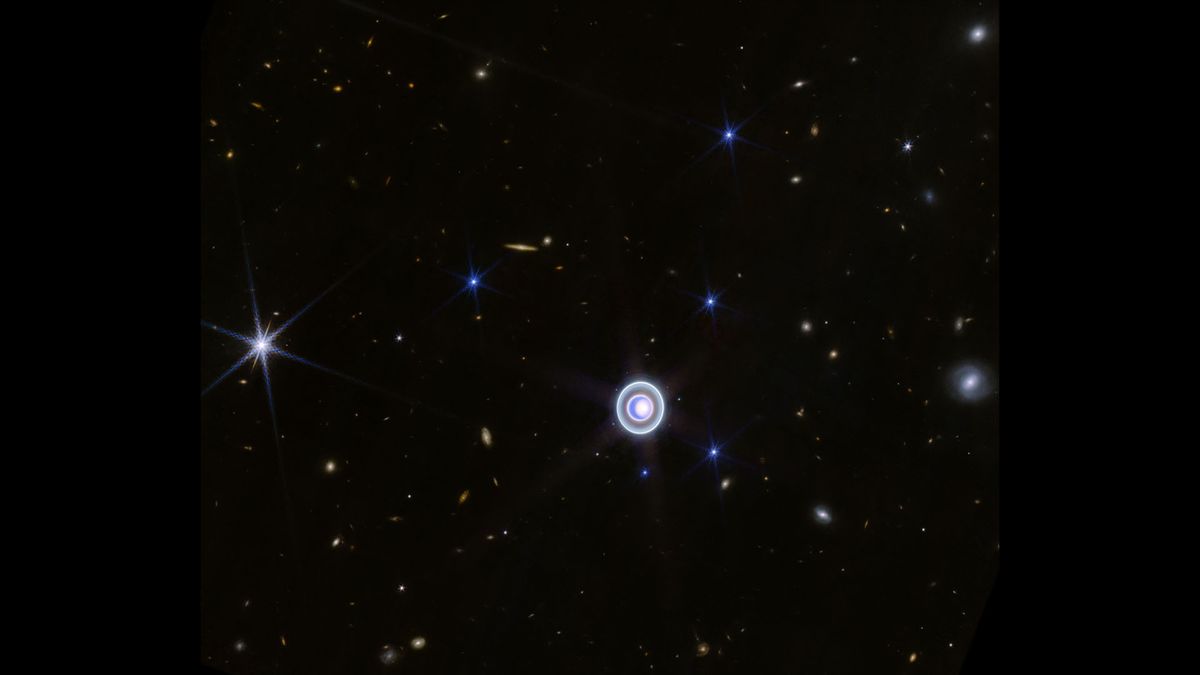
Why it's so special: This photo of Uranus, captured by the James Webb Space Telescope, reveals the ice giant planet in exquisite detail. The wide-field image shows Uranus' rings, a polar ice cap, 14 of the planet's 27 moons, background stars and galaxies.

The close-up image, snapped by JWST's Near Infrared Camera and released by NASA this week, is a follow-up to a set of photos taken in February. The new image features an extra wavelength of light, revealing a hidden ring. Although Uranus is known to have 13 distinct inner and outer rings, NIRCam revealed the planet's elusive "Zeta ring," a faint, diffuse ring nestled close to the planet.

Of Uranus' 27 moons, 14 are featured in this image: Oberon, Titania, Umbriel, Juliet, Perdita, Rosalind, Puck, Belinda, Desdemona, Cressida, Ariel, Miranda, Bianca and Portia.

It's a much more detailed view of Uranus than humankind's first close-up of the seventh planet, taken by NASA's Voyager 2 probe in 1986. That featureless image showed a solid bluish orb with no detail. JWST, by contrast, has captured atmospheric features such as a north polar cloud cap. That growing and receding cap is fascinating to planetary scientists because it's visible evidence that Uranus spins on an axis tilted by 98 degrees, producing seasonal and meteorological effects that create storms.

Uranus takes 84 Earth years to orbit the sun once. That slow orbit, plus the extreme tilt of Uranus, means the ice giant experiences extreme seasons, with the polar cap visible in the image resulting from its north polar region being in the depths of a 21 Earth-year-long winter that will end in 2028.

Dozens of background galaxies are visible in this wide-field image. Most have an orange tint, but if you look to the right of Uranus, you'll see two sizable white spiral galaxies.

In October, scientists at the University of Leicester in the U.K. published a paper in the journal Nature Astronomy revealing the presence of infrared aurorae around Uranus.

In April 2022, a Decadal Survey report by the National Academy of Sciences recommended that NASA probe the atmosphere, clouds and storms of the turquoise planet as part of the Uranus Orbiter and Probe Flagship mission.

Adblock test (Why?)

Article From & Read More ( Space photo of the week: Uranus 'rings' in the New Year in stunning James Webb telescope image - Livescience.com )
https://ift.tt/Gyz5ebw
Science

Nasa's Parker mission poised for solar 'landing' in 2024 - FRANCE 24 English

Since its launch in 2018, NASA’s Parker Solar Probe has inched closer to the sun with each passing year, shedding light on key solar processes. By the end of 2024, it will have set a new record by grazing our star from a distance of just over 6 million kilometres, delving deep into its scorching outer layers.

Issued on:

2 min

One of the most audacious missions in the history of space exploration, the Parker Solar Probe is the first spacecraft to have flown through the sun’s outer atmosphere, known to scientists as the corona. It is set to break new ground in late December by covering 96% of the distance separating our planet from its fiery star.

In doing so, Parker will hit speeds of around 700,000 km/h (or 435,000 mph), enough to fly from New York to Tokyo in one minute – making it the fastest human-made craft in history. It will achieve such velocity by swinging around Venus, using the planet’s gravity to tighten its orbit around the sun and acquire extra speed.

“This will be a monumental achievement for all humanity. This is equivalent to the Moon landing of 1969,” said Parker project scientist Dr Nour Raouafi of Johns Hopkins University, in an interview with the BBC. “We are basically almost landing on a star.”

Into the furnace 

Parker’s mission is to make repeated passes of the sun, drawing ever closer to the star as it travels through its outer atmosphere – which, paradoxically, is 300 times hotter than its actual surface. That means weathering unimaginable conditions, including temperatures of close to 1,400 degrees Celsius and solar winds charged with high-energy particles.

The trick for Parker is to make rapid dives into this hellscape, relying on its blistering speed and a thick heat shield made of carbon composite. The shield protects an array of instruments that  measure charged particles and magnetic fluctuations, capturing both images and sounds.

In 2020, recordings made close to the star provided the first sound clips of the solar wind – a stream of high-energy particles that flows continuously from the sun. 

Forecasting solar storms

The mission’s aim is to gain a better understanding of solar activity and to shed light on the many mysteries surrounding the corona, where temperatures can reach a million degrees Celsius and above – compared with just 6,000C at the sun's surface. Scientists hope data collected by Parker will help understand why the sun’s outer atmosphere is so much hotter than its surface.

The corona is also where the solar wind is generated and sometimes whipped up into solar “flares” and “storms”, potentially disrupting our planet’s magnetic field, degrading communications and posing health risks to astronauts. Ultimately, Parker’s findings could pave the way for a space weather service capable of forecasting and tracking such events.

An image of the sun, taken roughly halfway from our planet by the European Space Agency's Solar Orbiter on July 16, 2020.
An image of the sun, taken roughly halfway from our planet by the European Space Agency's Solar Orbiter on July 16, 2020. © ESA/EUI/NASA via AFP

The probe’s end-of-year voyage will mark its best chance of acquiring a greater understanding of key solar processes. It will also be its last: beyond December, the probe’s orbit will no longer allow it to swing around Venus, effectively precluding an even closer encounter with the sun.

This article has been translated from the original in French.

Adblock test (Why?)

Article From & Read More ( Nasa's Parker mission poised for solar 'landing' in 2024 - FRANCE 24 English )
https://ift.tt/EwtJWac
Science

Quadrantid meteor shower 2024: The year's 1st meteor shower blazes over North America on Jan. 3 - Livescience.com

The Quadrantid meteor shower will peak this week and could bring up to 120 shooting stars per hour to the night sky.

It has the potential to be the strongest meteor shower of 2024, according to the American Meteor Society, but with such a short peak — just six hours — the shower's climax can often occur in daylight.

This year, the predicted peak is 7:53 a.m. EST (12:53 GMT) on Jan. 4, according to EarthSky. That makes the pre-dawn hours — from around 4:53 a.m. EST to dawn — the best time to observe the shower from North America. Those in western regions of the continent will have the best chance to watch for Quadrantids earlier at night. (If you got a new pair of stargazing binoculars or a nice beginner telescope for the holidays, they sadly will not help you spot any fast-moving meteors. However, here are the best skywatching events of 2024 to look forward to.)

About 25 shooting stars per hour are typically seen in a dark sky during the peak of the Quadrantids, according to the American Meteor Society. However, it's likely not worth traveling to dark skies for this event in 2024 because a bright last quarter moon will be in the sky just as the Quadrantids peak. Moonlight bleaches the sky and makes it more challenging to see fainter shooting stars, though the Quadrantids are known to produce bright fireballs that cut through light pollution of all kinds.

Meteor showers are typically named after the constellation from which they appear to come from. In the case of the Quadrantids, that's the constellation of Quadrans Muralis, though it is no longer recognized as a constellation. It's between the constellations of Bootes and Draco, near the end of the handle of the Big Dipper in the northern sky, according to NASA. Because of its position in the sky, the Quadrantid meteor shower is only visible in the Northern Hemisphere.

Shooting stars are meteoroids — small, rocky particles that strike Earth's atmosphere. These tumbling particles heat up and vaporize, releasing energy that's visible as streaks of light in the night sky. The Quadrantid meteor shower is thought to be caused by dust and debris left in the inner solar system by the asteroid 2003 EH1, which orbits the sun every 5.5 Earth years.

Adblock test (Why?)

Article From & Read More ( Quadrantid meteor shower 2024: The year's 1st meteor shower blazes over North America on Jan. 3 - Livescience.com )
https://ift.tt/GCfQjZ7
Science

Search

Featured Post

Two meteor showers will peak tonight. How to watch the Southern Delta Aquariids and the Alpha Capricornids. - Yahoo

[unable to retrieve full-text content] Two meteor showers will peak tonight. How to watch the Southern Delta Aquariids and the Alpha Caprico...

Postingan Populer