Rechercher dans ce blog

Wednesday, January 3, 2024

How to find reputable solar eclipse glasses you can use for the total eclipse in April - KCRA Sacramento

A total solar eclipse will cross North America on April 8, with the moon completely blocking the face of the sun, darkening the sky and creating a path of totality. In order to view the historic event, you’ll need the right eye protection designed for solar viewing. The American Astronomical Society has a full list of manufacturers, importers and distributors that we’ll link to at the bottom of this article, but we used this list in order to find and deliver you the solar eclipse glasses you can buy and use on April 8.Alpine Astronomical AstroSolar eclipse glasses - $86These glasses come in a pack of 25, making it best if you’re looking to purchase glasses for friends, family or co-workers to view the total solar eclipse. American Paper Optics eclipse glasses - $17 These patriotic-themed glasses are manufactured by American Paper Optics, which is on the list of manufacturers recommended by the American Astronomical Society. It also features the date of the Great North American Eclipse on the “frames” of the glasses and the glasses come in a pack of 10, again, a nice selection if you’re getting some for friends. Celestial Optical EclipseGuard glasses - $13This pack comes with 12 pairs of glasses for viewing the eclipse. Celestron EclipSmart eclipse glasses - $13This kit comes with four solar eclipse glasses and a 32-page eclipse guidebook full of information. Rainbow Symphony eclipse glasses - $20If you're looking for a sunglasses look, these solar eclipse glasses are a nice and stylish option. They offer a pair of foldable glasses and a pair that is a wrap-around google. Lunt Solar Systems eclipse glasses - $20They even have a pack specifically for kids listed as junior-size. This pack comes with four pairs of glasses.Solar Snap Eclipse App Kit - $13.50This isn’t only a pair of solar eclipse glasses per se, but it’s actually a kit that comes with solar filters you can put on your smartphone camera lens. The filters allow you to safely photograph and share images of the total solar eclipse. Two pairs of glasses are included in the kit. DayStar Filters - $20 If you’re looking for a solar filter for telescopes, binoculars or camera lenses, B&H has a plethora of options. This one we found from DayStar Filter is only $20 and can be used on a camera or telescope to safely capture the eclipse. Be careful when purchasing solar eclipse glassesThe American Astronomical Society was careful to not list Amazon or eBay as marketplaces on their list of manufacturers.When making this list, we made sure to cross-reference the solar eclipse glasses we found on Amazon with the list of manufacturers listed on the society’s website. Why was this done? According to the society, sites like Amazon and other online marketplaces had numerous sellers of eclipse glasses and other solar viewers that had not been properly tested and shown to be safe. Because improper viewing of an eclipse can cause permanent eye damage, it’s critical that you’re not just purchasing any solar eclipse glasses or solar viewers. The American Astronomical Society recommends if you are purchasing from Amazon and other online marketplaces that you can see the seller is identified on the site and that the seller is listed on their full page. One more warning: NASA doesn’t approve or endorse any productDon’t be fooled by a product description or product title that mentioned that their solar eclipse glasses are “approved by NASA.” According to NASA’s website, they do not issue approvals for merchandise and they do not promote or endorse products because they are a U.S. government agency. The use of terms like “NASA approved” or “official NASA” is actually prohibited. Click here to view the full list of safe solar filters and viewers.

A total solar eclipse will cross North America on April 8, with the moon completely blocking the face of the sun, darkening the sky and creating a path of totality.

In order to view the historic event, you’ll need the right eye protection designed for solar viewing. The American Astronomical Society has a full list of manufacturers, importers and distributors that we’ll link to at the bottom of this article, but we used this list in order to find and deliver you the solar eclipse glasses you can buy and use on April 8.

Alpine Astronomical AstroSolar eclipse glasses - $86

These glasses come in a pack of 25, making it best if you’re looking to purchase glasses for friends, family or co-workers to view the total solar eclipse.

Alpine Astronomical AstroSolar Eclipse Glasses

Alpine Astronomical AstroSolar Eclipse Glasses

Alpine Astronomical

bhphotovideo.com

$86.00

American Paper Optics eclipse glasses - $17

These patriotic-themed glasses are manufactured by American Paper Optics, which is on the list of manufacturers recommended by the American Astronomical Society.

It also features the date of the Great North American Eclipse on the “frames” of the glasses and the glasses come in a pack of 10, again, a nice selection if you’re getting some for friends.

The Eclipser Paper Solar Glasses (Patriotic Eagle)

The Eclipser Paper Solar Glasses (Patriotic Eagle)

The Eclipser

amazon.com

$18.39

$16.99

Celestial Optical EclipseGuard glasses - $13

This pack comes with 12 pairs of glasses for viewing the eclipse.

Celestial Optical (12-Pack) EclipseGuard: Premium Eclipse Viewing Glasses

Celestial Optical (12-Pack) EclipseGuard: Premium Eclipse Viewing Glasses

Celestial Optical

amazon.com

$12.95

Celestron EclipSmart eclipse glasses - $13

This kit comes with four solar eclipse glasses and a 32-page eclipse guidebook full of information.

Celestron EclipSmart Solar Shades Observing Kit

Celestron EclipSmart Solar Shades Observing Kit

Celestron

amazon.com

$11.95

Rainbow Symphony eclipse glasses - $20

If you're looking for a sunglasses look, these solar eclipse glasses are a nice and stylish option.

They offer a pair of foldable glasses and a pair that is a wrap-around google.

Lunt Solar Systems eclipse glasses - $20

They even have a pack specifically for kids listed as junior-size. This pack comes with four pairs of glasses.

Solar Snap Eclipse App Kit - $13.50

This isn’t only a pair of solar eclipse glasses per se, but it’s actually a kit that comes with solar filters you can put on your smartphone camera lens.

The filters allow you to safely photograph and share images of the total solar eclipse.

Two pairs of glasses are included in the kit.
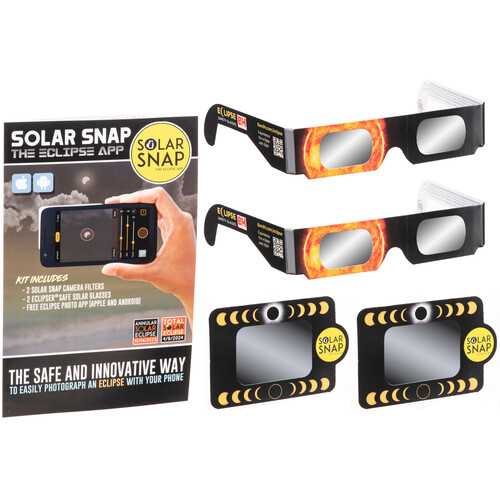
American Paper Optics Solar Snap

American Paper Optics Solar Snap

bhphotovideo.com

$13.50

DayStar Filters - $20

If you’re looking for a solar filter for telescopes, binoculars or camera lenses, B&H has a plethora of options.

This one we found from DayStar Filter is only $20 and can be used on a camera or telescope to safely capture the eclipse.

DayStar Filters 70mm White-Light Universal Lens Solar Filter

DayStar Filters 70mm White-Light Universal Lens Solar Filter

DayStar Filters

bhphotovideo.com

$16.95

Be careful when purchasing solar eclipse glasses

The American Astronomical Society was careful to not list Amazon or eBay as marketplaces on their list of manufacturers.

When making this list, we made sure to cross-reference the solar eclipse glasses we found on Amazon with the list of manufacturers listed on the society’s website.

Why was this done? According to the society, sites like Amazon and other online marketplaces had numerous sellers of eclipse glasses and other solar viewers that had not been properly tested and shown to be safe.

Because improper viewing of an eclipse can cause permanent eye damage, it’s critical that you’re not just purchasing any solar eclipse glasses or solar viewers.

The American Astronomical Society recommends if you are purchasing from Amazon and other online marketplaces that you can see the seller is identified on the site and that the seller is listed on their full page.

One more warning: NASA doesn’t approve or endorse any product

Don’t be fooled by a product description or product title that mentioned that their solar eclipse glasses are “approved by NASA.”

According to NASA’s website, they do not issue approvals for merchandise and they do not promote or endorse products because they are a U.S. government agency. The use of terms like “NASA approved” or “official NASA” is actually prohibited.

Click here to view the full list of safe solar filters and viewers.

Adblock test (Why?)

Article From & Read More ( How to find reputable solar eclipse glasses you can use for the total eclipse in April - KCRA Sacramento )
https://ift.tt/U1SIVc8
Science

Study Aims to Bring a Tinier Tyrannosaur Back From Oblivion - The New York Times

New research is trying to remake the case that fossils known as Nanotyrannus were their own species, rather than a teenage Tyrannosaurus rex.

It is only 23 inches long, but one tyrannosaur skull has been a bone of serious contention among paleontologists for decades.

In 1988, a team of researchers named it Nanotyrannus lancensis, suggesting that it represented a distinct animal that lived in the shadow of Tyrannosaurus rex. In 1999, another group argued that the skull and similar specimens were T. rex as a teenager, before the species underwent an extraordinary growth spurt that preceded adulthood.

For years, the teen T. rex hypothesis gained traction.

“Most people bought into it, including me,” said Nick Longrich, a paleontologist with the University of Bath in England.

But Dr. Longrich has changed his tune. In a study published Wednesday in the journal Fossil Studies, he and colleagues argue that enough evidence exists to resurrect Nanotyrannus as its own species among the larger Tyrannosaur family. Based on anatomical features, they argue, it isn’t even particularly closely related to T. rex.

Other experts say the study is unlikely to end the debate.

“It’s sort of like Schrodinger’s dinosaur,” said Thomas Holtz, a paleontologist at the University of Maryland who was not involved with the paper. “This paper’s going to keep people talking about it, but it’s not going to really resolve it.”

To make its case, Dr. Longrich’s team studied the original 23-inch skull and more recent finds named Jane and Petey, as well as a long-disputed tyrannosaur specimen, the “dueling dinosaurs.” All of these have been argued to represent adolescent T. rex, Dr. Longrich said. But his team said it found around 150 differences in their anatomy, including skull details; an extended, bladelike snout; and longer arms and claws than adult T. rex.

He also said the specimens had features consistent with mature animals, not adolescents. The growth rings inside the bone from three specimens — including Jane and Petey — likewise suggest slowing growth rates. The animals were on track to weigh over a ton, rather than the T. rex, which was four to five tons, the researchers estimated.

“We have three individuals, which basically rules out an individual variation or aberrant growth pattern,” Dr. Longrich said. “What we’re seeing is that the growth patterns are inconsistent with these animals being juveniles.”

A comparison of skulls, a T. rex, top, and the Nanotyrannus lancensis specimen found in the Hell Creek Formation of Montana.Larry Witmer; American Museum of Natural History
A fragment of juvenile T. rex skull bone from the Hell Creek of Montana.Nick Longrich

Where, then, are the actual juvenile T. rex? Dr. Longrich believes he’s found a fragment of one — a piece of skull from the University of California, Berkeley, collections described in the paper. “In every single feature it was T.rex,” he said.

Other paleontologists are not ready to throw out the teenage T. rex hypothesis, and they raised strong objections to the paper.

The specimens in question do show features in common with adult T. rex — among them the forehead, snout and braincase, said Thomas Carr, a paleontologist at Carthage College who first made the case that Nanotyrannus represented young T. rex. Moreover, he disagrees with the claim that they don’t fit the growth pattern in other tyrannosaur skulls.

“With T. rex and tyrannosaurs in general, differences between juveniles and adults are quite extreme and people are easily thrown,” Dr. Carr said.

Holly Woodward, a paleontologist at Oklahoma State University who produced some of the growth data used by Dr. Longrich’s team, also disputed their conclusions. The spacing of the innermost growth rings in the bone tissue of nearly full grown adult T. rex suggest “lower growth rates at younger ages before the big growth spurt,” she said.

Dr. Woodward added that the team’s choice of mathematical models risks producing a distorted picture that shows younger animals that are done growing, even if that isn’t the case.

“I’m just not convinced that the growth curve arguments support that hypothesis,” she said.

Dr. Longrich responded that teenage T. rex proponents haven’t proven their case either: “I’d throw it back in their camp and say, ‘Where is the evidence for your hypothesis?’”

He explained that “for Nanotyrannus to turn into T. rex, this requires an extraordinary number of transformations.” No other dinosaur develops like this, Dr. Longrich argues: Everything his team studied fits neatly into the Nanotyrannus form or the T. rex one.

Credible paleontologists have historically argued both sides of the issue, Dr. Holtz said. Part of the issue is that most T. rex specimens are adults, with only a few subadults. Everyone acknowledges that gap; they simply disagree about its meaning.

The discovery of either an older adult Nanotyrannus or a young T. rex distinct from the Nanotyrannus form would help clarify things, Dr. Holtz said. So could forthcoming data about Jane and the “dueling dinosaurs” tyrannosaur. While the team’s paper provides interesting suggestions, Dr. Holtz said it isn’t enough for him to reject the hypothesis “that these are juvenile T.rex.”

The argument continues. For an animal that may or may not have existed, Nanotyrannus is proving curiously difficult to kill.

Adblock test (Why?)

Article From & Read More ( Study Aims to Bring a Tinier Tyrannosaur Back From Oblivion - The New York Times )
https://ift.tt/Pxg4mqe
Science

Tuesday, January 2, 2024

Quadrantid Meteor Shower Set To Produce 120 Shooting Stars An Hour This Week - IFLScience

The Quadrantid meteor shower will peak this week and it’s set to be one of the strongest showers of 2024 with up to 120 shooting stars being visible each hour.

The Quadrantids are due to reach peak activity on the night of January 3 to 4, according to the American Meteor Society. 

The Quadrantid meteor shower started on December 26, 2023, and will continue until January 16, 2024. For star-gazers in North America, the shower will be at its most active in the early hours of January 4. 

The moon will be 51 percent full on this night, which may slightly interfere with the spectacle. Likewise, cloudy January weather often puts a dampening on this annual meteor shower.

However, the Quadrantids are widely considered to be one of the best annual meteor showers. As per NASA, you can expect to see approximately 120 meteors per hour during periods of peak activity. They’re also known for their bright fireball meteors that can persist longer than an average meteor streak.

To get the best view of the meteor shower, head outside in a dark place that’s far away from street lamps and other artificial lighting, including phone screens. You should be patient and go outside early to let your eyes acclimatize to the lower light conditions. 

In case you can't catch them in person, there will also be a live stream of the event broadcasted by the Virtual Telescope Project, which you can view in this link here.

Meteor showers occur when Earth passes through the debris left behind by a comet or asteroid. Tiny pieces of debris from these objects enter Earth’s atmosphere at approximately 41 kilometers (25.5 miles) per second for the Quadrantids. This intense amount of energy causes the debris to burn up when it smacks into Earth's atmosphere, leaving behind a bright streak of light in the sky.

In the case of the Quadrantids, the parent object is 2003 EH1, a near-Earth object that’s either a rocky asteroid or a possible "rock comet”, aka a "dead comet”. This is essentially a once-icy comet that has expelled all of its ice and other volatiles. Discovered in 2003, its diameter measures just 3 kilometers (2 miles) or so. 

There are plenty of other major meteor showers to look forward to in 2024. In mid-April, Earth's skies will be graced by the Lyrids, followed by the Aquariids in early May.

Adblock test (Why?)

Article From & Read More ( Quadrantid Meteor Shower Set To Produce 120 Shooting Stars An Hour This Week - IFLScience )
https://ift.tt/OkClnJ9
Science

NASA flies extremely close by volcano world, captures wild footage - Mashable

A NASA spacecraft survived extreme radiation and captured rich images of the most volcanic world in our solar system, the tortured moon Io.

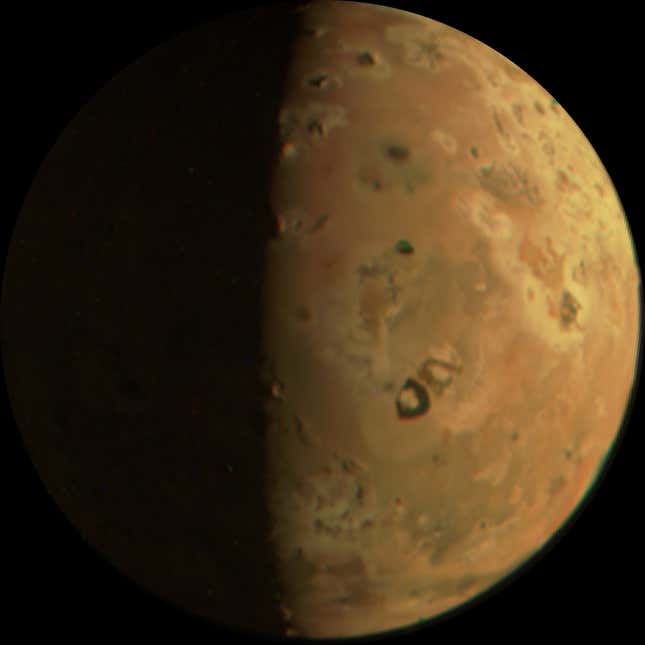
Over the last year, the legendary Juno craft has been swooping progressively closer to Jupiter's volcano-blanketed moon, and on Dec. 30 passed just some 930 miles (1,500 kilometers) from Io's surface. That's quite close — only about three times farther than the Hubble telescope orbits Earth. You can clearly see some impressive volcanoes.

To make such a near pass, Juno had to endure profoundly high levels of radiation around Jupiter — the type that could damage the spacecraft's instruments. In 2022, for example, a radiation spike during an Io fly-by caused the loss of some images.

NASA scientists had their fingers crossed. Alas, the spacecraft, which arrived around Jupiter in 2016 following a 1,740-million-mile journey, endured.

These impressive views are processed (removing noise and distortion, etc.) by both professional and amateur image processors, some of whom work for NASA or related space research programs. These are the closest views of Io captured in over two decades. (And more images will be added as they become available.)

Mashable Light Speed
Want more space and science stories in your inbox?
Sign up for Mashable's weekly Light Speed newsletter.
By signing up you agree to our Terms of Use and Privacy Policy.
Thanks for signing up!
a close view of Jupiter's moon Io.
Jupiter's moon Io with visible volcanoes. Credit: NASA / SwRI / MSSS

Io is blanketed in erupting volcanoes (there are currently 266 active hot spots on the surface) because it's relentlessly locked in a tug-of-war between nearby objects. "Not only is the biggest planet in the solar system forever pulling at it gravitationally, but so are Io’s Galilean siblings — Europa and the biggest moon in the solar system, Ganymede," NASA explained in a statement. "The result is that Io is continuously stretched and squeezed, actions linked to the creation of the lava seen erupting from its many volcanoes."

In the coming years, we'll also learn considerably more about the moon Europa, a world planetary scientists say harbors a salty sea beneath its thick, icy shell. "Europa may be the most promising place in our solar system to find present-day environments suitable for some form of life beyond Earth," NASA explains. In 2024, NASA will launch the much-anticipated Europa Clipper spacecraft to Jupiter, where the probe will repeatedly sweep close to the moon.

For now, expect more detailed views of Io. NASA plans another "ultra-close flyby" on Feb. 3, 2024. This data may help answer big, looming questions about the volcano world. Is there a grandiose global sea of magma swirling beneath Io's surface? Or, perhaps, is the lava pouring onto the moon largely created by a process more similar to Earth's, whereby a great amount of heat flow is created below the hard crust (in the upper mantle), which ultimately gives rise to regions where magma erupts onto the surface?

"That's the big question," Ashley Davies, a planetary scientist at NASA's Jet Propulsion Laboratory who researches Io, recently told Mashable.

Topics NASA

Adblock test (Why?)

Article From & Read More ( NASA flies extremely close by volcano world, captures wild footage - Mashable )
https://ift.tt/dFcfilK
Science

See Wild New Close-Up Images of Jupiter's Volcanic Moon Io - Gizmodo

NASA’s Juno mission captured Jupiter’s moon Io on December 30 during its closest flyby.
Image: NASA/Image processed by Kevin M. Gill

The mutilated surface of Jupiter’s moon Io was revealed in great detail by the Juno spacecraft, which has been exploring the Jovian system since 2016 and recently pulled off the closest flyby of the volcanic world.

NASA’s Jupiter probe had its close encounter with Io on Saturday, December 30, flying at a distance of 930 miles (1,500 kilometers) away from its hellish surface. This marked not only the closest flyby of Io by Juno, but by any spacecraft in the past 20 years, according to NASA.

During this rare rendezvous, Juno captured intimate views of Jupiter’s moon using all three of its on board cameras. On Sunday, NASA released six images of the moon Io as seen by the spacecraft.

A raw image of Io.
A raw image of Io.
Image: NASA

Jupiter’s rocky moon is the most volcanically active body in the solar system. As revealed in the new images, the surface of Io is mangled by hundreds of volcanoes and lakes of molten silicate lava that appear as burnt scarring across its tortured landscape. As the innermost of Jupiter’s four Galilean moons, Io is stuck between the planet’s immense gravitational force and the gravitational tug of its sister moons Europa and Ganymede. This contributes to the moon’s volcanic activity as Io is constantly being stretched and squeezed due to its position.

With its close flybys of Io, the team behind the Juno mission is investigating the source of the moon’s volcanic activity and hoping to find out whether it is harboring a magma ocean underneath its crust, according to NASA. The Juno science team will study how often the volcanoes on Io erupt, how bright and hot they are, and how the shape of the lava flow changes.

Io is also the main source of most of the charged particles in Jupiter’s magnetosphere, creating a donut-shaped cloud of ions and electrons that surround the planet. The cloud, known as Io Plasma Torus, is formed when the atmospheric gases escaping from Io are ionized. A group of scientists from the Southwest Research Institute in San Antonio, Texas, will also study how Io’s volcanic activity is connected to the flow of charged particles in Jupiter’s magnetosphere by combining Juno data with remote observations by the Hubble and Webb space telescopes.

In October, Juno captured an ominous view of Io, revealing its charred surface in the closest view of the moon thus far. Juno also captured a cozy family photo of Jupiter and Io in September, revealing the gas giant and its moon side by side.

Juno’s recent flyby of Io marked the spacecraft’s 57th orbit of the Jovian system, enduring years of radiation from the gas giant’s environment. “The cumulative effects of all that radiation has begun to show on JunoCam over the last few orbits,” Ed Hirst, project manager of Juno at NASA’s Jet Propulsion Laboratory, said in a statement. “Our engineering team has been working on solutions to alleviate the radiation damage and to keep the imager going.”

Juno is scheduled for a second close flyby of Io on February 3, in which the spacecraft will come within a distance of 930 miles (1,500 kilometers) from the moon’s surface.

For more spaceflight in your life, follow us on X (formerly Twitter) and bookmark Gizmodo’s dedicated Spaceflight page.

Adblock test (Why?)

Article From & Read More ( See Wild New Close-Up Images of Jupiter's Volcanic Moon Io - Gizmodo )
https://ift.tt/pwuq7v5
Science

Monday, January 1, 2024

Space photo of the week: Uranus 'rings' in the New Year in stunning James Webb telescope image - Livescience.com

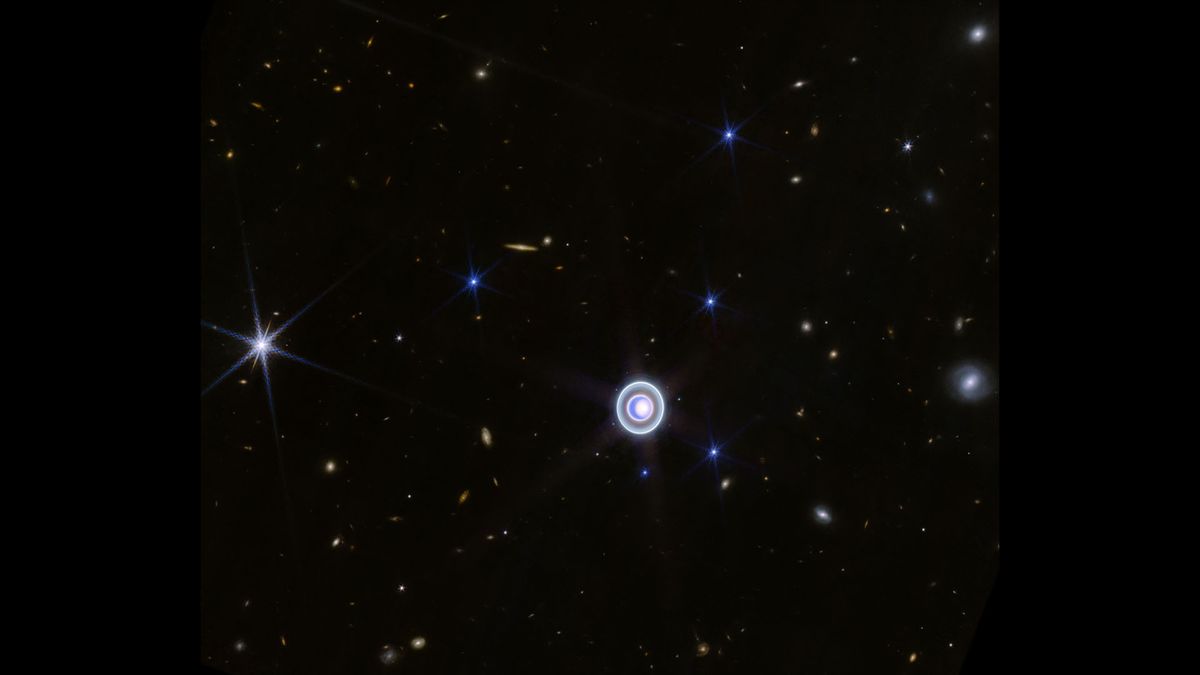
What it is: Uranus and 14 of its 27 moons

When it was taken: Dec. 18, 2023

Where it is: 1.8 billion miles (2.9 billion kilometers) from the sun

Why it's so special: This photo of Uranus, captured by the James Webb Space Telescope, reveals the ice giant planet in exquisite detail. The wide-field image shows Uranus' rings, a polar ice cap, 14 of the planet's 27 moons, background stars and galaxies.

The close-up image, snapped by JWST's Near Infrared Camera and released by NASA this week, is a follow-up to a set of photos taken in February. The new image features an extra wavelength of light, revealing a hidden ring. Although Uranus is known to have 13 distinct inner and outer rings, NIRCam revealed the planet's elusive "Zeta ring," a faint, diffuse ring nestled close to the planet.

Of Uranus' 27 moons, 14 are featured in this image: Oberon, Titania, Umbriel, Juliet, Perdita, Rosalind, Puck, Belinda, Desdemona, Cressida, Ariel, Miranda, Bianca and Portia.

It's a much more detailed view of Uranus than humankind's first close-up of the seventh planet, taken by NASA's Voyager 2 probe in 1986. That featureless image showed a solid bluish orb with no detail. JWST, by contrast, has captured atmospheric features such as a north polar cloud cap. That growing and receding cap is fascinating to planetary scientists because it's visible evidence that Uranus spins on an axis tilted by 98 degrees, producing seasonal and meteorological effects that create storms.

Uranus takes 84 Earth years to orbit the sun once. That slow orbit, plus the extreme tilt of Uranus, means the ice giant experiences extreme seasons, with the polar cap visible in the image resulting from its north polar region being in the depths of a 21 Earth-year-long winter that will end in 2028.

Dozens of background galaxies are visible in this wide-field image. Most have an orange tint, but if you look to the right of Uranus, you'll see two sizable white spiral galaxies.

In October, scientists at the University of Leicester in the U.K. published a paper in the journal Nature Astronomy revealing the presence of infrared aurorae around Uranus.

In April 2022, a Decadal Survey report by the National Academy of Sciences recommended that NASA probe the atmosphere, clouds and storms of the turquoise planet as part of the Uranus Orbiter and Probe Flagship mission.

Adblock test (Why?)

Article From & Read More ( Space photo of the week: Uranus 'rings' in the New Year in stunning James Webb telescope image - Livescience.com )
https://ift.tt/Gyz5ebw
Science

Nasa's Parker mission poised for solar 'landing' in 2024 - FRANCE 24 English

Since its launch in 2018, NASA’s Parker Solar Probe has inched closer to the sun with each passing year, shedding light on key solar processes. By the end of 2024, it will have set a new record by grazing our star from a distance of just over 6 million kilometres, delving deep into its scorching outer layers.

Issued on:

2 min

One of the most audacious missions in the history of space exploration, the Parker Solar Probe is the first spacecraft to have flown through the sun’s outer atmosphere, known to scientists as the corona. It is set to break new ground in late December by covering 96% of the distance separating our planet from its fiery star.

In doing so, Parker will hit speeds of around 700,000 km/h (or 435,000 mph), enough to fly from New York to Tokyo in one minute – making it the fastest human-made craft in history. It will achieve such velocity by swinging around Venus, using the planet’s gravity to tighten its orbit around the sun and acquire extra speed.

“This will be a monumental achievement for all humanity. This is equivalent to the Moon landing of 1969,” said Parker project scientist Dr Nour Raouafi of Johns Hopkins University, in an interview with the BBC. “We are basically almost landing on a star.”

Into the furnace 

Parker’s mission is to make repeated passes of the sun, drawing ever closer to the star as it travels through its outer atmosphere – which, paradoxically, is 300 times hotter than its actual surface. That means weathering unimaginable conditions, including temperatures of close to 1,400 degrees Celsius and solar winds charged with high-energy particles.

The trick for Parker is to make rapid dives into this hellscape, relying on its blistering speed and a thick heat shield made of carbon composite. The shield protects an array of instruments that  measure charged particles and magnetic fluctuations, capturing both images and sounds.

In 2020, recordings made close to the star provided the first sound clips of the solar wind – a stream of high-energy particles that flows continuously from the sun. 

Forecasting solar storms

The mission’s aim is to gain a better understanding of solar activity and to shed light on the many mysteries surrounding the corona, where temperatures can reach a million degrees Celsius and above – compared with just 6,000C at the sun's surface. Scientists hope data collected by Parker will help understand why the sun’s outer atmosphere is so much hotter than its surface.

The corona is also where the solar wind is generated and sometimes whipped up into solar “flares” and “storms”, potentially disrupting our planet’s magnetic field, degrading communications and posing health risks to astronauts. Ultimately, Parker’s findings could pave the way for a space weather service capable of forecasting and tracking such events.

An image of the sun, taken roughly halfway from our planet by the European Space Agency's Solar Orbiter on July 16, 2020.
An image of the sun, taken roughly halfway from our planet by the European Space Agency's Solar Orbiter on July 16, 2020. © ESA/EUI/NASA via AFP

The probe’s end-of-year voyage will mark its best chance of acquiring a greater understanding of key solar processes. It will also be its last: beyond December, the probe’s orbit will no longer allow it to swing around Venus, effectively precluding an even closer encounter with the sun.

This article has been translated from the original in French.

Adblock test (Why?)

Article From & Read More ( Nasa's Parker mission poised for solar 'landing' in 2024 - FRANCE 24 English )
https://ift.tt/EwtJWac
Science

Search

Featured Post

Two meteor showers will peak tonight. How to watch the Southern Delta Aquariids and the Alpha Capricornids. - Yahoo

[unable to retrieve full-text content] Two meteor showers will peak tonight. How to watch the Southern Delta Aquariids and the Alpha Caprico...

Postingan Populer