Rechercher dans ce blog

Sunday, February 4, 2024

SpaceX to launch NASA's PACE ocean-monitoring satellite this week - Space.com

A NASA satellite is about to take flight to map out the ocean's many hues.

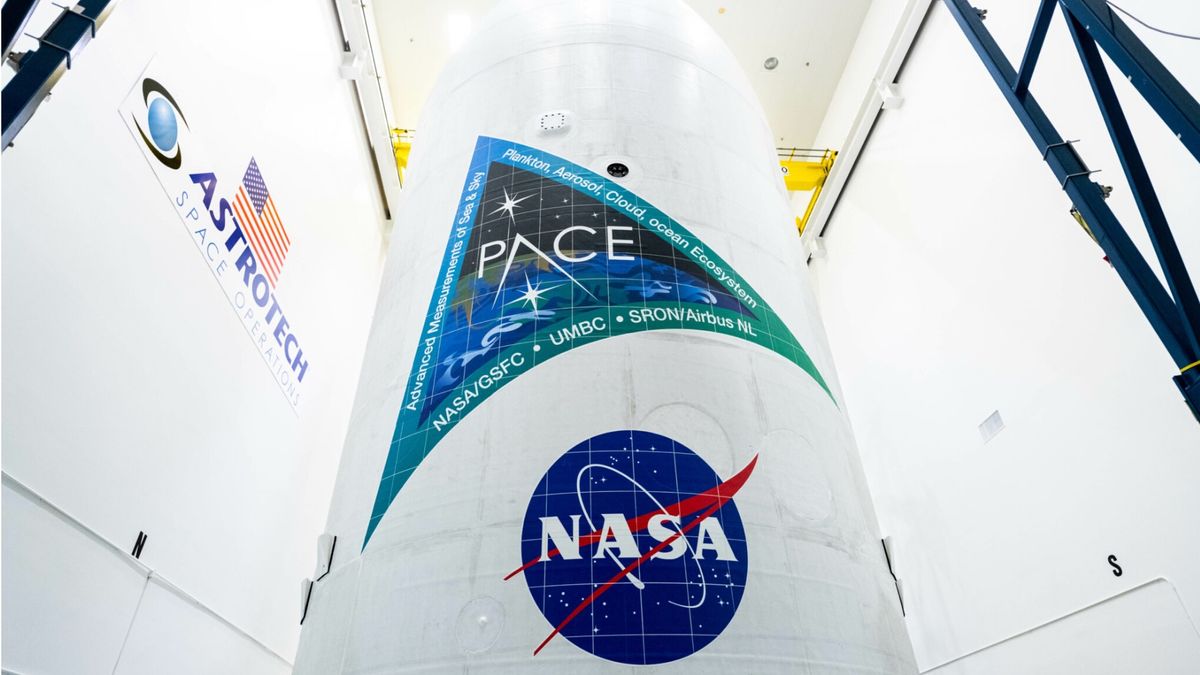
NASA's PACE spacecraft, which will help scientists gauge the health of oceans around the world, is set to launch atop a SpaceX Falcon 9 rocket from Florida's Cape Canaveral Space Force Station on Tuesday (Feb. 6) at 1:33 a.m. EST (0633 GMT).

You can watch the liftoff live here at Space.com, courtesy of NASA, or directly via the space agency. Coverage will begin at 12:45 a.m. EST (0545 GMT).

Related: Earth is getting hotter at a faster rate despite pledges of government action

The Falcon 9 will deliver PACE, whose name is short for Plankton, Aerosol, Cloud, ocean Ecosystem, to an orbit 420 miles (677 kilometers) above Earth — about 70% higher than the International Space Station flies.

From that perch, PACE will use its three science instruments "to collect data on clouds, aerosols and phytoplankton growth that can determine ocean color," NASA officials wrote in a mission update on Thursday (Feb. 1). 

"Measuring the color and amount of light will help scientists better understand the types and locations of microscopic algae, which are vital to the health of Earth's oceans and its marine life," they added. "PACE will contribute to NASA’s more than 20 years of global satellite observations of ocean biology and key measurements related to air quality and climate."

The 10.5-foot-long (3.2-meter-long) PACE will do this work for at least three years, if all goes according to plan.

RELATED STORIES:

PACE has had a long and somewhat harrowing road to the launch pad. The Trump administration tried to cancel the mission three separate times, in its budget proposals for fiscal years 2018, 2019 and 2020. But Congress allocated the required funds on each occasion, saving PACE from the chopping block. 

Back in 2014, NASA capped PACE's total cost (including for its launch vehicle) at $805 million, with a liftoff targeted for 2022. That price tag has gone up, however, to $948 million, according to Florida Today.

PACE's launch is part of a very busy year for SpaceX. The company launched 10 orbital missions in January — a single-month record, according to Elon Musk. And that impressive pace could ramp up even more: SpaceX aims to launch 144 missions in 2024, company representatives have said.

Adblock test (Why?)

Article From & Read More ( SpaceX to launch NASA's PACE ocean-monitoring satellite this week - Space.com )
https://ift.tt/fv7HOS3
Science

Saturday, February 3, 2024

Japan's moon lander took this eerie photo before being enveloped by lunar night - Engadget

Against all odds, Japan’s SLIM lander managed to turn back on more than a week after it plopped upside down onto the surface of the moon — but now, it’s gone dormant for the duration of the lunar night, and it may not be able to wake up again. The SLIM team from the Japanese space agency, JAXA, on Thursday shared the last image the lander captured at the moon’s Shioli crater before dusk, as night encroached. Lunar night lasts the equivalent of two Earth weeks and can get colder than -200 degrees Fahrenheit.

The team has confirmed that the solar powered lander is in a dormant state that will last at least the duration of the lunar night. Its chances of resuming operations afterward aren’t great, but then again, it’s already surprised us once. “Although SLIM was not designed for the harsh lunar nights, we plan to try to operate again from mid-February, when the Sun will shine again on SLIM’s solar cells,” the team wrote on X. If this truly is SLIM’s last photo, it sure is a spooky one.

Adblock test (Why?)

Article From & Read More ( Japan's moon lander took this eerie photo before being enveloped by lunar night - Engadget )
https://ift.tt/rd4cOAs
Science

Scientists discover trees from 350m years ago that look completely alien - The Independent

Scientists have discovered trees from 350 million years ago looked like “something from Dr Seuss’s imagination” and are “unlike any of those that live” in the modern day.

Research carried out on a fossilised tree species called Sanfordiacaulis from New Brunswick, Canada revealed a unique three-dimensional crown shape.

Tree fossils are usually only preserved with their trunks, however, in a groundbreaking study using a fossil from millions of years ago that had preserved its leaves, scientists discovered ancient trees had similarities to palm or fern trees.

Researchers investigating the rare fossil

“The way in which this tree produced hugely long leaves around its spindly trunk, and the sheer number over a short length of trunk, is startling,” says Robert Gastaldo of Colby College in Waterville, Maine.

“We all have a mental concept of what a tree looks like, depending on where we live on the planet, and we have a vision of what is familiar.”

“The fossil on which we report is unique and a strange growth form in the history of life. It is one of evolution’s experiments during a time when forest plants underwent biodiversification, and it is a form that seems to be short-lived,” he added.

Sanfordiacaulis model with simplified branching structure for easier visualization

One of the specimens revealed how the leaves departed from the top of the tree, which makes it “absolutely unique.” It’s one of only a few in a fossil record spanning more than 400 million years in which a trunk is preserved around which the crown leaves are still attached, the researchers say.

Another feature that makes the ancient tree fossils stand out is the preservation of its crown leaf.

“Any fossil tree with an intact crown is a rarity in the history of life,” Gastaldo said.

The researchers report that the tree likely relied on its unusual growth form to maximise the amount of light it could capture and reduce its competition with other plants on the ground.

They suggest the tree now represents the earliest evidence of smaller trees growing beneath a taller forest canopy.

It means that plant life in the Early Carboniferous period was more complex than expected, suggesting Sanfordiacaulis lived at a time when plants were “experimenting” with a variety of possible forms or architectures.

Sanfordiacaulis model with simplified branching structure for easier visualization

Scientists say they are a reminder that millions of years ago there were trees that existed that looked unlike any we have ever seen before and some as though they may have come from the imagination of Dr. Seuss.

Prof Gastaldo said: “The history of life on land consists of plants and animals that are unlike any of those that live at the present.

“Evolutionary mechanisms operating in the deep past resulted in organisms that successfully lived over long periods of time, but their shapes, forms, growth architectures, and life histories undertook different trajectories and strategies.

“Rare and unusual fossils, such as the New Brunswick tree, is but one example of what colonised our planet but was an unsuccessful experiment.”

Adblock test (Why?)

Article From & Read More ( Scientists discover trees from 350m years ago that look completely alien - The Independent )
https://ift.tt/7O9TcqZ
Science

Friday, February 2, 2024

April total solar eclipse facts for Texans | wfaa.com - WFAA.com

During a total eclipse, the moon is closer to the earth and it perfectly aligns with the sun creating total darkness.

DALLAS — On April 8, a total solar eclipse will cast the shadow of the moon, commonly called the Umbra, on a narrow path across the Earth. The result will be the path of totality reaching communities from Texas to Maine. 

Through a partnership with Dallas’s Perot Museum of Nature and Science, WFAA will be the only local television station hosting anchored live streaming coverage from the Perot Museum’s extraordinary Great North American Eclipse event, offering North Texans the opportunity to safely experience this once-in-a-lifetime phenomenon.

An annular eclipse, which is what occurred last fall, is not a total eclipse. This is due to the distance between Earth and the moon. In an annular eclipse, a "ring of fire" is visible around the moon. During a total eclipse, the moon is closer to the earth and it perfectly aligns with the sun creating total darkness.

Here is why this April total eclipse is so special for DFW: 

  • The last time DFW experienced a total eclipse was 1878.
  • On April 8, 2024, DFW will experience 4.5 minutes of totality – the longest amount of totality in the country.
  • Dallas is the largest metropolitan area in the line of totality.
  • After April 8, DFW will not experience a total eclipse for an estimated 300 years.
  • The next opportunities for total eclipses in the United States are 2044 (North Dakota and Montana) and 2045 (California to Florida – totality will be in Oklahoma).

There are many online resources and maps to figure out how long the eclipse will last near you. On Eclipse2024.org, you can type in your city or town and find precise timings and simulations.

For anyone who plans to view the eclipse, you must have properly certified solar glasses to do so safely. 

A limited number of tickets to the Perot Museum’s Great North American Eclipse watch party went on sale on Feb. 1 on the museum’s website at perotmuseum.org.

More Texas headlines:

Adblock test (Why?)

Article From & Read More ( April total solar eclipse facts for Texans | wfaa.com - WFAA.com )
https://ift.tt/EFws9dz
Science

Watch 'city killer' asteroid fly by Earth today on its closest approach for centuries (Feb. 2) - Livescience.com

UPDATE: You can watch the asteroid flyby on the video above for yourself thanks to a live stream from The Virtual Telescope Project, which will begin at 1:00 p.m. ET on Feb. 2.  

A "potentially hazardous" football stadium-size asteroid will zip safely past Earth on Friday (Feb. 2), and, in doing so, will reach its closest point to our planet for more than 100 years. It will also be at least several centuries before the space rock ever gets this close to us again. 

The massive asteroid, named 2008 OS7, is around 890 feet (271 meters) across and will pass by Earth at a distance of around 1.77 million miles (2.85 million kilometers), according to NASA's Jet Propulsion Laboratory (JPL). For context, that is more than seven times further away than the moon orbits Earth.

As it passes by Earth, the asteroid will be traveling at a speed of around 41,000 mph (66,000 km/h), according to JPL.

To compare this space rock's girth to that of other asteroids, it is around half the size of asteroid Bennu, which NASA visited and took samples of, and at least 70 times smaller than the Vredefort meteor — the largest known space rock to ever hit Earth.

Related: 'Planet killer' asteroids are hiding in the sun's glare. Can we stop them in time? 

The asteroid will pass Earth as it hurtles through space at 41,000 mph. (Image credit: Gianluca Masi/The Virtual Telescope Project)

Due to its size and proximity to Earth, the asteroid is classified as potentially hazardous despite the fact it will never come close enough to impact our planet, JPL predictions show. If the space rock did ever crash to Earth, it is big enough to wipe out a large city, such as New York. 

However, the object isn't hefty enough to be considered a "planet killer" asteroid, such as the Vredefort meteor or the space rock that wiped out the dinosaurs 66 million years ago.

NASA has identified around 25,000 potentially hazardous asteroids, although a significant percentage of these are not as large as the impending space rock. One of these deadly asteroids is expected to hit Earth every 20,000 years, Live Science previously reported.

2008 OS7 has a highly elliptical orbit around the sun (white ring). (Image credit: NASA/JPL-Caltech)

2008 OS7 has a highly elliptical orbit, meaning that it does not orbit evenly around the sun. Because of this, the distance between it and Earth varies wildly whenever the space rock makes a close approach to our planet. For example, when the asteroid approached us shortly after its discovery in 2008, it was around 55.9 million miles (90 million km) away from us, which is more than 30 times further away than it will be this week, according to JPL. 

Scientists have only directly observed the asteroid fly by Earth twice before. But based on the space rock's orbital data, JPL has simulated every close approach the asteroid has made since 1900 and predicted every close approach it will make until 2198. At no other point in this nearly 300-year dataset is the asteroid expected to be closer to our planet than on Feb. 2 this year. 

Several other asteroids have made close approaches to or directly hit Earth in the last few weeks. 

On Jan. 27, an airplane-size asteroid passed by Earth at a distance of just 220,000 miles (354,000 km), which is slightly closer than the moon is to our planet. And on Jan. 21, a child-size asteroid was discovered by astronomers around 3 hours before it exploded in the atmosphere above Germany

Adblock test (Why?)

Article From & Read More ( Watch 'city killer' asteroid fly by Earth today on its closest approach for centuries (Feb. 2) - Livescience.com )
https://ift.tt/740IGwK
Science

Total solar eclipse on April 8: Why this eclipse will be much different than the 2017 version - AL.com

April 2024 will bring something exciting for skywatchers - a total solar eclipse.

On Monday, April 8, a total solar eclipse will cross North America, passing over Mexico, the United States, and Canada. The eclipse will begin over the South Pacific Ocean. Weather permitting, the first location in continental North America that will experience totality is Mexico’s Pacific coast at around 11:07 a.m. PDT.

According to the Washington Post, the upcoming total solar eclipse coincides with a period when the sun will be particularly active. The active sun will look very spiky, like a “very irritated little hedgehog,” solar physicist Scott McIntosh told the newspaper.

READ MORE: How to safely watch an eclipse

Scientists say the sun is approaching its maximum activity of its cycle this year, meaning it will be sending off more solar flares and eruptions from its surface — potentially making this year’s total solar eclipse much more dynamic.

The 2024 eclipse will bring back memories of the 2017 eclipse when an estimated 88% of U.S. adults viewed the moon passing in front of the sun either directly or online. This year’s version could be even more exciting due “to differences in the path, timing, and scientific research,” NASA said.

Here’s NASA’s explanation:

The path of totality – where viewers can see the Moon totally block the Sun, revealing the star’s outer atmosphere, called the corona – is much wider during the upcoming total solar eclipse than it was during the eclipse in 2017. As the Moon orbits Earth, its distance from our planet varies. During the 2017 total solar eclipse, the Moon was a little bit farther away from Earth than it will be during upcoming total solar eclipse, causing the path of that eclipse to be a little skinnier. In 2017, the path ranged from about 62 to 71 miles wide. During the April eclipse, the path over North America will range between 108 and 122 miles wide – meaning at any given moment, this eclipse covers more ground.”

The 2024 eclipse path will also pass over more cities and densely populated areas. An estimated 31.6 million people live in the path of totality this year, compared to 12 million in 2017. An additional 150 million people live within 200 miles of the path of totality.

Solar eclipse 2024 path map

The dark gray line on this map from AccuWeather shows the path of the moon’s shadow during the total solar eclipse coming on April 8, 2024.AccuWeather

Adblock test (Why?)

Article From & Read More ( Total solar eclipse on April 8: Why this eclipse will be much different than the 2017 version - AL.com )
https://ift.tt/k6KIYQV
Science

Thursday, February 1, 2024

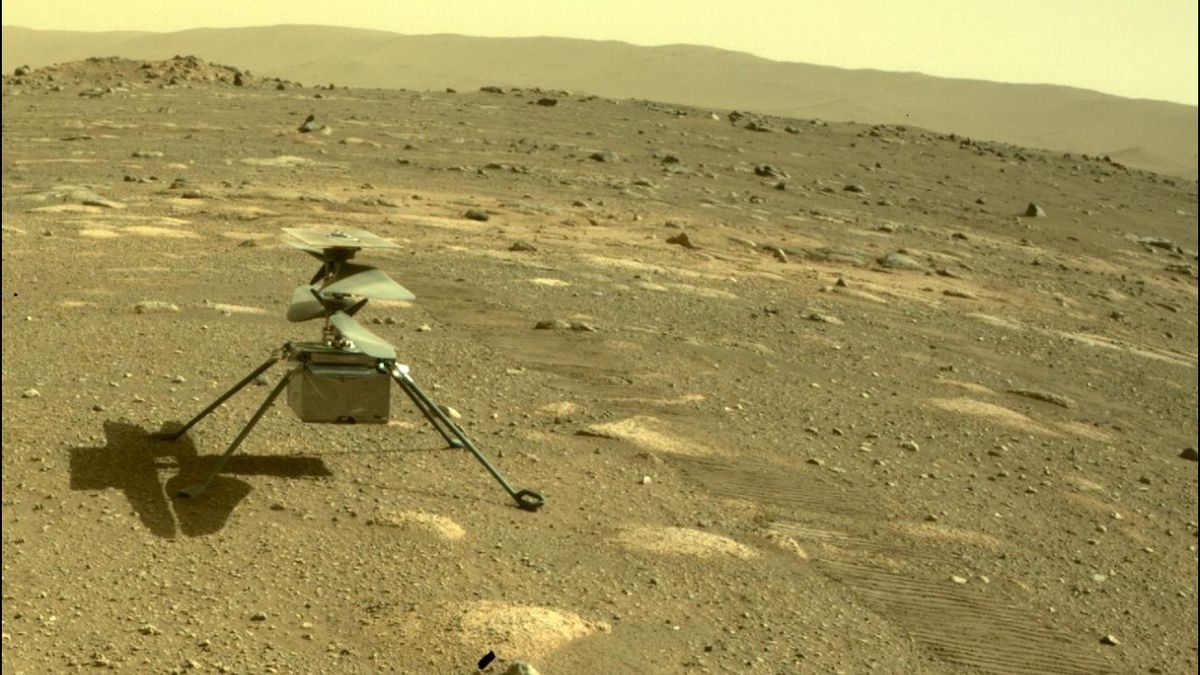
NASA to 'wiggle' broken Ingenuity Mars helicopter's blades to analyze damage - Space.com

Ingenuity's mission is officially coming to an end, but not before mission scientists try to determine how much damage the helicopter suffered.

NASA held a livestream Wednesday (Jan. 31) to pay tribute to Mars helicopter Ingenuity, which suffered rotor damage on its most recent flight. During the livestream, mission managers revealed that all four of Ingenuity's blades were damaged during a rough landing on the Red Planet surface.

Teddy Tzanetos, Ingenuity Project Manager, said that NASA and JPL still aren't sure what caused the damage to Ingenuity's blades; it remains unclear whether the helicopter's power dipped during landing, causing unwanted ground contact, or if it accidentally struck the ground to cause a "brownout."

Tzanetos added that NASA and the Jet Propulsion Laboratory (JPL) will slowly rotate the helicopter's blades and "wiggle" them, or adjust their angle, while collecting video in order to allow the team to determine the extent of Ingenuity's damage. However, Tzanetos said that no matter what such imaging will show, the dual-rotor drone has flown its last flight and will soon end its mission.

"Helicopters like this are not designed to fly even with the smallest fraction of a grant of imbalance and we're gonna have the end of our mission in the weeks ahead," Tzanetos said during the livestream.

Related: 'It's sort of been invincible until this moment:' Mars helicopter Ingenuity pilot says 'bland' terrain may have doomed NASA chopper

During the NASA Science Live webcast, Tzanetos and Tiffany Morgan, NASA's Mars Exploration Program Deputy Director, sang the praises of the plucky 'copter. Morgan described how Ingenuity proved to be a valuable companion for the Perseverance rover, with whom it has been exploring Mars since the pair landed on Feb. 18, 2021.

The helicopter was initially designed to make just five flights — its mission ended after number 72.

"Not only did it help us with designing for future missions, but it also helped with Perseverance's current mission. It scouted ahead and took a sneak peek at the operations Perseverance is going to experience, and that allowed the planners to navigate the terrain as well as to identify potentially compelling science targets," Morgan said.

The fact that Ingenuity was able to fly in the thin Martian atmosphere and carry out as many sorties as it did is a true testament to JPL's expertise and could foreshadow future missions, she added.

"The NASA JPL team didn't just demonstrate the technology, they demonstrated an approach that if we use in the future will really help us to explore other planets and be as awe-inspiring, as amazing, as Ingenuity has been," Morgan said.

RELATED STORIES:

The helicopter far exceeded the agency's expectations, especially given the fact that it was built with off-the-shelf commercial cell phone components and represented a largely unknown premise: Flying an aircraft on another planet. 

"We couldn't be prouder or happier with how our little baby has done," Tzanetos said. "It's been the mission of a lifetime for all of us. And I wanted to say thank you to all of the people here that gave their weekends, their late nights. All the engineers, the aerodynamic scientists, the technicians who hand-crafted this aircraft."

Morgan added that NASA is already envisioning using future helicopters on other planets or celestial bodies that will be built on the foundation that Ingenuity has laid and the knowledge the agency has gained from this completed mission.

"I really look forward to the future and what we can do with with the offspring of Ingenuity," she said.

Adblock test (Why?)

Article From & Read More ( NASA to 'wiggle' broken Ingenuity Mars helicopter's blades to analyze damage - Space.com )
https://ift.tt/ShME6AK
Science

Search

Featured Post

SpaceX pauses Falcon 9 launches after upper stage anomaly - SpaceNews

[unable to retrieve full-text content] SpaceX pauses Falcon 9 launches after upper stage anomaly    SpaceNews SpaceX experiences Falcon 9...

Postingan Populer