Rechercher dans ce blog

Wednesday, February 7, 2024

'Simply did not work': Mating between Neanderthals and modern humans may have been a product of failed alliances, says archaeologist Ludovic Slimak - Livescience.com

Since the late 1800s, we've known that other types of humans once roamed our planet. At that time, scientists recognized that fossils unearthed in caves across Europe belonged to archaic humans now known as Neanderthals. Over that time, our understanding of Homo neanderthalensis has undergone dramatic upheavals.

In the early 1900s, scientists conceived of Neanderthals as apelike and almost bestial. But in the past few decades, unambiguous evidence has indicated that our closest human relatives mated with us at multiple points in time. Artifacts found at several sites suggest Neanderthals may even have had aesthetic projects.

Ludovic Slimak, an explorer and archaeologist at the Centre for Anthropobiology and Genomics of Toulouse in France, has been fascinated by archaeology since he was 5 and has spent more than 30 years hunting for our closest human relatives in caves on nearly every continent. He spoke with Live Science about his new book, "The Naked Neanderthal: A New Understanding of the Human Creature" (Pegasus Books, 2024), about why Neanderthals are not simply another version of Homo sapiens, what their mating with modern humans tells us about our first and last encounters with them, and what they reveal about our own human nature.

Editor's note: This interview has been edited and condensed for clarity.

Related: Read an excerpt from Slimak's new book, "The Naked Neanderthal"

Tia Ghose: How did you first become interested in Neanderthals?

Ludovic Slimak: I must have been maybe 18 years old. So very, very early, I spent a lot of time tracking this kind of human. I wrote my first book, "Naked Neanderthal," after more than 30 years of quest for those creatures.

[There's a] certain perception of a Neanderthal like a beast, or since 20 to 40 years [ago] in Europe, we have another perception of Neanderthals like another "ourselves." And I think, after working so many times on millions of Neanderthal tools, searching for them in caves everywhere, I think that all that was just wrong.

The important thing about this book is that, with my very precise knowledge of these populations, I use Neanderthals to try to understand what we are — us, sapiens on Earth. By defining "What is a Neanderthal?" in fact, I created this mirror that allows us to talk about us, and to define us and to understand what we are and where eventually we are going.

TG: The image of the Neanderthal when I was growing up was subhuman on some level. But in recent years, we've learned that Neanderthals and humans mated at multiple points. Not only did they mate, but obviously those offspring went on to have children such that our DNA has their DNA in it. How do you think that's changed our understanding of who they were? Or does it?

LS: We use the fact that — look, all sapiens today, to different degrees, we all have a certain degree of Neanderthal DNA — and [use it to say], "OK, so they did not disappear. We all came together, and we created a new humanity."

And, in fact, that's not what it's saying, the DNA, at all. When you are searching for ancient DNA [from 40,000 to 45,000 years ago] … all these early sapiens have recent Neanderthal DNA, and that's why we have [Neanderthal DNA] today. But when you reach and you try to extract DNA from the last Neanderthals, contemporaries of these early sapiens — let's say between 40,000 and 50,000 years ago — there's not a single Neanderthal with sapiens DNA. [Editor's Note: except a newly studied 122,000-year-old Neanderthal from Siberia].

Related: Are Neanderthals and Homo sapiens the same species?

And this is something incredibly important in terms of cultural anthropology, because the exchange of genes is never a love affair. In every traditional society, it's the question of the identities we are going to build between two groups, and that's what we call patrilocality.

When two populations are close to one another but they are very distinct — maybe they can have a different language and different traditions, they are in neighboring territories — they are going to exchange their women. That means that the women have the mobility; that means that my sister will go into your group …

TG: They come to a place to marry and have kids, right?

LS: … But if we do that, your sister will come into my group, and with that, we will become brothers, and we will come all together and become one larger and more powerful group. That's something universal in anthropology.

And we know also by DNA that this question of patrilocality, the mobility of women, was also the same thing for Neanderthals.

But when we see what happened at the moment of the contact, we see that all sapiens have Neanderthal DNA, and there's not a single Neanderthal with sapiens DNA.This is a major issue to understand the extinction and the precise interaction between the two populations.

Your sister, your Neanderthal sister, will come with me among my sapiens group, but my sister won't come with you. It's very rare, but it happens when there's a total war between two populations. And in that case, you consider that the other group are the transgressors of certain taboos and they are no longer humans. You will kill everybody, but you will keep the children, the women with you.

I don't say that there was genocide at all here between sapiens and Neanderthals. That could have happened in certain regions, but I don't think that's the process of extinction of Neanderthals.

What could have happened? I think that, OK, they have exchanged their sisters. But the genetic differences between the two populations were so important that then they must have tried and it did not work. And we know by DNA that when these two populations met together and they had children — and these children, if they were male, they were sterile or they couldn't survive. And so I think that the population tried a lot to exchange and to have alliances between the populations, and that simply did not work.

TG: So are you saying that all of the mating would have been between Neanderthal women going to Homo sapiens' communities, having female children, and then those are the only children who passed on their genes?

LS: It's very likely that we have a process that must work like that. But we also, of course, must keep in mind that our understanding, the value of ancient DNA, is very partial.

Archaeologist Ludovic Slimak has spent 30 years studying Neanderthals. (Image credit: Dr. Laure Metz)

TG: Are there any artifacts or discoveries that you think give clues about their culture?

LS: The first thing we must realize is that the archaeological data are very, very rich. If you're interested to understand "Who were the Neanderthals?" they left behind them millions and millions and millions of tools and weapons and flint elements. In fact, we have too much data, and we are not able to analyze everything.

But the problem we had when working on all these millions of objects is that each time, we don't really "see" Neanderthals.

I'll give you a very simple example so you can understand. You know that I found the very first Homo sapiens in Europe, continental Europe. I found remains that are older than 54,000 years old, while we [previously] thought that sapiens came 45,000 years [ago to Europe].

We have there, also, thousands of objects that were abandoned by these very early Homo sapiens. When we take these tools, they are made of flint [points], like the tools made by Neanderthals. When I analyze them, they are all the same. That means that if you saw a hundred of these points, and the 10,000 after that, they are all the same. If you take measures at 1-millimeter [precision], they are all the same.

But when, now, you're dealing with Neanderthal tools and weapons, there's something very important. Each of these are impressive. They are very nice, like the craft of the Homo sapiens. Each of these objects are completely different. That means that each object is unique.

It's as if the craftsman, the Neanderthal man, when he took the flint, the raw material, the boulder, he began to craft. But before that, he looks at the morphology, he looks at the texture, he looks at the color — and, according to that, is going to change his project. And every object will be unique. There's an incredible creativity there.

So what did we have at the moment of contact? It's not a supercreative Homo sapiens that encountered an inferior creature. We had what would have been the encounter of us, a superefficient creature, with them, a supercreative creature. This efficiency, the normativity, the uniformity is something major that defined Homo sapiens, and that's the message of my book.

There's something dangerous among Homo sapiens. I don't say that to say, "Homo sapiens is a very bad creature on Earth." The encounter between the Neanderthal and sapiens was not the encounter between good and evil.

It's likely that we were so efficient … [that] by our simple presence on the same territory, they have vanished like a wave. We were, we are, not evil. We are just what we are, biologically.

We are still this über-efficient creature. And actually, what we see is that we are destroying our planet, not because we are evil but because we are too efficient. We are destroying all the biodiversity not because we want to destroy the planet but because we can't do anything about our own way to be humans.

We can fight that. Our cultures can transform.

There's something in us which is very special, which is very dangerous. But we can change it, and we can only change it if we realize it and if we put words on it.

TG: How would you change it? What would be the things you would change about us to keep us from destroying our planet?

LG: In sapiens, there's a desire to do all the same thing, all together. Now what are we going to do with that?

If everybody wants to do the same thing all together in our own society, in our sapiens society, that also means that … the single person or a group of persons can change the world.


 The Naked Neanderthal: A New Understanding of the Human Creature. Copyright © 2024 by Ludovic Slimak.

Published by Pegasus Books.

The Naked Neanderthal: A New Understanding of the Human Creature - $29.95 on Amazon

The Naked Neanderthal: A New Understanding of the Human Creature - $29.95 on Amazon

For over a century we saw Neanderthals as inferior to Homo Sapiens. More recently, the pendulum swung the other way and they are generally seen as our relatives: not quite human, but similar enough, and still not equal. Now, thanks to an ongoing revolution in palaeoanthropology in which he has played a key part, Ludovic Slimak shows us that they are something altogether different -- and they should be understood on their own terms rather than by comparing them to ourselves. As he reveals in this stunning book, the Neanderthals had their own history, their own rituals, their own customs. Their own intelligence, very different from ours.

Adblock test (Why?)

Article From & Read More ( 'Simply did not work': Mating between Neanderthals and modern humans may have been a product of failed alliances, says archaeologist Ludovic Slimak - Livescience.com )
https://ift.tt/ad1Jt3P
Science
Congressional budget gridlock leads to stunning NASA layoffs - The Washington Post

Congressional gridlock has thrown sand in the gears of NASA’s search for ancient life on Mars. Citing funding uncertainties and the failure of Congress to pass a 2024 budget, the NASA Jet Propulsion Laboratory, which is operated under contract by Caltech, on Tuesday announced that it is laying off 8 percent of its workforce, about 530 people, plus another 40 contractors.

The stunning move comes amid technical and budgetary challenges for the JPL’s most ambitious mission, Mars Sample Return, a partnership with the European Space Agency that is designed to bring Martian soil back to Earth for scrutiny in laboratories. Planetary scientists think such samples might hold evidence of past Martian life.

“Today I’m writing to share some difficult news,” JPL director Laurie Leshin wrote in a grim memo to employees Tuesday. “While we still do not have an FY24 appropriation or the final word from Congress on our Mars Sample Return (MSR) budget allocation, we are now in a position where we must take further significant action to reduce our spending, which will result in layoffs of JPL employees and an additional release of contractors.”

The Mars Sample Return mission has already racked up some major triumphs. The rover Perseverance, which landed on Mars in February 2021, has dug up and stored intriguing samples of Martian soil. It’s the “return” part of the mission that’s dicey. Getting the samples back to Earth will require novel feats of aerospace engineering.

And it will require money. A NASA Independent Review Board report estimated that sample return would cost between $8 billion and $11 billion over the full life cycle of the mission. In the world of space science, there’s a truism: “Budget is mission critical.”

Getting samples of Mars back to Earth for close scrutiny by scientists will take longer and cost more money than NASA had anticipated, according to a scathing Independent Review Board report released last year. According to a November report in Spacenews.com, NASA officials had instructed three NASA centers working on Mars Sample Return to “start ramping back on activity” related to the mission.

In the Tuesday memo, Leshin explained that NASA had previously instructed JPL to allocate $300 million in fiscal 2024 for Mars Sample Return, a decrease of 63 percent from 2023. That figure is consistent with the lower end of congressional markups on the NASA budget. The budget uncertainty led to a hiring freeze at JPL and cuts to budgets and the contractor workforce, she wrote.

“Unfortunately, those actions alone are not enough for us to make it through the remainder of the fiscal year. So in the absence of an appropriation, and as much as we wish we didn’t need to take this action, we must now move forward to protect against even deeper cuts later were we to wait,” she wrote.

A costly trip home

JPL has a fabled past in robotic space science. The Pasadena, Calif., laboratory managed the Viking and Voyager missions of the 1970s and, more recently, landed multiple rovers on Mars. The JPL-built Europa Clipper is scheduled to launch in October on a mission to an icy Jupiter moon known to have a subsurface ocean.

But its most important mission, officials have said, is Mars Sample Return. It is a high priority for planetary scientists, who suspect Mars was once congenial to life. Although Perseverance, like the still-operational Curiosity rover that preceded it, has instruments that can inspect and test Martian soil, scientists believe they need the material in their laboratories to tease out the full history of the Red Planet.

It’s also a complicated endeavor. The plan involves landing another spacecraft on Mars to collect the samples obtained by Perseverance. Then the samples will be launched into Mars orbit to rendezvous with yet another spacecraft that would haul everything back to Earth.

However, the mission “was established with unrealistic budget and schedule expectations from the beginning,” according to the Independent Review Board report. “As a result, there is currently no credible, congruent technical, nor properly margined schedule, cost, and technical baseline that can be accomplished with the likely available funding.”

NASA is in the process of reviewing and revising the mission architecture in response to that report, and a new plan will be unveiled in coming weeks, officials have said.

Meanwhile, the announcement of layoffs at JPL drew a sharp rebuke from Rep. Judy Chu (D-Calif.), who released a statement calling the move “premature and misguided.”

“I’m extremely disappointed with the impending JPL layoffs announced today, and my thoughts are with the workers who will be impacted and their families,” Chu said. “These cuts will devastate workers and Southern California in the short-term, and they hurt the long-term viability of not just our Mars Exploration Program but also many years of scientific discovery to come.”

At a NASA science town hall on Jan. 31, the agency’s top administrator for science, Nicola Fox, began her remarks by noting the difficult nature of budgetary uncertainties. “We do empathize with the stress in the community over this,” Fox said.

Wednesday is shaping up as particularly stressful. Most of the workforce at JPL has been instructed by Leshin to work remotely while employees learn if they still have a job.

“I am directing most employees to work from home tomorrow, Wednesday, February 7, so everyone can be in a safe, comfortable environment on a stressful day. Most individuals will not be able to enter the Lab during this mandatory remote work day,” Leshin wrote.

Following a virtual meeting with supervisors, employees will be notified by email if they are impacted by the layoffs, Leshin wrote.

“We encourage impacted employees to forward this email to their personal email account immediately, as NASA requires that access to JPL systems be shut off very shortly following the notification,” she wrote.

Perseverance, meanwhile, is continuing its mission on a planet that at the moment is roughly 213 million miles away. The rover is supposed to climb out of Jezero Crater, where it has been digging up samples of sedimentary rocks in what was a river delta billions of years ago.

This journey to higher ground will give the rover access to a different type of landscape, an enticing prospect for planetary scientists who know that Mars used to be warmer and wetter but don’t know if it ever had life.

Adblock test (Why?)

Article From & Read More ( Congressional budget gridlock leads to stunning NASA layoffs - The Washington Post )
https://ift.tt/tXpZUK0
Science

April 8 total solar eclipse will bring millions of visitors to Ohio - Mansfield News Journal

Millions of visitors are expected to invade Ohio two months from now for front-seat views of the April 8 total solar eclipse.

The extra people could easily cause traffic jams, overload cellphone towers, disrupt emergency personnel, and even buy up important supplies like food, medicine and gasoline.

That's why Ohioans who live and work anywhere near the eclipse's path should use the next few weeks to prepare for the stampede.

The Ohio EMA has compiled a map of public viewing areas expected to be available during the April 8, 2024, solar eclipse. The blue line represents the centerline and the red lines show the boundaries of the totality viewing area.

The Mansfield area alone could see as many as 250,000 guests the weekend of the eclipse, according to Rebecca Owens, director of the Richland County Emergency Management Agency.

April 8 is a Monday, and many reservations are already booked starting the Friday before. Crowds may linger until Tuesday.

"Be prepared," Owens said. "Think of it as a bad weather weekend. What would you do if you knew that we were getting six inches of snow that weekend?"

Here are five ways you can be prepared before the April 8 total solar eclipse:

1. Run errands early and stock up on essential supplies

The state's influx of guests is expected to begin Friday, April 5.

Traffic won't be bad at first, since people will trickle into the area over a three- or four-day period.

Once they're in Ohio, though, the visitors will begin buying food, medicine, gasoline and every other resource.

"Run your errands early in the week," Owens said. "Take care of getting your prescriptions refilled and any kind of medical supplies that you need."

Gas stations could sell out before trucks can refill their tanks.

Restaurants and grocery stores could run out of some items, including baby and pet foods.

Even the ATMs could go dry.

"If you're needing cash, you need to get that sooner rather than later," Owens said. "If something happens that the internet is down during that weekend, you may not be able to access cash."

2. Expect cellphone and internet service interruptions

As the number of people in Ohio grows, more devices will begin fighting over limited bandwidth.

Cellphone service is expected to be limited, and emergency personnel are concerned even line-supplied internet connections could be affected.

"There might be a better possibility of communicating via text versus actually trying to make a phone call," Owens said.

Service providers are warning customers that calls could be dropped or delayed.

People wear solar glasses taped to boxes over their heads to help stabilize the glasses.

Public safety professionals have been advised to access a secure wifi network ahead of the eclipse, since that will help calls and texts go through even if the wireless network is down.

"You need to know what is going to be your means of communication with your family if something happens, or if you need 911," Owens said.

3. Make a plan for every known potential emergency

Ohio's roads will be busy the weekend leading up the eclipse, but they will get even worse Monday, April 8.

The eclipse will enter western Ohio about 3:10 p.m. near the city of Greenville in Darke County, according to a NASA map. The path of the eclipse will travel northeast, reaching Cleveland by 3:15 p.m.

"Our big concern with the traffic is going to be after the eclipse," Owens said. "People want to leave pretty quickly after the event ends."

The thousands of extra vehicles could block roads for the rest of that afternoon, maybe even part of the night.

Dan Everly, left, and Bryan Summer of the Crawford Park Astronomy Club look over some of their equipment as they stand inside at Lowe-Volk Park as it rained during last year's annular eclipse.

Many Ohio schools will be closed that day, and employers have been warned about the traffic jams.

Patients are urged to reschedule any regular medical appointments they may have for April 8.

Those who have serious medical conditions — including pregnancies — should touch base with their healthcare provider ahead of time for instructions on what to do if a situation arises while the roads are blocked.

"You do need to have another plan," Owens said. "It's highly likely that there might be some adjusted traffic patterns, so people might not even be able to go the way they normally would go anyway."

4. Know where you're going to watch the eclipse

Of course, those who aren't experiencing emergencies will also be impeded by the unusual number of vehicles on Ohio's roads the weekend of the eclipse.

The ideal situation would be for everyone to stay home and shelter in place, but the EMA director admitted that wasn't possible with all of the watch parties planned across the Buckeye State.

"Be prepared, I guess, really is what we're trying to encourage people to do," Owens said.

There will be delays everywhere, so failure to plan ahead could leave someone stranded in a traffic jam watching the eclipse from the side of the road.

5. Be sure you have the proper solar glasses

There's still some time to purchase the special protective solar glasses that are designed for safely watching solar eclipses, but it's running out fast.

For those who cannot find them through schools or libraries or other organizations, the glasses are available online through several retailers at prices that astronomers say are reasonable.

The dangers of not wearing solar glasses — or wearing the wrong glasses — can be severe and lifelong.

Solar glasses like these can be purchased online. Make sure they have the "ISO" (International Organization for Standardization) icon and the ISO reference number 12312-2

Those safety concerns are why members of the International Organization for Standardization met in Switzerland and determined exactly how the most protective solar glasses should be made, the American Astronomical Society has reported.

Glasses that meet those standards have the code "ISO 12312-2:2015" stamped on them so everyone knows they are safe for use.

No matter how professional a new pair of glasses may look, it's important for the viewer to find the ISO 12312-2:2015 stamp before using them, because lower-quality glasses can make their way into the market.

"It is not necessarily illegal for a product to fail to meet the requirements of an ISO standard," the American Astronomical Society website reads. "But it may be inadvisable to buy or use such a product, as failure to meet the requirements of an applicable standard likely means the product is not well suited to its purpose."

ztuggle@gannett.com

419-564-3508

Adblock test (Why?)

Article From & Read More ( April 8 total solar eclipse will bring millions of visitors to Ohio - Mansfield News Journal )
https://ift.tt/5dHbV4m
Science

Tuesday, February 6, 2024

Pterosaur: Unique flying reptile soared above Isle of Skye - BBC.com

By Georgina Rannard

Natural History Museum The wings, backbone and legs of the flying reptile were found, but not the skullNatural History Museum
The wings, backbone and legs of the flying reptile were found, but not the skull

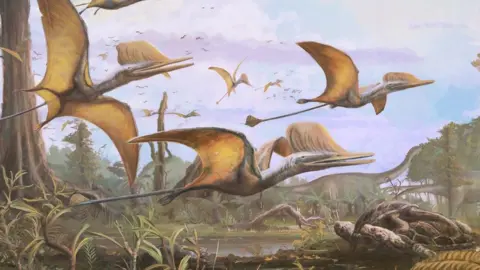
A unique species of flying reptile, or pterosaur, that lived 168-166 million years ago has been discovered on the Isle of Skye.

Its wings, shoulders, legs and backbone were found in a rock on a beach, but the fossil's skull was missing.

Scientists were surprised to find a pterosaur from this period off Scotland's west coast - they were thought to mostly live in China.

The creature - called Ceoptera - is the second pterosaur found on Skye.

Its name comes from the Scottish Gaelic word cheò, meaning mist, and is a reference to the Gaelic name of Isle of Syke - Eilean a' Cheò or Isle of Mist.

Fossils from this era, called the Middle Jurassic, are extremely rare, says Dr Liz Martin-Silverstone at the University of Bristol who used a CT scanner to make a 3D digital model of the fossil.

"Finding anything from that time period that's more than just a single bone is really exciting," she says.

The creature probably had a wing-span of around 1m to 1.5m.

Prof Steve Brusatte, who was not involved in the research, says it was unique to Scotland. The research proves that a type of pterosaur between the primitive and advanced stages of evolution existed, he adds.

"This is the time before birds, so pterosaurs ruled the sky. This research shows that pterosaurs were common animals in Scotland, soaring over the heads of dinosaurs," he said.

NHM & Whitton A drawing of the cheapteraNHM & Whitton
A drawing of the cheaptera

Prof Brusatte led a project that found another type of pterosaur, called Dearc, in 2022.

In the Middle Jurassic period, Scotland was part of an island in the middle of the Atlantic Ocean with a sub-tropical climate with beaches and lagoons where the pterosaurs probably liked to live, he explains.

Scientists with the Natural History Museum first found the fossil buried in rock on a dig in 2006.

"We were looking at very dark black bone on a very dark grey rock. We were on hands and knees crawling, looking for small smears of bone on the surface," says Dr Paul Barrett who was on the expedition.

The team carried the fragile fossil in backpacks on the journey back to London to protect it from damage, he adds.

It took thousands of hours to remove enough of the hard limestone rock around the fossil so it could be studied.

After using acid to dissolve rock and then scanning the specimen, scientists have now published their classification of the fossil.

"This group of more advanced flying reptiles had an earlier flourishing than we originally thought," says Dr Barrett.

The creature is from the Darwinoptera branch of pterosaurs. The research shows that the group lived for more than 25 million years, from the late Early Jurassic to the latest Jurassic, explains Dr Martin-Silverstone.

The findings are published in the Journal of Vertebrate Paleontology.


Adblock test (Why?)

Article From & Read More ( Pterosaur: Unique flying reptile soared above Isle of Skye - BBC.com )
https://ift.tt/a2X8sRC
Science

How will the 2024 total solar eclipse differ from the 2017 total solar eclipse? - Space.com

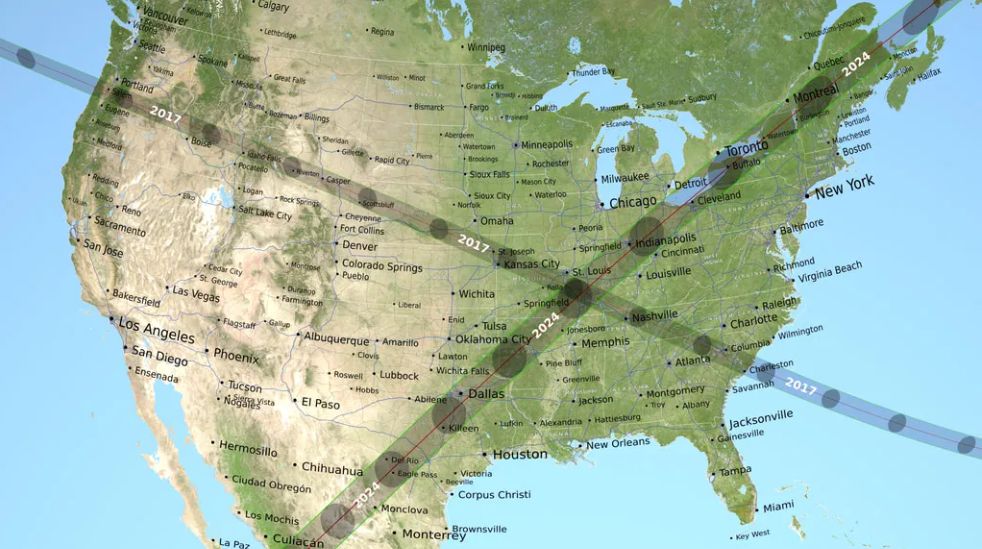
On August 21, 2017, a total solar eclipse moved from the Pacific to the Atlantic, throwing a narrow corridor through 14 U.S. states under the moon's shadow in the first coast-to-coast totality for 99 years. On that day, the shadow moved from Oregon across the U.S. to South Carolina, from roughly northwest to southeast. 

It's about to happen again, with the total solar eclipse on April 8 again beginning in the Pacific and ending in the Atlantic, but this time, the path appears to track from southwest to northeast. 

There are other differences, too, including the maximum length of totality (2 minutes 40 seconds in 2017 and 4 minutes 28 seconds in 2024) and the width of the path of totality (about 70 miles in 2017 and around 115 miles in 2024). This time around, many millions more people will experience totality — and at a time when the sun is close to solar maximum. 

Related: Total solar eclipse April 8, 2024: Live updates 

Here's how the 2024 total eclipse differs from the 2017 total eclipse:

Eclipse circumstances 

Related stories:

"The eclipse circumstances are just completely different," said Dan McGlaun, an eclipse expert at Eclipse 2024, which has an interactive map and eclipse simulator for the upcoming eclipse, in an interview with Space.com. 

"It's all about the distance to the sun and the moon — just simple geometry." Although the distance from Earth to the sun does change — it's closest at perihelion in January and farthest at aphelion in July — that doesn't affect these two eclipses because the sun is roughly the same distance away. 

What does differ hugely is the distance from Earth to the moon, which has a slightly elliptical orbit. 

The distance to the moon 

During the peak of the 2017 eclipse, the moon was 231,155 miles (372,008 km) from Earth, while on April 8, it will be 223,392 miles (359,515 km) away. On April 8, the moon will be a couple thousand miles closer, so its conical shadow that falls on Earth will have a larger diameter. In 2017, the path of totality was 62 to 71 miles wide, according to NASA, while on April 8, it will range between 108 and 122 miles wide, covering much more of Earth.

The path of totality — a projection of the moon's shadow — moves from west to east because that's the direction the moon orbits Earth (and the moon travels much faster than Earth is rotating, visibly overtaking it during the eclipse). That partly cancels out the moon's speed, but its shadow will still sweep across Earth from west to east at more than 1,500 miles (2,400 km) per hour on April 8, according to NASA. 

The position of the moon 

The moon's orbital path around Earth is tilted by 5.1 degrees with respect to the orbit of the Earth around the sun. That means its orbit crosses the ecliptic — the apparent path of the sun through our daytime sky — at two points, which astronomers call nodes (ascending and descending). When it does so at a new moon, it causes a solar eclipse, but what node it occurs at makes a difference. 

"An ascending node eclipse has the moon going upward while a descending node eclipse it's going downward," said McGlaun. However, since both the 2017 and 2024 are ascending node eclipses, there's something else that's much more important when looking at the different paths — the angle of Earth. 

The rotation of Earth 

The sun and moon combine to produce a shadow in space that's always there. It's only when a planet rotating on an axis titled by 23.4 degrees gets in the way that a path of totality is created. "As the year progresses, the Earth changes its orientation and rotates in place, and this, more than anything else, is why the shadow in 2017 is different to 2024," said McGlaun. In short, Earth's axis is leaning different ways during both eclipses. 

"In 2017, it's the Earth rotating during totality that's causing that path to look like it's going down, but it's really going up," said McGlaun. As seen from the sun, North America appears to move up the globe as Earth rotates during the eclipse, as you can see on McGlaun's solar eclipse simulator. "For the 2024 eclipse, the moon's shadow is doing the same thing, but the Earth is leaning the other way." During the eclipse, North America appears to move down the globe as Earth rotates. 

Change the angle of the Earth's axis, and you can make the path of totality go anywhere you want. 

The 'Eclipse Crossroads' 

Another effect of all this is that the 2017 and 2024 paths cross, creating an "Eclipse Crossroads" area of about 9,000 square miles (14,500 square km) in parts of southeastern Missouri, southern Illinois and western Kentucky that will soon experience a second totality in less than seven years. 

The centrelines cross in Makanda, Illinois, close to Carbondale. Also in the lucky quadrant are Paducah, Kentucky, Cape Girardeau and Farmington, Missouri. Texas Hill Country, meanwhile, has a 14,000 square miles (36,000 square km) "Eclipse Crossroads" region of its own — centered on Vanderpool — where a "ring of fire" annular solar eclipse on October 14 was merely a warm-up for the totality to come. 

The solar cycle 

Another big change between 2017 and 2024 is the sun's magnetic activity. The sun has its own cycle, the solar cycle, which lasts about 11 years. During that time, its magnetic activity waxes and wanes. The 2017 eclipse occurred close to the solar minimum when magnetic activity was low. Solar maximum is predicted to occur in 2024, meaning more to see on the sun during the eclipse. 

Use your solar eclipse glasses during the partial phases of the eclipse, and you'll see sunspots — dark areas of magnetic activity — on the surface, close to its equator. If you're in the path of totality, totality will likely reveal a larger corona, streamers throughout the corona and prominences, which appear as bright, pink curls or loops coming off the sun.

Adblock test (Why?)

Article From & Read More ( How will the 2024 total solar eclipse differ from the 2017 total solar eclipse? - Space.com )
https://ift.tt/KGgC0dv
Science

Monday, February 5, 2024

Pensacola targeted as splashdown location for SpaceX Ax-3 mission - Pensacola News Journal

SpaceX and Axiom Space are eyeing the waters off Pensacola for a possible splashdown location for the Ax-3 mission Tuesday evening.

The Federal Aviation Administration issued a notice to pilots Sunday that restricts airspace for a 9-mile area approximately 30 miles offshore from the Pensacola area for "space operations" from 5:10 p.m. to 5:40 p.m.

NASA and SpaceX announced Sunday that the crew of Ax-3 would undock their Dragon spacecraft from the International Space Station at 8:05 a.m. Tuesday to prepare for re-entry.

The Ax-3 mission launched in January as the first all-European private astronaut mission to the International Space Station from NASA's Kennedy Space Center.

Splashdown for the mission was previously planned to occur off Florida's east coast, but weather conditions in the Atlantic make the Gulf of Mexico a better option.

Axiom Space has used SpaceX rockets to fly two previous private astronaut crews to the ISS.

When the crew of Ax-2 returned to splash down in the Gulf of Mexico near Panama City, many Pensacola residents heard the sonic boom as the Dragon capsule passed overhead.

With the splashdown of Ax-3 set off the coast of Pensacola, hearing any kind of sonic boom in Pensacola is unlikely. But areas to the northwest of Pensacola in Alabama and Mississippi may hear a sonic boom.

Adblock test (Why?)

Article From & Read More ( Pensacola targeted as splashdown location for SpaceX Ax-3 mission - Pensacola News Journal )
https://ift.tt/hykM6XJ
Science

Sunday, February 4, 2024

SpaceX to launch NASA's PACE ocean-monitoring satellite this week - Space.com

A NASA satellite is about to take flight to map out the ocean's many hues.

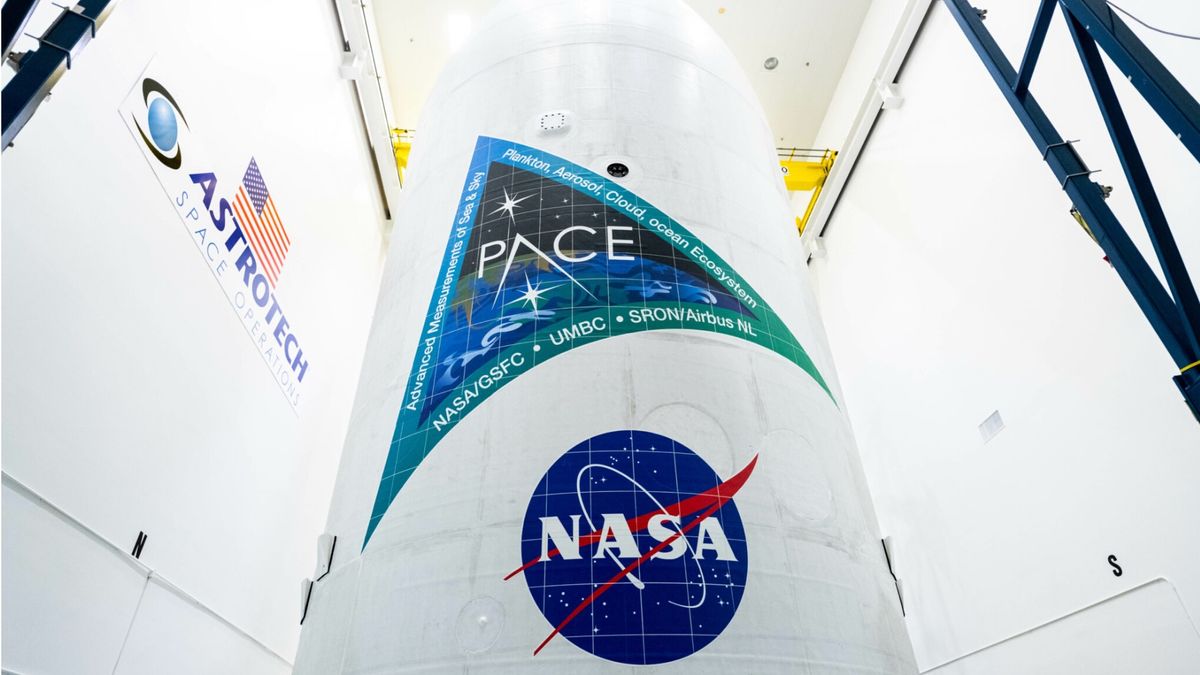
NASA's PACE spacecraft, which will help scientists gauge the health of oceans around the world, is set to launch atop a SpaceX Falcon 9 rocket from Florida's Cape Canaveral Space Force Station on Tuesday (Feb. 6) at 1:33 a.m. EST (0633 GMT).

You can watch the liftoff live here at Space.com, courtesy of NASA, or directly via the space agency. Coverage will begin at 12:45 a.m. EST (0545 GMT).

Related: Earth is getting hotter at a faster rate despite pledges of government action

The Falcon 9 will deliver PACE, whose name is short for Plankton, Aerosol, Cloud, ocean Ecosystem, to an orbit 420 miles (677 kilometers) above Earth — about 70% higher than the International Space Station flies.

From that perch, PACE will use its three science instruments "to collect data on clouds, aerosols and phytoplankton growth that can determine ocean color," NASA officials wrote in a mission update on Thursday (Feb. 1). 

"Measuring the color and amount of light will help scientists better understand the types and locations of microscopic algae, which are vital to the health of Earth's oceans and its marine life," they added. "PACE will contribute to NASA’s more than 20 years of global satellite observations of ocean biology and key measurements related to air quality and climate."

The 10.5-foot-long (3.2-meter-long) PACE will do this work for at least three years, if all goes according to plan.

RELATED STORIES:

PACE has had a long and somewhat harrowing road to the launch pad. The Trump administration tried to cancel the mission three separate times, in its budget proposals for fiscal years 2018, 2019 and 2020. But Congress allocated the required funds on each occasion, saving PACE from the chopping block. 

Back in 2014, NASA capped PACE's total cost (including for its launch vehicle) at $805 million, with a liftoff targeted for 2022. That price tag has gone up, however, to $948 million, according to Florida Today.

PACE's launch is part of a very busy year for SpaceX. The company launched 10 orbital missions in January — a single-month record, according to Elon Musk. And that impressive pace could ramp up even more: SpaceX aims to launch 144 missions in 2024, company representatives have said.

Adblock test (Why?)

Article From & Read More ( SpaceX to launch NASA's PACE ocean-monitoring satellite this week - Space.com )
https://ift.tt/fv7HOS3
Science

Search

Featured Post

Two meteor showers will peak tonight. How to watch the Southern Delta Aquariids and the Alpha Capricornids. - Yahoo

[unable to retrieve full-text content] Two meteor showers will peak tonight. How to watch the Southern Delta Aquariids and the Alpha Caprico...

Postingan Populer