Rechercher dans ce blog

Friday, March 29, 2024

How to Watch Upcoming Total Solar Eclipse with NASA from Anywhere - NASA

On Monday, April 8, most of North America will have the chance to see the Moon pass in front of the Sun during a solar eclipse. NASA is inviting the public to participate with in-person events, opportunities to do NASA science, and multiple ways to watch online.

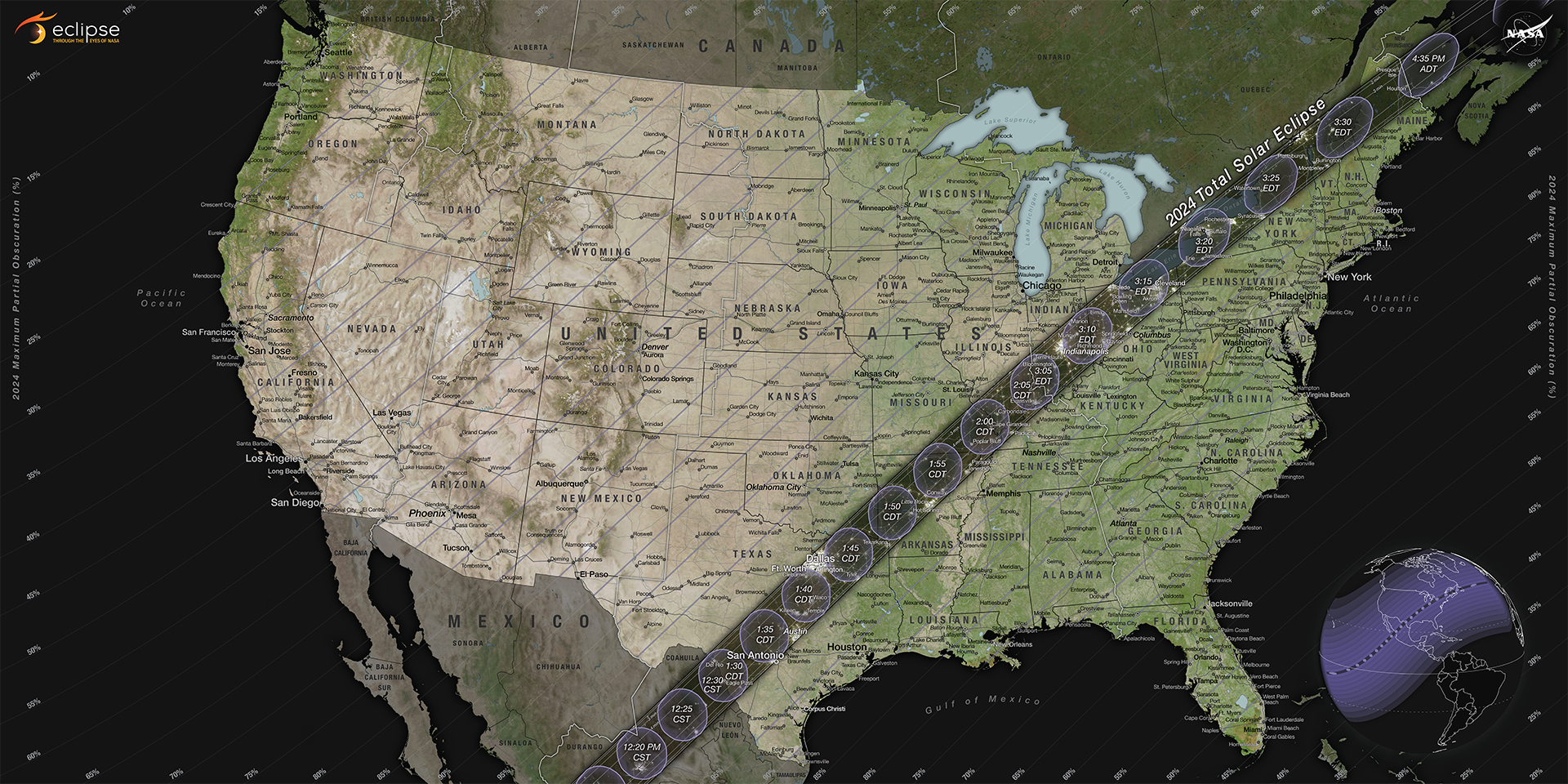
Millions of people along the path of totality – which stretches from Texas to Maine in the United States – will see a total solar eclipse, when the Moon completely covers the Sun. Outside the path of totality, people across the contiguous United States will have a chance to see a partial solar eclipse, when the Moon covers part of the Sun. Learn how to safely view this celestial event.

Watch Through Eyes of NASA

NASA will host live coverage of the eclipse starting at 1 p.m. EDT. The agency’s eclipse coverage will include live views of the eclipse from across North America, special appearances by NASA experts, astronauts aboard the space station, and an inside look at NASA’s eclipse science experiments and watch parties across the country. NASA’s broadcast will last three hours, and features live locations from across the nation including the agency’s only center in the path of totality, NASA’s Glenn Research Center in Ohio, as well as:

  • Carbondale, Illinois
  • Dallas
  • Houlton, Maine
  • Indianapolis
  • Kerrville, Texas
  • Niagara Falls, New York
  • Russellville, Arkansas

The NASA broadcast will stream on NASA+, air on NASA TV, and the agency’s website. Learn how to stream NASA TV through a variety of platforms including social media and the agency’s app.

NASA also will host a watch party of the eclipse in Spanish starting at 1:30 p.m. on YouTube.

NASA will provide a no-commentary, telescope-only feed of the eclipse on NASA Television’s media channel and YouTube, starting at 1 p.m. and running for three hours. The telescope feed will incorporate views from multiple locations, and will be switched based on weather, the eclipse’s progress, and feed availability. Locations may include:

  • Carbondale, Illinois
  • Cleveland
  • Dallas
  • Houlton, Maine
  • Indianapolis
  • Junction, Texas
  • Kerrville, Texas
  • Mazatlán, Mexico
  • Niagara Falls, New York
  • Russellville, Arkansas
  • Torreón, Mexico
  • Tupper Lake, New York

NASA’s Wallops Flight Facility in Virginia will provide a commentated livestream of three sounding rocket launches for the Atmospheric Perturbations around Eclipse Path mission. The livestream will begin at 2:30 p.m. on NASA Wallops’ YouTube channel and conclude after the last of the three sounding rocket launches.

NASA’s interactive Eclipse Explorer Map will allow users to track the total solar eclipse in real time on April 8 as it moves across North America. Use the tool ahead of time to search by zip code or city for eclipse timing, get real-time weather updates, percent of eclipse coverage, and even a corona prediction for locations in the path of totality.

Media Resources

Media resources are available on NASA’s eclipse website. To request a remote or in-person eclipse interview with NASA, please contact agency-eclipsemedia@mail.nasa.gov.

Details about in-person eclipse events and registration requirements for media are available online.

NASA eclipse photos will be shared on the Flickr account.  

To learn more about the total solar eclipse, visit:

go.nasa.gov/Eclipse2024

-end-

Karen Fox
Headquarters, Washington
202-358-1100
karen.c.fox@nasa.gov

Sarah Frazier
Goddard Space Flight Center, Greenbelt, Maryland
202-853-7191
sarah.frazier@nasa.gov

Adblock test (Why?)

Article From & Read More ( How to Watch Upcoming Total Solar Eclipse with NASA from Anywhere - NASA )
https://ift.tt/5udADZf
Science

Climate change could affect timekeeping, study says - BBC.com

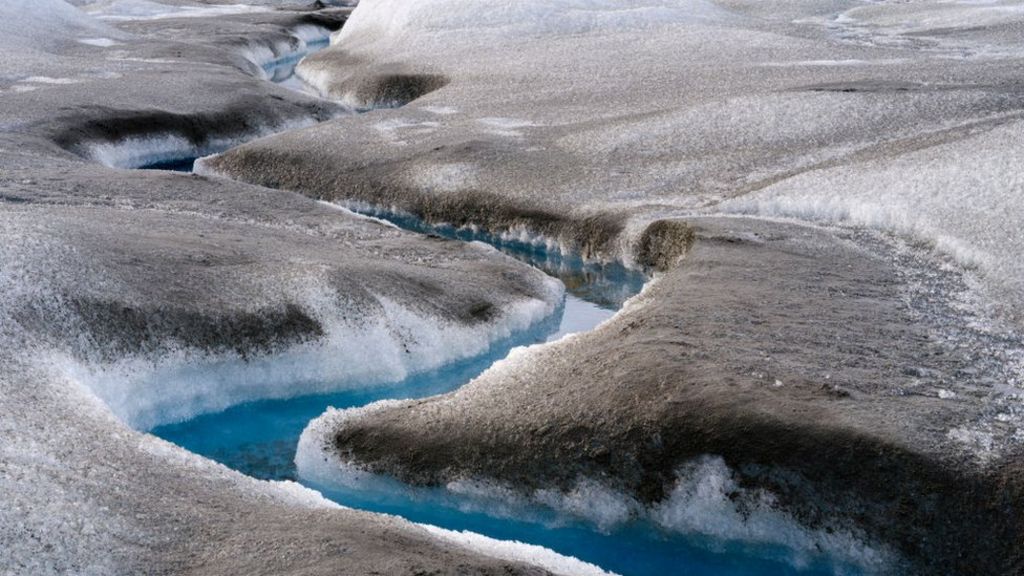
Landscape of the Greenland ice sheet near Kangerlussuaq, Greenland

Climate change is affecting the speed of the Earth's rotation and could impact how we keep time, a study says.

Accelerating melt from Greenland and Antarctica is adding extra water to the world's seas, redistributing mass.

That is very slightly slowing the Earth's rotation. But the planet is still spinning faster than it used to.

The effect is that global timekeepers may need to subtract a second from our clocks later than would otherwise have been the case.

"Global warming is already affecting global timekeeping," says the study, published in the journal Nature.

Coordinated Universal Time (UTC) - which is used by most of the world to regulate clocks and time - is calculated by the Earth's rotation.

But the Earth's rotation rate is not constant and can therefore have an effect on how long our days and nights are.

Changes to the planet's liquid core have meant the Earth has been spinning slightly quicker.

Since the 1970s, to correct for this, about 27 leap seconds have been added to the global clock, with timekeepers planning on subtracting a second for the first time in 2026. This is known as a "negative leap second."

However, the study finds that ice melt caused by climate change has partly offset that acceleration.

Ice sheets are now losing mass five times faster than they were 30 years ago, meaning that the negative leap second change will not be needed until 2029, the study suggests.

"It's kind of impressive, even to me, we've done something that measurably changes how fast the Earth rotates," Duncan Agnew, the author of the study, told NBC News.

"Things are happening that are unprecedented."

The negative leap second has never been used before and, according to the study, its use "will pose an unprecedented problem" for computer systems across the world.

"This has never happened before, and poses a major challenge to making sure that all parts of the global timing infrastructure show the same time," Mr Agnew, who is a researcher at the University of California, San Diego told AFP news agency.

"Many computer programs for leap seconds assume they are all positive, so these would have to be rewritten," he added.

There has been some scepticism of the study, however.

Demetrios Matsakis, former chief scientist for time services at the US Naval Observatory, told AFP that "Earth is too unpredictable to be sure" if a negative leap second would be needed any time soon.

Human activities like burning fossil fuels are causing world temperatures to rise.

That temperature rise is having a huge effect on the environment, including the rapid melting of glaciers and ice sheets.

Adblock test (Why?)

Article From & Read More ( Climate change could affect timekeeping, study says - BBC.com )
https://ift.tt/1fuDtT7
Science

Thursday, March 28, 2024

Final launch of Delta IV Heavy rocket scrubbed late in countdown - Space.com

We'll have to wait at least one more day to see the swan song of United Launch Alliance's (ULA) powerful Delta IV Heavy rocket.

The Delta IV Heavy was supposed to launch for the final time this afternoon (March 28), sending a U.S. spy satellite skyward from Cape Canaveral Space Force Station in Florida. But the attempt was scrubbed with just under four minutes left in the countdown "due to an issue with the gaseous nitrogen pipeline which provides pneumatic pressure to the launch vehicle systems," ULA wrote in an update today.

The launch is now scheduled to take place on Friday (March 29) at 1:37 p.m. EDT (1737 GMT). You can watch the action live here at Space.com, courtesy of ULA.

Related: United Launch Alliance to launch final Delta Heavy IV rocket March 29. Here's how to watch live

The coming launch will be the 16th and final Delta IV Heavy mission, as well as the last for the Delta rocket family, which has been flying for more than six decades.

The Delta IV Heavy's successor, ULA's Vulcan Centaur, is already up and running. The new rocket aced its first mission this past January, successfully lofting the private Peregrine moon lander (although Peregrine suffered problems after deploying into space and failed to reach the moon as planned).

A United Launch Alliance (ULA) Delta IV Heavy rocket is raised vertically at the Space Launch Complex-37 pad in preparation to launch the NROL-70 mission for the National Reconnaissance Office. (Image credit: United Launch Alliance)

RELATED STORIES:

The final Delta IV Heavy mission, called NROL-70, will launch a classified payload for the U.S. National Reconnaissance Office. The NRO builds and operates the nation's fleet of spy satellites and rarely divulges many details about their capabilities and activities.

Thus, unsurprisingly, ULA's NROL-70 mission description is vague, as the team only stated that the launch will "strengthen the NRO's ability to provide a wide range of timely intelligence information to national decision makers, warfighters and intelligence analysts to protect the nation’s vital interests and support humanitarian efforts worldwide."

Adblock test (Why?)

Article From & Read More ( Final launch of Delta IV Heavy rocket scrubbed late in countdown - Space.com )
https://ift.tt/iQs4Tuv
Science

Wednesday, March 27, 2024

Polar ice is melting and changing Earth’s rotation. It’s messing with time itself - CNN

CNN  — 

One day in the next couple of years, everyone in the world will lose a second of their time. Exactly when that will happen is being influenced by humans, according to a new study, as melting polar ice alters the Earth’s rotation and changes time itself.

The hours and minutes that dictate our days are determined by Earth’s rotation. But that rotation is not constant; it can change ever so slightly, depending on what’s happening on Earth’s surface and in its molten core.

These nearly imperceptible changes occasionally mean the world’s clocks need to be adjusted by a “leap second,” which may sound tiny but can have a big impact on computing systems.

Plenty of seconds have been added over the years. But after a long trend of slowing, the Earth’s rotation is now speeding up because of changes in its core. For the first time ever, a second will need to be taken off.

“A negative leap second has never been added or tested, so the problems it could create are without precedent,” Patrizia Tavella, a member of the Time Department at the International Bureau of Weights and Measures in France, wrote in an article accompanying the study.

But exactly when this will happen is being influenced by global warming, according to the study published Wednesday in the journal Nature. Melting polar ice is delaying the leap second by three years, pushing it from 2026 to 2029, the report found.

“Part of figuring out what is going to happen in global timekeeping … is dependent on understanding what is happening with the global warming effect,” said Duncan Agnew, professor of geophysics at the University of California San Diego and the study’s author.

Before 1955, a second was defined as a specific fraction of the time the Earth took to rotate once in relation to the stars. Then came the era of highly precise atomic clocks, which proved a much more stable way of defining a physical second.

From the late 1960s, the world started using coordinated universal time (UTC) to set time zones. UTC relies on atomic clocks but still keeps pace with the planet’s rotation.

But as the rotation speed is not constant, the two timescales slowly diverge. This means a “leap second” must be added every now and then to bring them back into alignment.

Changes in Earth’s rotation over the long term have been dominated by the friction of the tides on the ocean floor — which has slowed down its rotation. Recently, the impacts of melting polar ice, driven by humans burning planet-heating fossil fuels, have become a significant factor, Agnew said. As the ice melts into the ocean, meltwater moves from the poles toward the equator, which further slows the speed of the Earth’s rotation.

Ted Scambos, a glaciologist at the University of Colorado Boulder who was not involved in the study, describes the process like a figure skater spinning with their arms over their head. As they bring their arms down toward their shoulders, their spin slows.

Polar ice melt “has been large enough to noticeably affect the rotation of the entire Earth in a way that is unprecedented,” Agnew said. “To me, the fact that human beings have caused the rotation of the Earth to change is kind of amazing.”

Flowing water from melting ice in Scoresby Fjord, Greenland, in August 12, 2023.

But while melting ice may be slowing the Earth’s spin, there’s another factor at play when it comes to global timekeeping, according to the report: processes in the Earth’s core.

The planet’s liquid core spins independently of its solid outer shell. If the core slows down, the solid shell speeds up to maintain momentum, Agnew said, and that is what’s currently happening.

Very little is known about what’s going on roughly 1,800 miles below the Earth’s surface, and it’s not clear why the core’s speed is changing. “It’s fundamentally unpredictable,” said Agnew.

But what is clear, according to the study, is that despite polar ice melt exerting a slowing influence, overall the Earth’s rotation is speeding up. That means the world will soon need to subtract a second for the first time.

“A second doesn’t sound like much,” Agnew said, but computing systems set up for activities such as stock exchange transactions need to be accurate to a thousandth of a second.

Many computer systems have software enabling them to add a second, but few have the capability to subtract one. Humans will need to reprogram computers, introducing the potential for error.

“Nobody really anticipated that the Earth would speed up to the point where we might have to remove a leap second,” Agnew said.

Scambos, the University of Colorado Boulder glaciologist, said the “big deal” of the study is that it shows “changes from the Earth’s core are now trending bigger than the trends in loss of ice from the poles — even though ice loss has picked up in the last decade.”

“It’s a ‘yikes’ moment for some computer applications,” he told CNN, but for most people life will carry on as usual.

For Agnew, the findings could be a powerful tool to connect people with the ways humans are changing the planet.

“Being able to say so much ice has melted that it’s actually changed the rotation of the Earth by a measurable amount, I think gives you the sense, OK, this is a big deal.”

Adblock test (Why?)

Article From & Read More ( Polar ice is melting and changing Earth’s rotation. It’s messing with time itself - CNN )
https://ift.tt/MQlgsyG
Science

A way-too-early look at the cloud cover forecast for the solar eclipse - The Washington Post

First things first: You’re not going to get anything here resembling a confident cloud forecast for a few-minute window 12 days from now. But if you’ve got plans to watch the April 8 total solar eclipse, especially travel plans, we think you’re desperate enough to keep reading.

In all seriousness, there are a few things we can say about the early outlook for that day, and a few things worth learning before you start obsessively checking the forecast every day, multiple times a day, if you haven’t started already.

Why are clouds so difficult to predict?

End of carousel

Clouds are one of the most difficult weather parameters to forecast, even just a few days ahead of time, let alone more than 10 days out.

It’s not just large storm systems that produce extensive cloud cover. Those clouds are relatively easy to forecast, especially within a few days. Smaller, weaker disturbances in the atmosphere can generate clouds as well, even when they don’t have enough moisture to make precipitation. Meanwhile, skies can transition from completely cloudy to totally clear within just 50 miles or so of a weather front, while model forecasts for the location of a front can be off by twice that much a day or two beforehand.

The challenge is that cloud cover often depends on processes happening at very small scales in the atmosphere — small enough that models don’t have enough detailed data to accurately resolve them.

Why do I need to know what an ‘ensemble’ is?

Normally we try to keep the technical jargon to a minimum. However, for those of you invested in this forecast, it’s worth learning what an “ensemble” is and why it matters.

There are two main flavors of forecast models: deterministic and ensemble.

A deterministic model is the forecast you’re used to seeing. It’s a single-solution forecast: The temperature will be X, the chance of precipitation is Y and the cloud coverage will be Z. Such forecasts are typically most accurate up to two to three days beforehand.

For forecasts several days to about two weeks in advance, most meteorologists prefer to look at ensembles. These are essentially multiple runs of a deterministic forecast. In each run, or simulation, the initial weather observations fed into the models are slightly tweaked to represent imperfections in both the observations and the models themselves. By analyzing the similarities and differences among the multiple simulations, forecasters can get a better idea of the range of possible weather outcomes and their probabilities, and of the overall forecast confidence.

What is the deterministic forecast showing for April 8?

The image above is a deterministic model forecast for midday on April 8. It shows lots of clouds across a large portion of the path of totality, the roughly 115-mile-wide swath that stretches across the United States from Texas to Maine. It could be totally right, and it could be totally wrong. It’s just too many days away to base anything off a deterministic forecast.

What it shows is similar to climatology — or what average cloud conditions are around this time of year — with clearer skies over Texas and increasing clouds to the northeast. However, there are pockets of clear skies over the Northeast, too, tied to a predicted area of high pressure nearby, off the East Coast.

What are the ensembles showing?

The image above shows an ensemble forecast of atmospheric pressure, using the average of the pressure predicted from 30 simulations from the American modeling system. Generally speaking, areas of low pressure — shown in shades of blue — tend to be cloudier, while areas of high pressure — shown in yellow and orange — tend be sunnier.

Quite a few of the individual simulations suggest lower pressure and thus cloudier skies across a significant portion of the path of totality. There are some that hint at higher pressure and sunnier skies for eastern or northeastern parts of the path of totality, but still show lower pressure moving into western parts of the path of totality, especially areas north of Texas.

The cloud cover forecast shown at the very top of this article suggests the low pressure area is far enough north of Texas that cloud cover may be limited if its simulation of the location of the low is correct.

Of course, this far out, not only is confidence in the presence and location of weather systems low, but the models could be up to a day or two slow or fast on how the systems will progress across the country.

What does AI say?

Excarta, an artificial intelligence weather forecasting start-up, has launched a solar eclipse tracker providing cloud forecasts along the path of the eclipse.

The company is one of several that have developed AI weather models, which make forecasts by learning to recognize patterns in historical weather data, whereas traditional models crunch complex mathematical equations that represent the physics of the atmosphere.

“This allows us to produce highly accurate, hourly, global forecasts in minutes instead of hours,” Vivek Ramavajjala, CEO and founder of Excarta, said in an email. “We can also exploit the improved speed and cost to produce ensembles of weather forecasts, which are crucial in quantifying forecast uncertainty beyond a few days out.”

A news release from the company says its forecasts can be as much as 20 percent more accurate than traditional models.

Here is the AI model’s current forecast for several cities in the path of totality at the time of peak eclipse:

  • Dallas: 53 percent cloud cover (+/-20 percent uncertainty).
  • Little Rock: 58 percent cloud cover (+/- 15 percent uncertainty).
  • Indianapolis: 54 percent cloud cover (+/- 19 percent uncertainty).
  • Cleveland: 55 percent cloud cover (+/- 19 percent uncertainty).
  • Buffalo: 53 percent cloud cover (+/- 19 percent uncertainty).
  • Burlington, Vt.: 47 percent cloud cover (+/- 22 percent uncertainty).

(The figure for uncertainty means that, for example, it predicts Dallas could have anywhere between 33 and 73 percent cloud cover.)

Bottom line

Is the forecast off to a great start for those hoping for clear skies? Not exactly. But we’re still at least several days away from being able to take any cloud forecast too seriously, and forecast confidence may not be terribly high until just a day or two before April 8.

The Washington Post will launch its own eclipse cloud forecast tracker on Friday, so stay tuned.

Adblock test (Why?)

Article From & Read More ( A way-too-early look at the cloud cover forecast for the solar eclipse - The Washington Post )
https://ift.tt/zDEslAU
Science

Melting polar ice is slowing Earth’s rotation and may affect time - NBC News

Global warming has slightly slowed the Earth’s rotation — and it could affect how we measure time. 

A study published Wednesday found that the melting of polar ice — an accelerating trend driven primarily by human-caused climate change — has caused the Earth to spin less quickly than it would otherwise. 

The author of the study, Duncan Agnew, a geophysicist at the Scripps Institution of Oceanography at the University of California San Diego, said that as ice at the poles melts, it changes where the Earth’s mass is concentrated. The change, in turn, affects the planet’s angular velocity. 

Agnew compared the dynamic to a figure skater twirling on ice: “If you have a skater who starts spinning, if she lowers her arms or stretches out her legs, she will slow down,” he said. But if a skater’s arms are drawn inward, the skater will twirl faster. 

Less solid ice at the poles, then, means more mass around the equator — Earth’s waist.

“What you’re doing with the ice melt is you’re taking water that’s frozen solid in places like Antarctica and Greenland, and that frozen water is melting, and you move the fluids to other places on the planet,” said Thomas Herring, a professor of geophysics at the Massachusetts Institute of Technology who was not involved in the new study. “The water flows off towards the equator.” 

The study suggests, in other words, that human influence has monkeyed with a force that scholars, stargazers and scientists have puzzled over for millennia — something long considered a constant that was out of humanity’s control.

“It’s kind of impressive, even to me, we’ve done something that measurably changes how fast the Earth rotates,” Agnew said. “Things are happening that are unprecedented.”

His study, which was published in the journal Nature, suggests that climate change is playing a significant enough role in the Earth’s rotation to delay the possibility of a “negative leap second.” If polar ice had not melted, clocks worldwide might have required the subtraction of a single second as soon as 2026 to keep universal time in sync with Earth’s rotation, which is influenced by various factors. 

Instead, the effect of climate change has pushed that prospect back by an estimated three years. If timekeeping organizations do eventually decide to add a negative leap second, the adjustment could disrupt computer networks.

View of Earth captured by the Deep Space Climate Observatory satellite
A view of Earth captured by the Deep Space Climate Observatory satellite.NASA

The reason leap second adjustments are needed is that even without climate change, Earth’s daily rotation has trended slower over time, even though it may seem constant. 

About 70 million years ago, days were shorter and lasted roughly 23.5 hours, a study in Paleoceanography and Paleoclimatology suggests. That means Cretaceous dinosaurs experienced a planet with 372 days in each year.  

Several key factors affect the planet’s spin — sometimes working in opposition. 

The friction of ocean tides, due in part to the moon’s gravitational pull, slows the Earth’s rotation. Meanwhile, since the last Ice Age, the Earth’s crust has been uplifting in some regions as it responds to the removal of ice sheets’ weight. That effect shifts where mass is distributed and speeds up the planet’s spin. Both of those processes are fairly constant and have predictable rates. 

Yet another factor is the movement of fluid within the Earth’s liquid inner core — a wild card that can either speed or slow how fast the Earth rotates, Agnew said. 

Now, polar ice melt has been added to the mix. As climate change intensifies, researchers expect ice melt to have an even more profound effect on how the planet spins. 

“It will have a bigger contribution as time goes on and as melt accelerates, as we expect it’s likely to do,” Herring said. He added that the new study was a thorough, solid analysis that combined research from several disciplines of science.

The need for timekeepers to adjust universal time to stay in line with the Earth’s rotation is not a new phenomenon. But historically, that has involved adding leap seconds to the common standard for clocks, because Earth’s slowing spin causes astronomical time to fall behind atomic time (which is measured by the vibration of atoms in atomic clocks). 

In recent decades, however, the Earth has rotated faster than would be otherwise expected because of fluctuations in its core. That has prompted timekeepers to consider — for the first time since Coordinated Universal Time was officially adopted in the 1960s — whether it might make sense to subtract a leap second to keep universal time in lockstep with Earth’s rotation.  

The melting of polar ice has counteracted that trend and forestalled any decision point about a negative leap second. According to Agnew’s estimates, it has delayed that possibility by three years — from 2026 to 2029 —  if the current pace of Earth’s rotation holds. 

Adding and subtracting leap seconds is a pain, because they have the potential to disrupt satellite, financial and energy transmission systems that rely on extremely precise timing. Because of that, global timekeepers voted in 2022 to do away with the leap second additions and subtractions by 2035 and let universal time drift away from the pace of the Earth’s rotation. 

“There’s been a push since about 2000 to get rid of leap seconds,” Agnew said. 

Regardless of whether clocks wind up changing, the notion that melting polar ice is affecting the Earth’s rotation speaks to how significant an issue it has become. Research has already described the profound impact that ice loss will have on coastal communities.  

Scientists expect sea level rise to accelerate as the climate warms, a process that will continue for hundreds of years. Last year, top polar researchers warned in a report that parts of key ice sheets could collapse and that coastal communities should prepare for many feet of sea level rise. If humanity allows average global temperatures to rise by 2 degrees Celsius, the planet could be committed to more than 40 feet of sea level rise.

Adblock test (Why?)

Article From & Read More ( Melting polar ice is slowing Earth’s rotation and may affect time - NBC News )
https://ift.tt/mNJHFCM
Science

Why NASA Will Fire Three Rockets At The Solar Eclipse - Forbes

NASA has announced it will fire three scientific sounding rockets into the moon’s shadow on Monday, April 8 during a partial solar eclipse across North America.

In what will be a total solar eclipse for a 115 miles-wide path through parts of Mexico, 15 U.S. states and Canada and a partial solar eclipse for the entire Americas, the event will see a sudden drop in sunlight.

Serpent Deity

The space agency’s project, Atmospheric Perturbations Around The Eclipse Path, will investigate how that drop in sunlight and temperature affects Earth’s upper atmosphere. APEP is named after the serpent deity from ancient Egyptian mythology, nemesis of the sun deity Ra, according to NASA.

NASA’s suborbital rockets won’t launch into totality. Instead they’ll go from Wallops Flight Facility in Wallops Island, Virginia, from where 81% of the sun will be blocked by the moon. That moment will happen at 15:33 EST, though the eclipse will take part between 14:06 and 16:33.

Moon Shadow

However, this won’t be the first simultaneous measurements taken from different locations in a very special layer of Earth’s atmosphere during a solar eclipse.

On Saturday, October 14 at 10:00 a.m, 10:35 a.m and 11:10 a.m. MT, the same three rockets were launched into the moon’s shadow during another partial solar eclipse. They launched from White Sands Missile Range, New Mexico, where a 90% partial solar eclipse took place, reached altitudes of 216 miles, 219 miles and 218 miles.

All three scientific payloads were successfully recovered to be reflown from Wallops Flight Facility for the second part of the APEP experiment. Just as from New Mexico, the rockets will launch before, during and after the peak of the eclipse.

“Each rocket will eject four secondary instruments the size of a two-liter soda bottle that also measure the same data points, so it's similar to results from fifteen rockets, while only launching three,” said Aroh Barjatya, a professor of engineering physics at Embry-Riddle Aeronautical University in Florida, where he directs the Space and Atmospheric Instrumentation Lab.

Rapid Ripples

The point of APEP is to look for perturbations—changes in the Earth’s atmosphere—during the eclipse, with four small scientific instruments measuring changes in electric and magnetic fields, density and temperature. The rockets will enter the ionosphere, where the air becomes electric. It’s here that ions and electrons wax and wane in temperature and density at sunrise and sunset. It’s expected that the rapid eclipse of the sun will see waves ripple through the ionosphere.

“It’s an electrified region that reflects and refracts radio signals, and also impacts satellite communications as the signals pass through,” said Barjatya. “Understanding the ionosphere and developing models to help us predict disturbances is crucial to making sure our increasingly communication-dependent world operates smoothly.”

For the very latest on the total solar eclipse check my main feed for new articles each day.

Wishing you clear skies and wide eyes.

Adblock test (Why?)

Article From & Read More ( Why NASA Will Fire Three Rockets At The Solar Eclipse - Forbes )
https://ift.tt/4XABRyu
Science

Search

Featured Post

Two meteor showers will peak tonight. How to watch the Southern Delta Aquariids and the Alpha Capricornids. - Yahoo

[unable to retrieve full-text content] Two meteor showers will peak tonight. How to watch the Southern Delta Aquariids and the Alpha Caprico...

Postingan Populer