Rechercher dans ce blog

Saturday, April 6, 2024

How to make your own DIY solar eclipse viewer - USA TODAY

By now, everyone has heard that the rare 2024 total solar eclipse is coming – and it's got people excited.

While cities brace for traffic, schools brace for absences and space enthusiasts are planning parties, the glasses that enable safe viewing of the eclipse have become something of a hot commodity.

Peeking directly at the eclipse before it reaches totality without proper eye protection can cause permanent eye damage, experts have warned, making glasses a necessity for safe viewing. But, as the day approaches, they may become harder to find.

Luckily, people who didn't manage to get their hands on glasses are not completely down and out. There are other safe ways to view the eclipse, say experts, and a lot of them only require a little bit of craftiness and items you can find lying around the house.

Here are a few DIY eclipse viewers you can make at home.

As a reminder, none of these options allow you to look directly at the eclipse: you need special eclipse glasses for that.

Solar eclipse guide:When is the 2024 total solar eclipse? Your guide to glasses, forecast, where to watch.

NASA's DIY cereal box viewer

This NASA project uses components you almost certainly already have at home. Using a cereal box, cardboard, foil, paper, scissors and tape or glue, you can put together this projection eclipse viewer.

As always, NASA advises not to look directly into the sun using this tool.

Lauren Grant (6) views the solar eclipse at the Arizona Science Center, 600 E. Washington Street, Phoenix in 2017.

Steps to make the cereal box eclipse viewer:

  • Get an empty, clean cereal box.
  • Cut a white piece of cardboard that will fit snuggly in the bottom of the box, or secure it permanently by gluing it in place.
  • Cut the top of the cereal box, removing both ends and leaving the center intact.
  • Put a piece of tape across the center of the top to securely hold it closed.
  • Tape a piece of heavy-duty foil or double a single layer for additional strength, covering one of the openings at the top of the cereal box. The other opening will remain open for viewing.
  • Using a small nail (approximately 3mm in diameter) push a hole in the foil.
  • Cover the entire box with construction paper, leaving the single-viewing opening and the foil uncovered.

How to use the DIY viewer:

  • The finished box should be held with the pin-hole side facing the sun. It may take a little practice pointing the box.
  • With your back facing the sun, look through the viewing opening. A small image of the sun, about ½ cm in diameter can be seen projected on the white paper inside the box.

Watch the demo here:

The Planetary Society DIY paper viewer

While the Planetary Society also offers instructions for box or projector viewers that are more "fancy," as they put it, it doesn't get easier than their simple pinhole paper projector.

To make it, you only need two index cards (3-by-5 or A6 or A7 size) or small paper plates for each person and basic pushpins. Simply use the pushpin to punch a small hole close to the middle of one of the cards and you're done.

Another super easy version that requires no crafting? A kitchen colander. An ordinary kitchen colander can easily be used to view a solar eclipse in the same way as other projector viewers; the colander's circular holes project crescent images of the sun onto the ground.

To make the "fancier" version, you'll need 2 index cards (larger, 5-by-7 or A5 cards work better for this) or small paper plates for each person, a pencil, pushpins and a towel, sweatshirt, blanket, flattened corrugated cardboard box, carpet, or other soft substrate to place underneath card during pin pushing.

To make the fancier version:

  • Draw a simple design on a card. The lines should not be too close together
  • Place the card on top of something soft (blanket, towel, etc)
  • Using the push pin, make small holes along your design lines. Not too close together – about 5 millimeters (1/4 inch) apart.
People observe a partial solar eclipse on a paper through a telescope in Ankara, on October 25, 2022.

To use it, you'll again want to avoid looking directly at the sun:

  • Go to your eclipse observing spot and make sure you can see the shadow of your head and shoulders clearly.
  • Hold up the card with the hole on top of your shoulder so that you can see the shadow of the card above the shadow of your shoulder.
  • Now hold up the other card and make sure you can see its shadow, too.
  • Move the second card and watch how its shadow moves. Keeping the card in front of you, move its shadow until the second card's shadow overlaps the first card's shadow.
  • Now look at the second card. You should see a dot on the card for every hole you punched. Those dots are actually images of the sun.

Watch the demo here:

Cardboard or paper tube eclipse viewer

Sticking with the theme of using items you can easily find around the house, tube viewers can be made using cardboard tubes from household items like paper towels or toilet paper rolls. You can also use thick cardstock rolled up and taped to make your own tube.

A boy uses a DIY tube viewer to watch the partial solar eclipse in Bogota on August 21, 2017.

To make one, you'll need a cardboard tube, white paper, aluminum foil, tape and a pushpin or something else sharp to poke a small hole. According to "Let's Talk Science," you can put this viewer together with these steps:

  • Trace the opening of the tube on a piece of white paper. Draw a slightly bigger circle around it. Cut around the bigger circle. Cut small slits to the inner circle.
  • Cut an opening near one end of the tube to make a viewing window.
  • Tape the paper circle to the end of the tube near the viewing window.
  • Cut a piece of aluminum foil that is a bit larger than the opening of the tube.
  • Poke a small hole in the center of the aluminum foil.
  • Tape the aluminum foil over the other opening of the tube.

How to use the viewer:

  • With your back to the sun, hold the tube parallel to the path of the sun. Look through the viewing hole. Move the viewer until a small white circle appears on the paper.

See an example below:

Adblock test (Why?)

Article From & Read More ( How to make your own DIY solar eclipse viewer - USA TODAY )
https://ift.tt/RoqBGPI
Science

A Soyuz capsule carrying 3 crew from the International Space Station lands safely in Kazakhstan - The Associated Press

MOSCOW (AP) — A Russian space capsule with two women and one man safely landed in a steppe in Kazakhstan on Saturday after their missions aboard the International Space Station.

The Soyuz MS-24 carrying Russia’s Oleg Novitsky, NASA’s Loral O’Hara and Marina Vasilevskaya of Belarus touched down southeast of the remote town of Dzhezkazgan at 12:17 p.m. Kazakh time (0717 GMT).

Those remaining at the orbiting outpost are NASA astronauts Michael Barratt, Matthew Dominick, Tracy Dyson and Jeannette Epps as well as Russian cosmonauts Nikolai Chub, Alexander Grebenkin and Oleg Kononenko.

O’Hara arrived at the International Space Station on Sept. 15, 2023, spending a total of 204 days there, NASA said.

Novitsky and Vasilevskaya blasted off to space on March 23, two days later than initially planned. The launch of a Soyuz spacecraft carrying them and Dyson, scheduled for March 21, was aborted at the very last minute due to a voltage drop in a power source, according to Yury Borisov, head of Russia’s space agency Roscosmos.

The delay resulted in a two-day, 34-orbit trip to the space station for the crew. If the launch had gone as scheduled, the journey would have been much shorter, requiring only two orbits.

The space station, which has served as a symbol of post-Cold War international cooperation, is now one of the last remaining areas of collaboration between Russia and the West amid tensions over Moscow’s military action in Ukraine. NASA and its partners hope to continue operating the orbiting outpost until 2030.

Russia has continued to rely on modified versions of Soviet-designed rockets for commercial satellites, as well as crews and cargo to the space station.

Adblock test (Why?)

Article From & Read More ( A Soyuz capsule carrying 3 crew from the International Space Station lands safely in Kazakhstan - The Associated Press )
https://ift.tt/CMW70KY
Science

Total solar eclipse 2024: Here's the national weather forecast for April 8 - Space.com

During the past week, the day-to-day weather outlook for the total solar eclipse on April 8 has been changing.

Although modern numerical weather prediction systems are marvels of science and technology, forecasts made beyond a week in advance are subject to significant changes as new information is ingested into later simulations. 

But now, as the days to totality have dwindled to a precious few, these forecasts are now showing increasing signs of converging, providing useful, consistent guidance for which broad areas along the path of totality have the best chance of good viewing conditions.

Related: What happens if it's cloudy for the April 8 solar eclipse? 

These can be augmented by forecasts issued by National Weather Service forecast offices located near and along the totality path. In the final hours before the eclipse, the very latest meteorological data, including careful scrutiny of satellite images and radar scans should be used to modify final observing plans.

And those who would like to peruse various computer guidance models should take advantage of a great weather primer, "Weather Planning for Eclipse Day" by Canadian meteorologist Jay Anderson.

Not what was expected!

The overall pattern certainly does not reflect what long-term climatology averages have suggested.  Many who consulted these values from a year or more ago, immediately placed their hotel and airline reservations down for Mexico and Texas and did not give much consideration to New England and Atlantic Canada.  But climatology, while quite useful, is not absolute. In his 1973 novel, Time Enough for Love, science fiction writer Robert A. Heinlein came up with the following aphorism: "Climate is what we expect, weather is what we get!"

And indeed, the outlook for eclipse day shows that climatology has been practically turned upside-down, with Mexico and Texas showing quite unfavorable conditions for Eclipse Day, while New England and Atlantic Canada, for the most part, suggesting favorable sky conditions for eclipse watchers.  But the latter case is not too surprising.  In a Feature Article that I penned for the November/December 2023 issue of "Weatherwise" magazine, I commented, "April weather is extremely variable and changeable, so at any location, there is some hope of very clear skies on eclipse day."

In addition, I was never really impressed by the seemingly favorable cloud statistics for Texas. In fact, in that same article, I pointed out that, "The weather outlook from Texas through the Deep South looks marginal and going from the Ohio Valley and points north, downright unfavorable; the chances of seeing the eclipsed sun at any given moment on April 8 from Texas to Indiana is about 55-60%.  These conditions are somewhat better than those for the Northeast United States, Ontario, Quebec, and Atlantic Canada, but, surprisingly, not that much better."

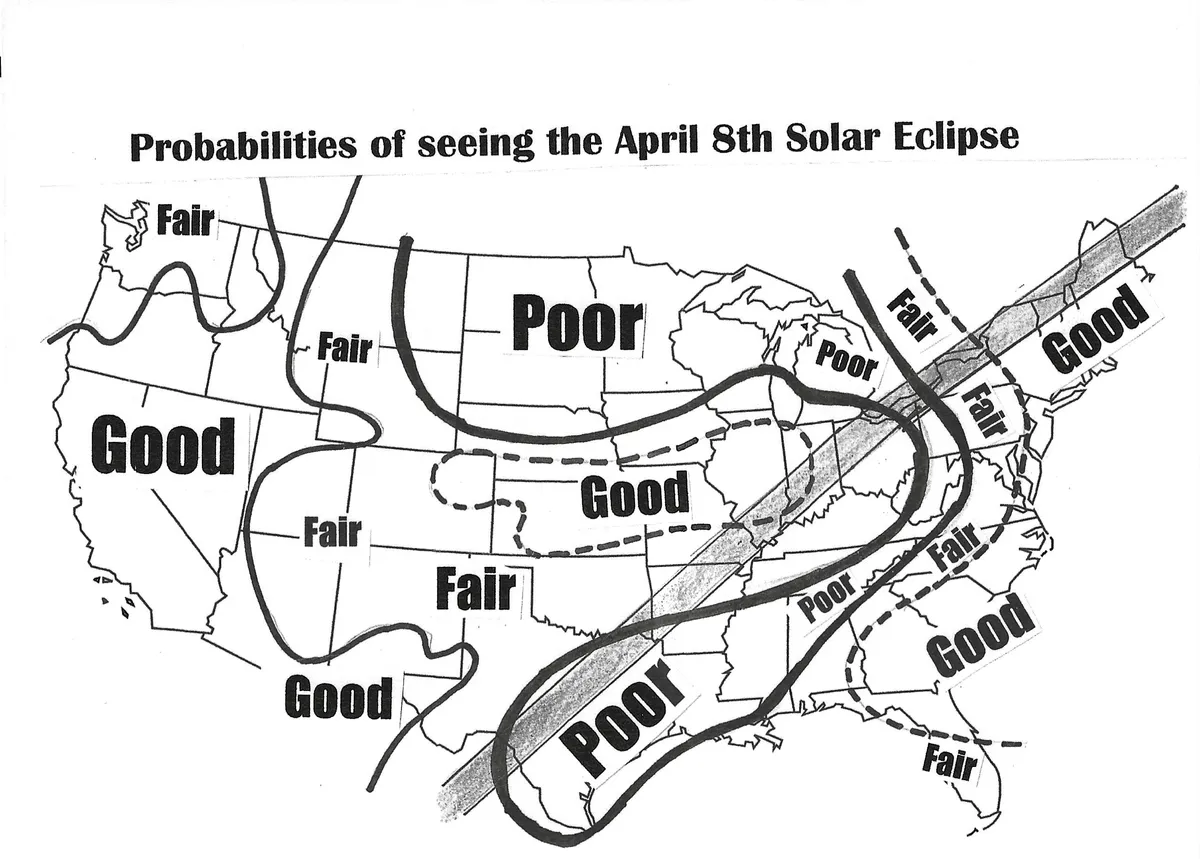
Weather map for April 8

Viewing probability map for April 8 total solar eclipse. (Image credit: Joe Rao)

That having been said, the weather maps for Eclipse Day depict a ridge of high pressure extending south from New York State to the outer banks of North Carolina.  Low pressure is centered over Iowa with associated frontal systems extending through central Illinois, southeast Missouri, Arkansas and into central Texas.  Another area of low pressure is forecast to be over southwest Texas.

A proliferation of clouds

Consulting our Space.com cloud probability map (above), we find that along the path of totality, widespread low cloud cover is being indicated across much of the Texas totality zone. This opaque cloud cover, however, might thin out a bit, possibly allowing for some dim views of the sun for the eclipse track that extends northeast through southeast Oklahoma, the northern half of Arkansas, southeast Missouri, southernmost Illinois, parts of extreme southwestern and eastern Indiana, as well as western and northern Ohio. Northeast Ohio and northwest Pennsylvania might be plagued by a lower/thicker deck of clouds. 

Stay mobile!

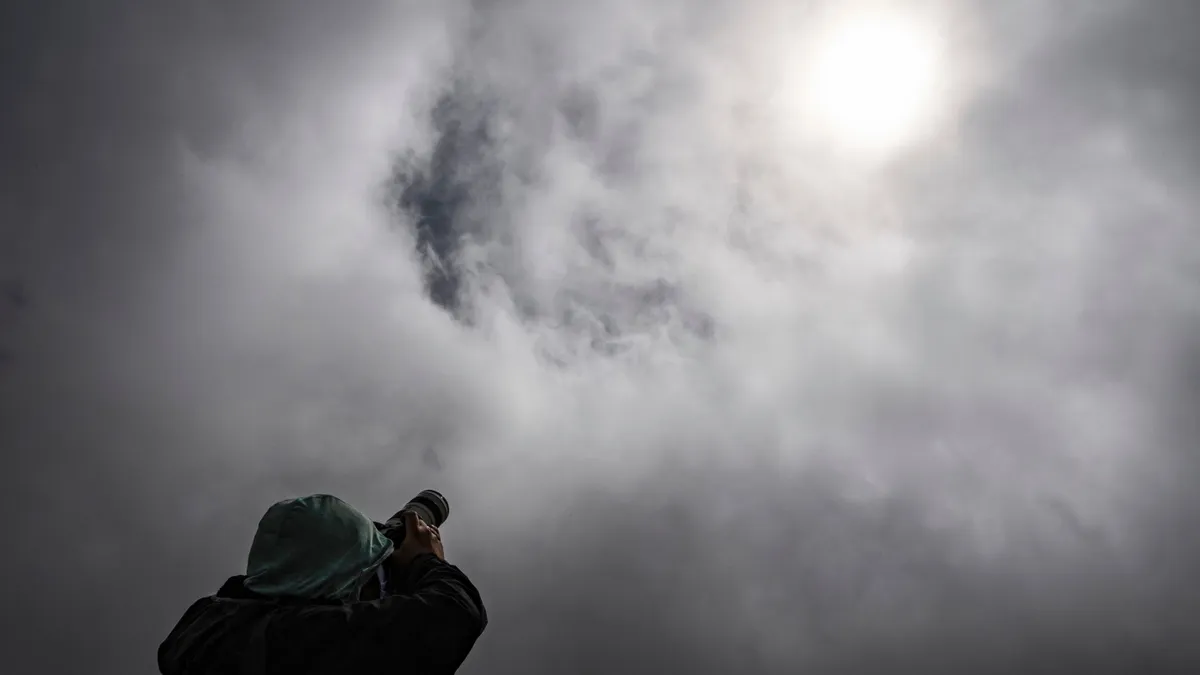
A photographer takes a picture of the sun through the clouds at the Villarica volcano sky center refuge, in Pucon, Chile on December 13, 2020. (Image credit: MARTIN BERNETTI/AFP via Getty Images)

Those, who have mobility and can take advantage of last-minute "seat-of-the-pants weather updates," should pay close attention on eclipse day to satellite images over south-central Illinois and western Indiana, where cloudiness could fortuitously thin to just scattered high-level cloudiness or even perhaps mainly clear skies. Of course, even a slight layer of cirrus cloudiness would interfere with viewing the outermost parts of the corona, and yet a considerable amount of detail can still be seen through a layer of thin cirrus or perhaps even a layer of thin cirrostratus.       

Similarly . . . a swath of high-to-mid-level cloudiness will likely be advancing into western New York at eclipse time. Generally speaking, such clouds tend to "spill over" the top (or center) of an upper-level ridge of high pressure.  

In recent days, the various computer guidance models have been positioning the axis of this high-pressure ridge anywhere from just west of the Hudson River Valley to as far west as the NY/PA border.  So right now, the best compromise would be to assume that by eclipse time some high cloudiness could reach as far east as central New York (Watertown to Syracuse).  But more often than not, high clouds tend to spread east faster than the models suggest, so it would not be at all surprising if, in the end, they spread as far east as Montreal-to-Burlington.

Where to get the very best views

A professional astronomer or astrophotographer whose success depends on a pristine clear sky should consider the eclipse path running from the northeast corner of New York State, through northern Vermont, northern New Hampshire, northern Maine and possibly as far east as New Brunswick, Prince Edward Island and Nova Scotia. . . the farther east, the better.  Some cloud cover statistics show ranges as low as 15 to 30% in these areas.  

Newfoundland, however, could be adversely affected by the same storm system currently affecting the Eastern US; by Eclipse Day this system will be located just southeast of the Avalon Peninsula and could bring cloudy/windy and rainy weather to that province.

Parting thoughts

Two final comments: NOAA/NWS Storm Prediction Center is forecasting a 15% probability of severe weather on April 8, for much of central and eastern Texas, (including the Dallas-Fort Worth and Austin areas), southernmost Oklahoma, a slice of northwest Louisiana and south-westernmost Arkansas; a region that is populated by over 12 million people.  Any potential severe weather that develops in this region would likely wait until after the lunar umbra has passed by but could prove problematic for those heading home after the eclipse. 

Lastly, is the topography of upstate New York, Vermont, New Hampshire and Maine. The Adirondacks, Green, White and Longfellow Mountains could very well generate convective (cumulus) clouds by midday and afternoon; by eclipse time much of the sky might be covered by these big, billowing clouds. I'm sure, however, that during the roughly 75 minutes of growing partial eclipse, the reduction of sunlight and falling temperatures will cause most of these clouds to dissipate . . . but there is always the chance of a lingering stray cumulus cloud crossing in front of the sun at the wrong moment.

Good Luck to all!

Submit your story and photos! If you capture a photo of the April 8 total solar eclipse or any of these strange effects and would like to share it with Space.com's readers, send photos, videos, comments, and your name, location and content usage permission release to spacephotos@space.com.

Adblock test (Why?)

Article From & Read More ( Total solar eclipse 2024: Here's the national weather forecast for April 8 - Space.com )
https://ift.tt/uyD6QMl
Science

Rockets and planes will chase the eclipse to solve the sun’s enduring mysteries - CNN

Editor’s note: A version of this story appeared in CNN’s Wonder Theory science newsletter. To get it in your inbox, sign up for free here.

CNN  — 

Here comes the sun, as the Beatles famously sang.

On Monday, a total solar eclipse will grace the skies over Mexico, the United States and Canada as the moon obscures the face of the sun from view, momentarily turning day to night.

Millions of people will be in the path to witness the celestial phenomenon unfold. As the eclipse creates syzygy, or the alignment of three bodies in space, it will unite spectators in moments of wonder.

Totality, when the sun’s light is briefly dimmed, plays on the emotions. You know it’s coming, but the sudden change is still so unexpected — and it’s something I’m personally hoping to experience for the first time when I’m reporting from my own spot within the path.

So grab your eclipse glasses, savor eclipse-themed treats and cue up a stellar-themed playlist (“Total Eclipse of the Heart,” anyone?). It will soon be time to indulge in a bit of cosmic awe and whimsy.

Defying gravity

NASA's WB-57 jets will fly within the path of totality on Monday to collect data about the sun during the eclipse.

High-altitude aircraft will fly within the path of Monday’s eclipse to unravel some of the greatest unresolved secrets about the sun.

Three sounding rockets are set to lift off from NASA’s Wallops Flight Facility in Virginia before, during and after the eclipse to measure the impact of the sun on Earth’s upper atmosphere, known as the ionosphere.

Meanwhile, NASA is outfitting its WB-57 planes with scientific instruments as they fly 50,000 feet (15,240 meters) above Earth’s surface to get a clear view of the sun’s outer atmosphere. Called the corona, it’s millions of degrees hotter than the sun’s surface, but scientists don’t know why.

The faint corona will be visible during the eclipse when the sun’s light is blocked, allowing researchers a detailed look at its mysterious glowing structures.

Curiosities

Packing for your eclipse travels or trying to decide what to wear on Monday? A nifty optical phenomenon that occurs during the celestial event might make you lean more toward red and green.

More than two centuries ago, physiologist Jan Evangelista Purkyně noted how dissimilar red flowers appear on sunny days versus nighttime. The Purkinje effect explains why some colors appear differently depending on lighting.

For example, in low light, bright reds appear dark or nearly black, while blues and greens increase in vividness. And the quick contrast of an eclipse makes this effect plain to see.

Send us your stories and photos from the eclipse!

Are you watching the eclipse from the path of totality? Did you travel far and gather with family and friends to witness the event? Or is your hometown in the path of what for many is a once-in-a-lifetime spectacle? Everyone has their own eclipse story to tell, and we want to hear yours! Send images* and a few details about your eclipse experience to sciencenewsletter@cnn.com, and it could end up in CNN’s ongoing Eclipse Across America coverage. Please share your full name and pronouns for credit and caption info.

Force of nature

A total solar eclipse is visible through the clouds as seen from the island of Vágar, one of the Faroe Islands, on March 20, 2015.

As the eclipse approaches, many people are scrambling to make or change their plans — and weather is playing a large role by tossing out some unexpected curveballs. 

Advance planning is key, but many made travel reservations and booked flights for areas within the path of totality based on historic data about spring weather patterns.

Now, Mother Nature is doing a bit of a flip-flop, and areas typically experiencing cloud cover and inclement weather are clear, and the opposite is true for other parts of the country.

However, not all clouds will stick around on the big day. Shallow cumulus clouds largely dissipate even when just a fraction of the sun’s light is blocked, and new research has revealed why they don’t reform until after the eclipse has passed.

The wonder

Eclipse mania may seem prevalent, but these celestial happenings can be a more spiritual and reflective experience for some, depending on religion or culture.

Hindus consider an eclipse a bad omen, while many Muslims view the phenomenon as a time for prayer and spiritual contemplation.

Meanwhile, some Christians have interpreted the temporary darkening of the sky as a sign that “end-times” are approaching.

And Navajos regard eclipses with solemnity, marking them as a time to show reverence and respect for the sun and Earth.

Explorations

The STS-107 crew includes, from the left, Mission Specialist David Brown, Commander Rick Husband, Mission Specialists Laurel Clark, Kalpana Chawla and Michael Anderson, Pilot William McCool and Payload Specialist Ilan Ramon.

When Columbia lifted off on its maiden flight in 1981, it kicked off NASA’s space shuttle program and ushered in a new era of exploration. 

But nearly 22 years later, the aging shuttle’s 28th flight ended in disaster when it broke apart over east Texas, killing all seven crew members.

The tragedy marked the beginning of the end of the shuttle program. How did such a revolutionary idea go so wrong?

Explore new details that explain what ultimately led to disaster in a four-part CNN Original Series, “Space Shuttle Columbia: The Final Flight,” that premieres at 9 p.m. ET/PT Sunday.

Discoveries

Catch up on these fun reads before turning your focus to the eclipse:

— Scientists found a multitude of new species, including a sauntering Barbie-pink sea pig, during a deep-sea expedition 16,400 feet (5,000 meters) beneath the surface of the Pacific Ocean.

— The endangered Indochinese leopard and flat-headed cat are two of the wild felines that roam Malaysia’s tropical jungle. A new photo series features a rare glimpse at several of the notoriously elusive species.

— An Asian elephant bathed in sunlight, polar bears sparring and blue-footed boobies are just a few of the images featured in a fine-art photography sale inspired by the legacy of primatologist Jane Goodall, who turned 90 on Wednesday.

Like what you’ve read? Oh, but there’s more. Sign up here to receive in your inbox the next edition of Wonder Theory, brought to you by CNN Space and Science writers Ashley Strickland and Katie Hunt. They find wonder in planets beyond our solar system and discoveries from the ancient world.

*Any materials sent are subject to the following terms. I agree that CNN can use my photos/video (“Material”) on all CNN media, worldwide in perpetuity along with affiliate distribution. I also confirm that I am the exclusive owner and rights holder of the Material, did not create the Material using AI, and have all the necessary rights to authorize use of this Material at this URL.

Adblock test (Why?)

Article From & Read More ( Rockets and planes will chase the eclipse to solve the sun’s enduring mysteries - CNN )
https://ift.tt/tGbvdr1
Science

Friday, April 5, 2024

2024 solar eclipse map: Where to see the eclipse on April 8 - Livescience.com

The day has almost arrived: On Monday (April 8) a total solar eclipse will pass across North America, giving more than 33 million people living in 15 U.S. states a rare view of the totally-obstructed sun, and — weather permitting — a taste of some seriously strange eclipse phenomena.

If you’re wondering where the total and partial phases of the eclipse will be visible, the good news is that almost everyone in the contiguous U.S. will be able to see the celestial spectacle to some extent. But for a more detailed view of the eclipse’s path, take a look at these handy eclipse maps, courtesy of GreatAmericanEclipse.com. 

Solar eclipse 2024 path of totality map

Map of path of totality across North America of solar eclipse on April 8, 2024. (Image credit: GreatAmericanEclipse.com)

Totality is the moment that every eclipse-chaser lives for: The moment when the moon completely covers the sun’s face, resulting in a brief but eerie darkness in the daytime. The path of totality, shown in the map above, is the path of the moon’s shadow across Earth’s surface. 

On Monday (April 8), totality will begin in Sinaloa, Mexico, then move northeast up to Texas, ultimately crossing 15 states before moving on to Canada. The states where totality will be visible are: Texas, Oklahoma, Arkansas, Missouri, Kentucky, Tennessee, Illinois, Indiana, Ohio, Michigan, Pennsylvania, New York, Vermont, New Hampshire and Maine — although Tennessee and Michigan will only be glanced by the moon's shadow.

Related: April 8 solar eclipse: What time does totality start in every state?

Viewers MUST be within the path of totality to witness the total phase of the eclipse; if you are off the path by even a mile, you will only see a partial eclipse, and miss out on the spooky daytime darkness. Furthermore, the closer you are to the center of the path of totality, the longer totality will last for you — up to a maximum duration of 4 minutes, 27 seconds in Torreón, Mexico.

Note: Totality is the ONLY TIME when it is safe to view the sun without protective eyewear like certified solar eclipse glasses. You must protect your eyes during the entire partial phase of the eclipse, no matter where you are.

Solar eclipse 2024 partial eclipse map

A map of total and partial eclipse coverage across North America on April 8, 2024. (Image credit: GreatAmericanEclipse.com)

If you live in the U.S. and can’t make it to the path of totality, a partial eclipse still awaits you on April 8. The entire contiguous U.S. will have some view of the partial eclipse, ranging from 99% coverage of the sun just off the path of totality to about 15% coverage far to the northwest of the path.

The map above shows how much of the sun’s disk will be blocked from your location. Watching the partial phases of the eclipse — which last about an hour and 20 minutes before and after totality — means wearing protective eyewear at all times. Failure to do so could result in permanent eye damage, according to NASA.

If you want to experience the celestial spectacle but don’t have a pair of eclipse glasses handy, there are many other ways to safely enjoy the partial eclipse. These include making a homemade pinhole projector, using a pasta strainer to project the shadow of the moon onto the ground or watching one of the various eclipse live streams available.

2024 eclipse travel maps

A travel map showing driving distances to the path of totality on April 8, 2024 (Image credit: GreatAmericanEclipse.com)

If you want to see totality but don’t live within the path, driving or taking public transit to a city within the path may be possible. The map above shows how far the drive is to the path of totality, based on where you’re coming from. Meanwhile, the map below shows the most populated cities within the path of totality — many of which are expected to be flooded with millions of eclipse tourists on April 8.

The biggest cities within the path of totality include: San Antonio, Dallas, Austin and Fort Worth in Texas; Indianapolis, Indiana; Hamilton and Montreal in Canada; and Torreón and Mazatlan in Mexico.

A map showing the 10 biggest cities on the path of the April 8, 2024 eclipse (Image credit: GreatAmericanEclipse.com)

Wherever you are on April 8, we wish you clear skies and protected eyes during this rare, wondrous eclipse over North America.

Adblock test (Why?)

Article From & Read More ( 2024 solar eclipse map: Where to see the eclipse on April 8 - Livescience.com )
https://ift.tt/x2yIkLp
Science

Why NASA jets will chase the April 8 total solar eclipse (video) - Space.com

Eclipse junkies will soon be bathing in the dark comfort of the moon's shadow on April 8, when the highly anticipated event event cuts a diagonal ribbon across Mexico, 15 U.S. states, and Canada.

Many observatories, educational institutions, museums, theme parks and sporting venues situated along the path of totality for the April 8 solar eclipse will be staging special viewing parties and informational events to coincide with the celestial spectacle.

But one of the most stunning vantage points in North America could be from the clear cockpits of a pair of NASA WB-57 jets streaking across the path of totality and thereby greatly extending the amount of time they spend in the moon's moving shadow.

Related: 6 reasons why the 2024 total solar eclipse could be the best eclipse for hundreds of years

A NASA eclipse-chasing WB-57 jet. (Image credit: NASA Goddard)

According to a NASA press release, a trio of NASA-funded teams have equipped these special airplanes with scientific instruments able to take more precise measurements of the eclipse. 

A pair of research teams will image the sun's shimmering outer atmosphere, known as the corona, and a third test will record measurements of the ionosphere, the upper, electrically charged portion of Earth’s atmosphere. 

This new info will improve scientists' knowledge of the structure and temperature of the corona, the impact of the sun on Earth's atmosphere, and potentially help locate stray asteroids circling near our star, NASA officials said.

One of the benefits of using high-altitude WB-57s soaring at 50,000 feet (15,000 meters) is that they can climb above any cloud cover that would obscure the dramatic effects of the total eclipse. This lofty altitude also has the advantage of being above the main portion of Earth’s atmosphere, where cameras can take sharper images and capture wavelengths like infrared light. And, by zooming above Earth at roughly 460 mph (740 kph), the jets can stretch out their totality time by approximately 25%, which works out to be around 6 minutes and 22 seconds.

"By extending the duration of totality, we're increasing the duration of how much data we can acquire," said Shadia Habbal, a University of Hawaii researcher in charge of one of the WB-57 eclipse experiments. "This light is our best probe short of sticking a thermometer in the corona."

A map of the path for the 2024 total solar eclipse. (Image credit: NASA/Scientific Visualization Studio/Michala Garrison; Eclipse Calculations By Ernie Wright, NASA Goddard Space Flight Center)

RELATED STORIES:

Habbal's team will record specific wavelengths of light using sensitive tools that measure the temperature and chemical composition of the corona and coronal mass ejections, which are vast outflows of solar material.

A second team headed up by Amir Caspi at the Southwest Research Institute in Boulder, Colorado, has already chased an eclipse via planes; he led a groundbreaking WB-57 experiment nearly seven years ago to investigate the sun's corona during the Great American Eclipse of 2017, marking the first time jets were employed for this purpose. Now an improved high-resolution, high-speed camera in the jet will obtain measurements in more wavelengths from infrared to visible light to reveal new data about structures in the middle and lower corona.

"There isn't a lot of data of the sun at some of the wavelengths we'll be studying," Caspi said. "We don't know what we'll find, so it's extra exciting to be making these measurements."

Adblock test (Why?)

Article From & Read More ( Why NASA jets will chase the April 8 total solar eclipse (video) - Space.com )
https://ift.tt/3N1tXe4
Science

Thursday, April 4, 2024

Upstate NY now looks like one of the clearest spots in U.S. to see the solar eclipse - syracuse.com

Syracuse, N.Y. -- Upstate New York may defy the historical odds and boast some of the clearest skies of anywhere along the total solar eclipse path in the U.S. on Monday.

“Clear skies in the path of totality are most likely in northern New England and Upstate New York,” the Weather Prediction Center said today in its daily eclipse weather briefing. The center is the medium-range forecasting arm of the National Weather Service.

Adblock test (Why?)

Article From & Read More ( Upstate NY now looks like one of the clearest spots in U.S. to see the solar eclipse - syracuse.com )
https://ift.tt/Y3AmJNx
Science

Search

Featured Post

Two meteor showers will peak tonight. How to watch the Southern Delta Aquariids and the Alpha Capricornids. - Yahoo

[unable to retrieve full-text content] Two meteor showers will peak tonight. How to watch the Southern Delta Aquariids and the Alpha Caprico...

Postingan Populer