Because of the lander's now-apparent inverted position, its solar panels weren't oriented correctly to generate power, according to the space agency. The team elected to conserve power by shutting down the spacecraft about 2.5 hours after landing.
What's perhaps as surprising as the photo of the lander is how it was taken. Two small rovers separated from the crewless mothership just prior to touchdown. It was one of these baseball-sized robots that was able to snap the image of the spacecraft with its head in the moondust. The rover, built with the help of Japanese toy maker Takara Tomy, is a sphere that splits in half to expose a pair of cameras that point front and back. The two hemispheres also become the rover wheels. "The company is perhaps most famous for originally creating the Transformers, the alien robots that can disguise themselves as machines," said Elizabeth Tasker, who provided commentary on the moon landing in English on Jan. 20.
The space agency still isn't entirely sure what went wrong. At about 55 yards above the ground, the spacecraft performed an obstacle avoidance maneuver, part of the pinpoint-landing demonstration. Just prior to this step, one of the two main engines stopped thrusting, throwing the lander's orientation off. JAXA is continuing to investigate what caused the engine problem... Despite the fact that the spacecraft is now sleeping, the SLIM team hasn't lost hope for a recovery. With solar panels facing west, the lander still has a chance of catching some rays and generating power. If the angle of sunlight changes, SLIM could still be awakened, mission officials said.
That would have to happen soon, though. Night will fall on the moon on Feb. 1, bringing about freezing temperatures. The spacecraft was not built to withstand those conditions.
NASA's Lunar Reconnaissance Orbiter spacecraft has now passed over the landing site at an altitude of about 50 miles (80 km) — and snapped their own photograph which they say shows "the slight change in reflectance around the lander due to engine exhaust sweeping the surface."
An artist's impression of the newly discovered red giant, which has been dubbed the "old smoker"
Astronomers have discovered a new type of red giant star near the centre of the galaxy.
A project led by the University of Hertfordshire has spent 10 years studying almost a billion stars in the Milky Way.
The scientists have now found hidden stars, including a new type of elderly giant star nicknamed "an old smoker".
The team said the stars looked dim for several years before they puffed out huge clouds of smoke into space.
Prof Philip Lucas of the University of Hertfordshire, who led the operation, said his global team also detected dozens of rarely seen newborn stars, known as protostars.
Most of these stars were hidden from view in visible light by large amounts of dust and gas in the Milky Way.
However the scientists used infrared light, which allowed the stars to be seen for the first time.
Philip Lucas/University of Hertfordshire
Scientists used an infrared telescope to study stars over a decade
'Wider significance'
Mr Lucas said: "About two thirds of the stars were easy to classify as well-understood events of various types.
"The rest were a bit more difficult, so we used the European Southern Observatory's Very Large Telescope to get spectra of many of them individually."
Astronomers from the UK, Chile, South Korea, Brazil, Germany and Italy worked with Mr Lucas on the research. The team was helped by a British-built infrared telescope based in the Chilean Andes.
Mr Lucas said the discoveries could change what we know about the way elements were distributed across space.
He added: "Matter ejected from old stars plays a key role in the life cycle of the elements, helping to form the next generation of stars and planets.
"This was thought to occur mainly in a well-studied type of star called a Mira variable.
"However, the discovery of a new type of star that throws off matter could have wider significance for the spread of heavy elements in other galaxies."
SpaceX is preparing to launch a Northrop Grumman Cygnus spacecraft on its flagship Falcon 9 rocket for the first time next week.
The launch of the NG-20 resupply mission is targeted for no earlier than Tuesday, Jan. 30 at 12:07 p.m. EST (1707 GMT). As its name implies, this is the twentieth cargo flight that Northrop Grumman has sent to the International Space Station (ISS), but the first time that the company's Cygnus cargo craft has been sent to the orbital lab atop a SpaceX Falcon 9 rocket.
During a pre-flight teleconference on Friday (Jan. 26), William Gerstenmaier, vice president of Build and Flight Reliability at SpaceX, said that the Falcon 9's payload fairing, the shell that surrounds and protects a spacecraft during ascent while atop a rocket, had to be modified to add a hatch measuring 5 feet by 4 feet (1.5m by 1.2m). The hatch gives ground crews the ability to add extra "late-load" cargo before launch including special treats like ice cream for the astronauts aboard the space station, Gerstenmaier said.
Gerstenmaier added that the complication of addition of the hatch contributed to the decision to delay the launch one day to Jan. 30. That's because the area inside that hatch must be environmentally controlled, since any contamination on Cygnus's docking hardware could affect how well it berths at the ISS.
"So that's a pretty intense activity," Gerstenmaier said. "This will be the first time we've done that. It's taken a lot of modifications on our part to get this hardware ready to go fly."
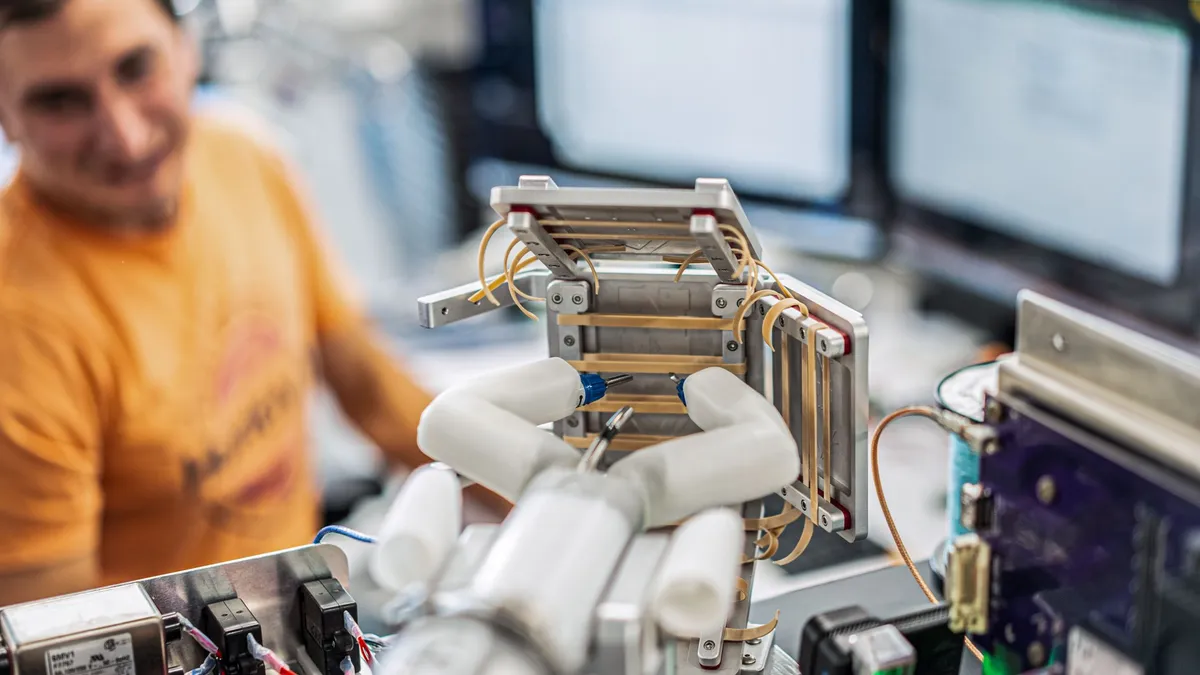
Aboard the latest Cygnus freighter will be fresh foods and supplies for the astronauts currently aboard the space station and a slew of sophisticated science experiments, including the first robotic surgeon to make it up to the ISS.
MIRA, Virtual Incision's miniaturized robotic assisted surgery system, is pictured in position to reach rubber bands serving as simulated surgical tissue.(Image credit: NASA/Virtual Incision)
Cyrus Dhalla, vice president and general manager of tactical space systems at Northrop Grumman, explained that Cygnus will stay docked at the International Space Station for roughly six months, during which it might be called upon to boost the space station back up to its optimal altitude. That's because the station slowly falls towards Earth over time due to atmospheric drag.
Northrop Grumman’s Cygnus cargo craft is pictured from the International Space Station as it approaches while orbiting 261 miles above the coast of the Garabogazköl Basin in Turkmenistan.(Image credit: NASA)
RELATED STORIES:
When it's time at the ISS is complete, Cygnus will depart carrying trash and other waste to be disposed of in a fiery reentry in Earth's atmosphere, which is "another really important function of the platform," Dhalla added.
Previous Cygnus cargo missions flew atop Northrop Grumman's Antares rocket, but the current version of that vehicle is being phased out due to Russia's ongoing invasion of Ukraine. Supply chains for Antares, which relied on Ukrainian-built first stages and Russian rocket engines, have been disrupted by the invasion. Antares 230 made its last flight in August 2023.
Deep beneath the Mediterranean seabed circling the Greek island of Santorini, scientists have discovered the remnants of one of the most explosive volcanic eruptions Europe has ever seen.
"We know that this volcano's had many big, explosive eruptions — sort of Krakatoa style," study lead author Tim Druitt, a professor of volcanology at the University of Clermont Auvergne in France, told Live Science. But the newly discovered deposits point to a cataclysmic blast "that we didn't even know had existed."
Extensive land-based research has previously painted a relatively detailed picture of past volcanism across the Hellenic Island Arc — a string of volcanic islands stretching from Greece to Turkey along a curved line where the African tectonic plate plunges beneath Europe. For instance, geologists knew that Santorini emerged from the sea about 400,000 years ago, as successive eruptions piled volcanic debris onto the seafloor. The present-day Santorini archipelago formed during the Late Bronze Age (1600 to 1200 B.C.), when the explosive Minoan eruption blasted the top off what was then one island. A magma chamber beneath the Kameni islands, in the center of the Santorini caldera, still feeds the volcano today.
The JOIDES Resolution north of Santorini volcano (in the distance). The ship is a research deep-drilling vessel 460 feet (140 m) long and 200 feet (60 m) high.(Image credit: Thomas Ronge)
But there's only so much scientists can learn on land, Druitt said, because erosion from rain and wind wipes away some geological evidence. "That's why we moved to the marine realm, because in the sea it's calmer," he said.
To find out more about the region's volcanic activity, Druitt and his colleagues drilled into marine sediments around Santorini in late 2022 and early 2023. With help from the International Ocean Discovery Program, the researchers extracted sediment cores from up to 3,000 feet (900 m) below the seafloor at 12 drilling sites.
The team could then read the different layers of sediment "like a book," Druitt said.
"What you see is volcanic layers from all the eruptions that we knew on land," he said. "But then we go down to deeper levels before the volcano became emergent, when it was still submarine."
It's in these deeper levels that researchers discovered the remnants of a 520,000-year-old eruption that was "bigger than anything else Santorini's produced and probably one of the two biggest eruptions that the whole Hellenic volcanic arc has ever had," Druitt said.
Scientists examine core sections from the expedition. Each recovered core is 31 feet (9.5 m) long and is cut into sections 4.9 feet (1.5 m) long for handling. The sections are then sliced in half along their length for detailed description and collection of samples for further laboratory analysis.(Image credit: Tim Druitt)
The eruption ejected at least 21.6 cubic miles (90 cubic kilometers) of volcanic rock and ash, according to the study, published Jan. 15 in the journal Communications Earth & Environment. The Tonga eruption of 2022, by comparison, produced 1.4 cubic miles (6 cubic km) of debris.
"It's a lot bigger — 15 times bigger — there, in the heart of Europe," Druitt said.
The discovery is big because it shows that the Hellenic volcanic arc is capable of producing tremendous underwater eruptions. "It gives us an example to study in detail of a very large version of Hunga-Tonga," Druitt said.
Santorini probably won't see an eruption on this scale for another several hundred thousand years, Druitt said. The volcano last erupted in 1950, emitting lava that didn't pose a significant threat.
However, the magma chamber "will continue to feed eruptions of lava and small explosive eruptions for the coming decades and maybe even centuries," Druitt said.
Article From & Read More ( Underwater Santorini volcano eruption 520000 years ago was 15 times bigger than record-breaking Tonga eruption - Livescience.com )
https://ift.tt/twnBjfI
Science
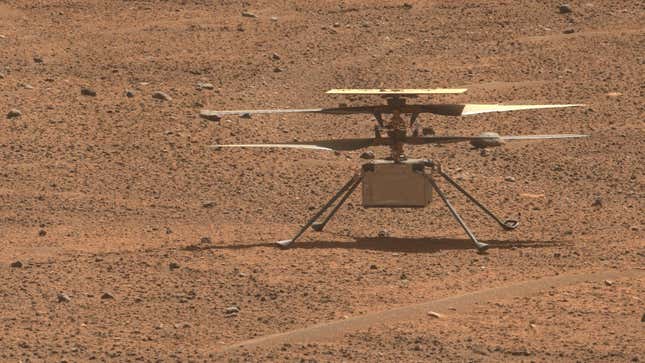
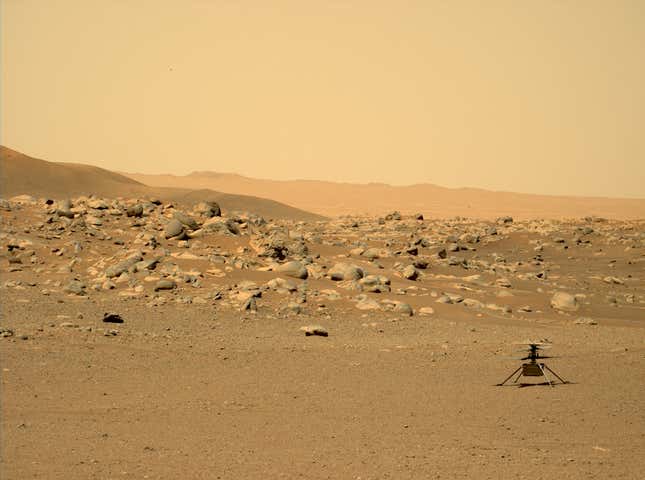
After nearly 3 years on the surface of Mars, NASA’s Ingenuity helicopter is dead. NASA is investigating the cause of the helicopter’s death, but the agency says that the Ingenuity clipped one of its wings, so to speak, having struck one of its rotor blades on the ground, which means the Mars helicopter can no longer fly.
Missing Sub_Vid
Off
English
The Ingenuity may now be operationally dead, but the helicopter shattered its initial expectations. It was originally meant to be a tech demonstration device, and was slated for five flight missions over a 30-day period on the Red Planet. But the Ingenuity far exceeded its planned lifespan, completing a whopping 72 flight missions in just under three years. I’ll let NASA Administrator Bill Nelson rightfully sing its praises:
Among Ingenuity’s achievements, some of the standouts include being the first helicopter on another planet, as well as flying in the Martian atmosphere, which has an atmospheric volume that is less than one percent of the Earth’s. Ingenuity logged nearly 129 flight minutes and covered 10.5 miles during those missions, according to NASA. It reached a max altitude of 78.7 feet.
That doesn’t sound like much but, then again, Ingenuity was only designed to fly missions at up to 15 feet. The helicopter is also small, having a height of 19 inches, blade span of four feet and weighing in at four pounds. It had to be tiny in order to be part of Perseverance’s payload, deploying from its belly when the rover landed on Mars. Ingenuity acted as an aerial scout, looking ahead for hazards in the rover’s path and beaming that information back to NASA.
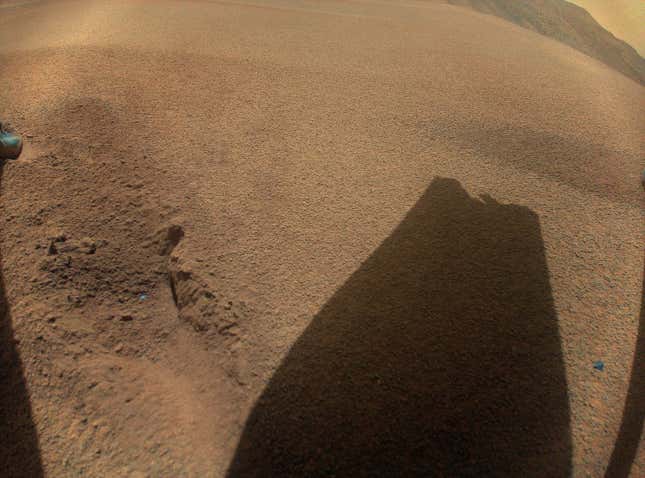
But one of the autonomous helicopter’s flights ended with the scene of a broken rotor blade. The broken tip of the carbon fiber blade is visible in the shadow, which didn’t bode well for the little helicopter. Indeed, RIP, Ingenuity.
As Bill Nelson said, it’s a bittersweet send off. On the one hand, the little ’copter is dead. A flightless bird on the barren surface of Mars. It’s a tragedy almost fit for one of Ray Bradbury’sMartian Chronicles. On the other hand, however, Ingenuity accomplished much more than NASA hoped to achieve. Nelson put it best as he concluded NASA’s announcement: “And, so, thank you, Ingenuity.”
Shortly after Japan’s space agency became the fifth country to land a spacecraft on the surface of the moon, its scientists discovered the Smart Lander for Investigating Moon (SLIM) unfortunately touched down upside down. The Japan Aerospace Exploration Agency (JAXA) said that the SLIM landed on the lunar surface on January 20 but it knew it might have bigger problems due to an issue with power generation. Just hours after making landfall, JAXA expected the power to run out, before it ultimately did.
SLIM met the moon’s surface about 55 meters east of the original target landing site, JAXA said. The agency did get all of the technical information related to its navigation prior to landing and ultimately becoming stationary on the lunar surface. JAXA captured photos of the SLIM from its The Lunar Excursion Vehicle 2, its fully autonomous robot currently exploring the moon.
The reason behind the main engine malfunctioning is under investigation by the space agency. There is a slim chance for regeneration because the solar cells that power the spacecraft are facing west, meaning there is a chance for SLIM recovery if enough light from the sun reaches the cells as more time passes. The SLIM JAXA team took to X earlier this week to write, “We are preparing for recovery.” The agency said it will “take the necessary preparations to gather more technical and scientific data from the spacecraft.