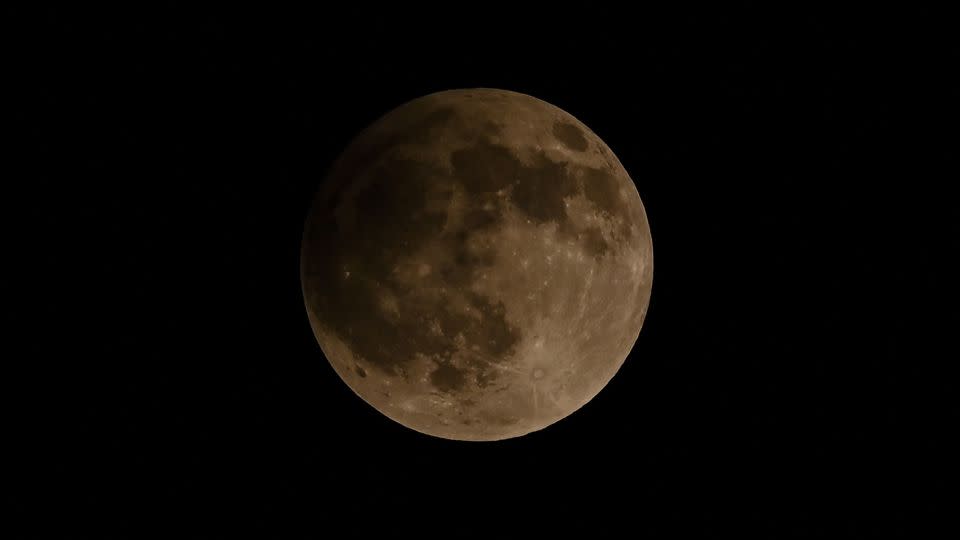
A glowing worm moon will light up the sky on Monday with a celestial performance in store for people venturing out in the early morning hours — a penumbral lunar eclipse.
March’s full moon, referred to as the worm moon by the Farmers’ Almanac due to its proximity to the spring equinox, will be at its fullest at 3 a.m. ET.
A few hours earlier, starting at 12:53 a.m. ET, according to EarthSky, the moon will be almost perfectly aligned with the sun and Earth, causing the outer edge of Earth’s shadow, known as the penumbra, to be cast onto the glowing orb.
The greatest eclipse will be at 3:12 a.m. ET, when the moon will appear to be slightly darker than usual, said Dr. Shannon Schmoll, director of the Abrams Planetarium at Michigan State University.
“It’ll be almost a gradient of darkening happening from one side of the moon to the other. It’s not going to be a super dramatic change in what we see in the moon,” Schmoll said. “But if you’re sitting there watching it, you might notice some slight variations in brightness.”
The worm moon — named by Native American tribes in reference to the beetle larvae and other creatures that emerge from hibernation in the spring — will be visible to everyone across the world, since the moon will appear to be full for a couple of days.
However, the penumbral eclipse will only be visible to those who are on the night side of Earth when the event occurs, including Europe, North and East Asia, Australia, Africa, North America and South America. The lunar eclipse will finish at 5:33 a.m. ET, according to EarthSky.
The penumbral eclipse comes about two weeks before a total solar eclipse that will cross Mexico, the United States and Canada on April 8. Lunar and solar eclipses always come in pairs due to the period when the sun, Earth and moon stay aligned, Schmoll said. While the full moon will be caught in Earth’s shadow during this penumbral eclipse, the moon’s next new moon phase will allow for the conditions needed for a solar eclipse, when the moon will be in between the sun and Earth and thus block the face of the sun from view.
Eclipse season
An “eclipse season” is the approximate 35-day period that occurs every six months, near the equinoxes,when the near-perfect alignment of the three celestial bodies needed for eclipses occurs, according to NASA.
A lunar eclipse does not happen monthly during each full moon because the moon’s orbital plane is tilted by about 5 degrees, so for most full moons, the shadow of the Earth will be just below or above the moon, Schmoll said.
While a penumbral eclipse is not as dramatic as a total lunar eclipse with the moon appearing an eerie red, there is no special equipment required to view a lunar eclipse such as the viewing glasses needed for a solar eclipse, Schmoll said, allowing for lunar eclipses to be viewed with the naked eye.
“You pretty much just need to be outside with a clear view of the moon when it’s happening,” Schmoll added. “(Eclipses are) always a good excuse to go outside and try to look at the sky and appreciate where we are in the universe, and what we are able to observe from our planet.”
Solar and lunar eclipses
While the most highly anticipated of the four eclipse events occurring in 2024 is the total solar eclipse on April 8, an annular solar eclipse will occur on October 2 over parts of South America. This type of eclipse is similar to a total solar eclipse, except the moon is at the farthest point in its orbit from Earth, so it can’t completely block the sun. Instead, annular solar eclipses create a “ring of fire” in the sky as the sun’s fiery light surrounds the moon’s shadow.
Meanwhile, a partial lunar eclipse, in which Earth moves between the sun and the full moon without being perfectly aligned, will appear over Europe and much of Asia, Africa, North America and South America between September 17 and 18.
Of the 12 full moons in 2024, the September and October lunar events will be considered supermoons, according to EarthSky.
Definitions of a supermoon can vary, but the term generally denotes a full moon that is closer to Earth than normal and thus appears larger and brighter in the night sky. Some astronomers say the phenomenon occurs when the moon is within 90% of perigee — its closest approach to Earth in orbit.
Here are the remaining full moons of 2024:
• April 23: Pink moon
• May 23: Flower moon
• June 21: Strawberry moon
• July 21: Buck moon
• August 19: Sturgeon moon
• September 17: Harvest moon
• October 17: Hunter’s moon
• November 15: Beaver moon
• December 15: Cold moon
Meteor showers of 2024
Skygazers can look forward to a multitude of meteor showers this year, according to the American Meteor Society. Here are the dates when meteor events are expected to peak this year.
A glowing worm moon will light up the sky on Monday with a celestial performance in store for people venturing out in the early morning hours — a penumbral lunar eclipse.
March’s full moon, referred to as the worm moon by the Farmers’ Almanac due to its proximity to the spring equinox, will be at its fullest at 3 a.m. ET.
A few hours earlier, starting at 12:53 a.m. ET, according to EarthSky, the moon will be almost perfectly aligned with the sun and Earth, causing the outer edge of Earth’s shadow, known as the penumbra, to be cast onto the glowing orb.
The moon looks slightly darker during a 2023 penumbral lunar eclipse in Banda Aceh, Indonesia. On Monday, the lunar event will begin at 12:53 a.m. ET. - Chaideer Mahyuddin/AFP/Getty Images
The greatest eclipse will be at 3:12 a.m. ET, when the moon will appear to be slightly darker than usual, said Dr. Shannon Schmoll, director of the Abrams Planetarium at Michigan State University.
“It’ll be almost a gradient of darkening happening from one side of the moon to the other. It’s not going to be a super dramatic change in what we see in the moon,” Schmoll said. “But if you’re sitting there watching it, you might notice some slight variations in brightness.”
The worm moon — named by Native American tribes in reference to the beetle larvae and other creatures that emerge from hibernation in the spring — will be visible to everyone across the world, since the moon will appear to be full for a couple of days.
However, the penumbral eclipse will only be visible to those who are on the night side of Earth when the event occurs, including Europe, North and East Asia, Australia, Africa, North America and South America. The lunar eclipse will finish at 5:33 a.m. ET, according to EarthSky.
The penumbral eclipse comes about two weeks before a total solar eclipse that will cross Mexico, the United States and Canada on April 8. Lunar and solar eclipses always come in pairs due to the period when the sun, Earth and moon stay aligned, Schmoll said. While the full moon will be caught in Earth’s shadow during this penumbral eclipse, the moon’s next new moon phase will allow for the conditions needed for a solar eclipse, when the moon will be in between the sun and Earth and thus block the face of the sun from view.
Eclipse season
An “eclipse season” is the approximate 35-day period that occurs every six months, near the equinoxes,when the near-perfect alignment of the three celestial bodies needed for eclipses occurs, according to NASA.
A lunar eclipse does not happen monthly during each full moon because the moon’s orbital plane is tilted by about 5 degrees, so for most full moons, the shadow of the Earth will be just below or above the moon, Schmoll said.
While a penumbral eclipse is not as dramatic as a total lunar eclipse with the moon appearing an eerie red, there is no special equipment required to view a lunar eclipse such as the viewing glasses needed for a solar eclipse, Schmoll said, allowing for lunar eclipses to be viewed with the naked eye.
“You pretty much just need to be outside with a clear view of the moon when it’s happening,” Schmoll added. “(Eclipses are) always a good excuse to go outside and try to look at the sky and appreciate where we are in the universe, and what we are able to observe from our planet.”
Solar and lunar eclipses
While the most highly anticipated of the four eclipse events occurring in 2024 is the total solar eclipse on April 8, an annular solar eclipse will occur on October 2 over parts of South America. This type of eclipse is similar to a total solar eclipse, except the moon is at the farthest point in its orbit from Earth, so it can’t completely block the sun. Instead, annular solar eclipses create a “ring of fire” in the sky as the sun’s fiery light surrounds the moon’s shadow.
Meanwhile, a partial lunar eclipse, in which Earth moves between the sun and the full moon without being perfectly aligned, will appear over Europe and much of Asia, Africa, North America and South America between September 17 and 18.
Of the 12 full moons in 2024, the September and October lunar events will be considered supermoons, according to EarthSky.
Definitions of a supermoon can vary, but the term generally denotes a full moon that is closer to Earth than normal and thus appears larger and brighter in the night sky. Some astronomers say the phenomenon occurs when the moon is within 90% of perigee — its closest approach to Earth in orbit.
Here are the remaining full moons of 2024:
• April 23: Pink moon
• May 23: Flower moon
• June 21: Strawberry moon
• July 21: Buck moon
• August 19: Sturgeon moon
• September 17: Harvest moon
• October 17: Hunter’s moon
• November 15: Beaver moon
• December 15: Cold moon
Meteor showers of 2024
Skygazers can look forward to a multitude of meteor showers this year, according to the American Meteor Society. Here are the dates when meteor events are expected to peak this year.
• Lyrids: April 21-22
• Eta Aquariids: May 4-5
• Southern delta Aquariids: July 29-30
• Alpha Capricornids: July 30-31
• Perseids: August 11-12
• Draconids: October 7-8
• Orionids: October 20-21
• Southern Taurids: November 4-5
• Northern Taurids: November 11-12
• Leonids: November 17-18
• Geminids: December 13-14
• Ursids: December 21-22
For more CNN news and newsletters create an account at CNN.com
A severe geomagnetic storm is underway after eruptions from the Sun sent plasma blasting toward Earth, with the potential to produce northern lights as far south as Alabama and Northern California heading into Monday.
Auroras occur when charged particles from the Sun interact with the Earth’s atmosphere, creating what are known as the Northern and Southern Lights.
On its five-point scale of geomagnetic storms, space experts believed the first wave of energy could rank as either a G1 or G2 but increase on Monday to a G3. However, within the past 24 hours, severe G4 space weather conditions were observed and are predicted to continue, according to the SWPC dashboard.
A geomagnetic storm of a G1 rating is the weakest and commonly leads to displays of Northern Lights over Alaska and Canada.
A G3 rating would possibly allow an aurora to be seen as far south as Washington, Wisconsin and New York if skies are clear.
With G4 (level 4 out of 5) conditions observed and predicted through Monday, displays of Northern Lights could be visible as far south as Alabama and northern California.
The amount of geomagnetic activity is also monitored by ground-based magnetometers, and the event is measured on the Kp index scale, which ranges from 0 to 9.
A full halo CME was detected in NASA/SOHO coronagraph imagery as seen in this https://t.co/aKDvZ0ApRZ video showing the massive CME departing the Sun. The CME was associated with the X1 (R3) flare and SWPC forecasters are now analyzing for Earth-directed potential. Stay tuned! pic.twitter.com/gs9n8VZt8S
A G3 event with a high Kp-index value caused the northern lights to be spotted as far south as Las Vegas in December.
Space experts believe the upcoming event could reach a Kp-index value of at least 6, which would put cities such as Seattle, Minneapolis, Green Bay, and Syracuse, New York, in the visibility zone.
The University of Alaska Fairbanks Geophysical Institute is forecasting high aurora activity with Kp-6 levels through Monday night.
“The public should not anticipate adverse impacts, and no action is necessary, but they should stay properly informed of storm progression by visiting our webpage,” the SWPC said on Sunday.
The FOX Forecast Center expects there to be plenty of hindrances in the sky on Sunday and Monday nights that could complicate viewing.
What Kp index value is needed to see the Northern Lights in the US. NOAA
A large storm system will be moving through the country’s heartland, producing plenty of showers and thunderstorms.
In addition to the increased cloud cover, March’s full Worm Moon will illuminate the sky, impeding visibilities of other celestial objects.
A faint lunar eclipse will start shortly before 1 a.m. EDT on Monday and last until about 5:30 a.m. as the Moon passes through Earth’s shadow.
Space experts admit determining the exact strength of the geomagnetic activity is challenging, even with more frequent occurrences.
The center said satellites detected at least one flare and coronal mass ejection that was emitted from the Sun on Friday. NASA via Getty Images
Geomagnetic storms have become more numerous over the last year as the Sun begins to reach its maximum phase of its solar cycle.
A solar cycle is a sequence the Sun’s magnetic field goes through every 11 years, where the field flips. Solar Cycle 25 began in 2019 and could last until 2030.
Article From & Read More ( Severe geomagnetic storm could create northern lights displays throughout US - New York Post )
https://ift.tt/W7i81Vk
Science
The successful take off to the International Space Station follows an aborted launch on Thursday after a voltage drop in a power source.
A Russian Soyuz rocket carrying three astronauts to the International Space Station (ISS) blasted off on Saturday, two days after its launch was aborted at the last minute.
The spacecraft carrying NASA astronaut Tracy Dyson, Russian Oleg Novitsky and Marina Vasilevskaya of Belarus launched smoothly from the Russian-leased Baikonur launch facility in Kazakhstan.
The space capsule atop the rocket separated and went into orbit eight minutes after the launch. It then began a two-day, 34-orbit trip to the space station.
The three astronauts are to join the station’s crew, NASA astronauts Loral O’Hara, Matthew Dominick, Mike Barratt, and Jeanette Epps and Russians Oleg Kononenko, Nikolai Chub, and Alexander Grebenkin.
Novitsky, Vasilevskaya and O’Hara are to return to Earth on April 6.
The space station, which has served as a symbol of post-Cold War international cooperation, is now one of the last remaining areas of collaboration between Russia and the West amid tensions following Russia’s full-scale invasion of Ukraine.
NASA and its partners hope to continue operating the orbiting outpost until 2030.
Russia has continued to rely on modified versions of Soviet-designed rockets for commercial satellites, as well as crews and cargo to the space station.
Crew members of the expedition Oleg Novitsky, bottom, Marina Vasilevskaya of Belarus, top, and Tracy Dyson, centre, board the Soyuz MS-25 spacecraft at the Baikonur Cosmodrome, Kazakhstan, on March 23, 2024 [Yuri Kochetkov/Pool via Reuters]
Aborted launch
The launch had been planned for Thursday, but was halted by an automatic safety system about 20 seconds before the scheduled liftoff.
The head of the Russian space agency, Yuri Borisov, said a voltage drop in a power source triggered the launch to be aborted.
The aborted launch was a significant mishap for the Russian space programme.
It followed an October 2018 launch failure when a Soyuz rocket carrying NASA astronaut Nick Hague and Roscosmos’s Alexei Ovchinin to the ISS failed less than two minutes after the blastoff, sending their rescue capsule into a steep ride back to a safe landing.
Hague and Ovchinin had a brief period of weightlessness when the capsule separated from the malfunctioning Soyuz rocket at an altitude of about 50km (31 miles), then endured gravitational forces of six to seven times more than is felt on Earth as they came down at a sharper-than-normal angle.
The 2018 launch failure was the first such accident for Russia’s manned programme in more than three decades.
If the launch had gone as scheduled on Thursday, the journey would have been much shorter, requiring only two orbits. Docking is now expected at 15:10 GMT on Monday.
Article From & Read More ( Russian Soyuz rocket with 3 astronauts blasts off to ISS, days after glitch - Al Jazeera English )
https://ift.tt/xCG2AYN
Science
We're almost two weeks away from Michigan residents having a once-in-a-lifetime opportunity. A solar eclipse will take place April 8, 2024, and it's expected to cast a sizeable chunk of North America in darkness.
There's one small sliver of Monroe County, near Toledo, that's expected to be in the path of totality. Residents of Luna Pier, right on Lake Erie, are excited. The head of astronomy at the Cranbrook Institute of Science, Michael Narlock, said the rest of the state will get about 98% sun coverage. Detroit will get about 99% coverage.
You've probably seen some of the huge buildup to the total solar eclipse, but maybe you missed what day it is or when it starts in your city. Here's when the solar eclipse will happen in Detroit and other Michigan cities, such as Grand Rapids, Lansing, Flint, Midland, Traverse City and Marquette.
What time is the solar eclipse in Detroit?
Here's the 2024 solar eclipse schedule for Detroit on April 8, 2024:
The very southeast corner of the state, in Monroe County, is along the edge of the path of totality. This means the area will likely dim and temperatures drop a few degrees as the moon's shadow covers the sun.
Here's when you can expect to view the eclipse from your city or area. (Can't see the chart below? Tap here.)
Click the cities on the map to see the percentage of totality and the start time in each community.